
Understanding the "Fungal Acne" Puzzle
Is Your Routine Acne-Safe?
Do not guess. Instantly check your products for pore-clogging ingredients with our AI-powered tool.
Check Ingredients NowIf you have been struggling with persistent, itchy, uniform bumps that refuse to respond to traditional benzoyl peroxide or salicylic acid treatments, you may not be dealing with acne at all. What is commonly referred to as "fungal acne" is actually a condition known as Malassezia folliculitis.
As a dermatologist, I see patients daily who are frustrated because their skincare routine—designed to fight bacteria—is actually "feeding" the yeast causing their breakouts. Choosing the right moisturizer is the most critical step in managing this condition. In this guide, we will dive into the science of Malassezia-safe hydration and how to identify the best moisturizer for fungal acne.
What Exactly is Fungal Acne?
Unlike traditional acne (acne vulgaris), which is caused by oil production and P. acnes bacteria, fungal acne is an infection of the hair follicles caused by an overgrowth of Malassezia yeast. This yeast is a normal part of the skin's microbiome, but under certain conditions—heat, humidity, or the use of occlusive products—it multiplies rapidly.
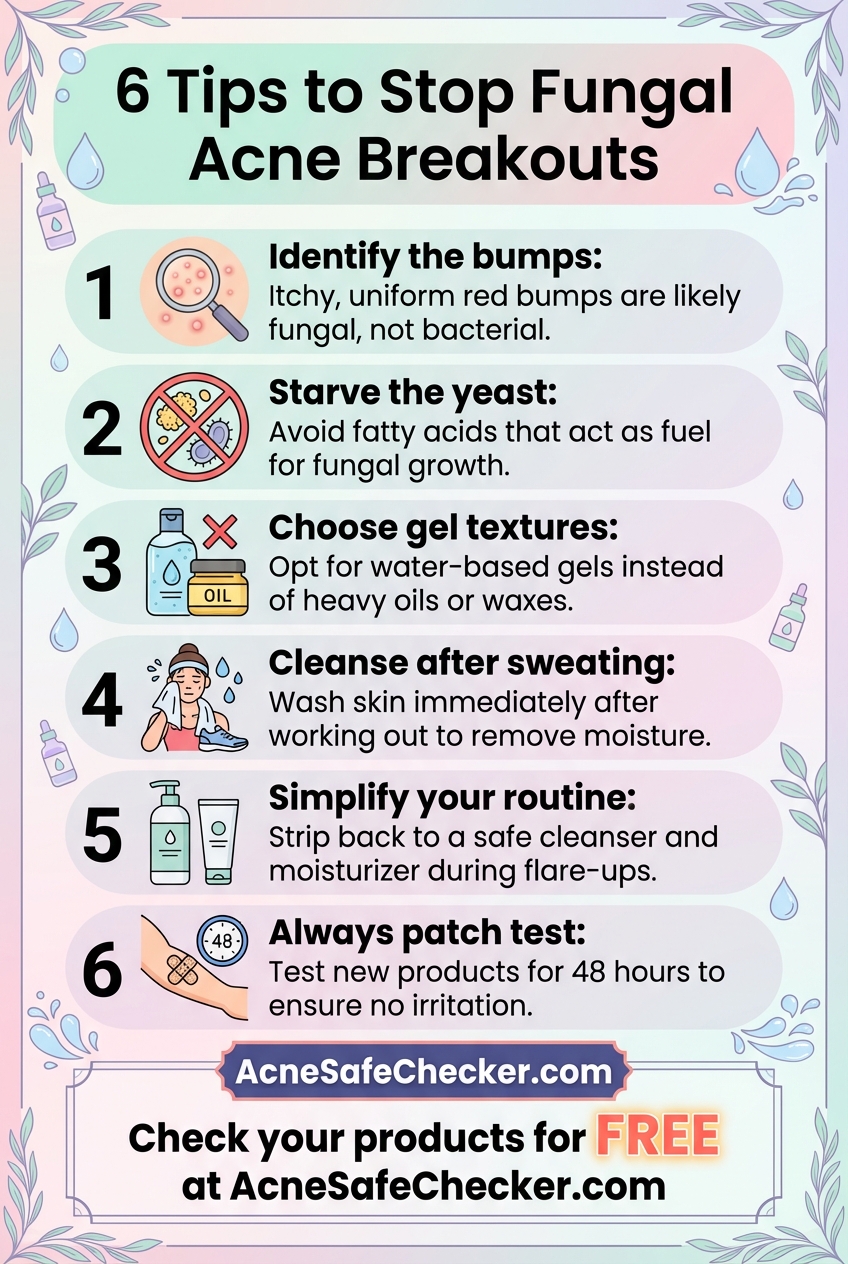
Because this yeast feeds on specific fatty acids found in many skincare products, using the wrong moisturizer can act like fuel for the fire. The result is small, itchy, red bumps usually located on the forehead, chest, back, and shoulders.
The Science: Why Most Moisturizers Fail
The Malassezia species are lipid-dependent, meaning they require fatty acids to grow. Specifically, research shows that these yeasts thrive on fatty acids with carbon chain lengths ranging from C11 to C24.
Unfortunately, the vast majority of skincare oils and fatty acids fall right into this range. When you apply a standard moisturizer containing oils like coconut oil, almond oil, or polysorbates, you are essentially providing a buffet for the yeast. To clear the skin, we must starve the yeast by using "fungal acne-safe" ingredients.
Ingredients to Avoid at All Costs
When scanning a label, look out for these common offenders that can trigger a flare-up:
- Oils and Butters: Most vegetable oils (Cocoa butter, Shea butter, Coconut oil) are high in carbon chains that feed the yeast.
- Fatty Acids: Lauric, Myristic, Palmitic, Stearic, Oleic, and Linoleic acids.
- Esters: Usually ending in "-ate" (e.g., Isopropyl Palmitate, Glyceryl Stearate).
- Polysorbates: Such as Polysorbate 20, 40, 60, or 80.
- Fermented Ingredients: Galactomyces or other fermented extracts can sometimes exacerbate the condition in certain individuals.
Key Ingredients to Look For
Safe moisturizing requires a focus on humectants and specific lipids that the yeast cannot metabolize. Look for these "green light" ingredients:
1. Squalane Oil (Pure)
While most oils are off-limits, pure Squalane (derived from olives or sugarcane) is a notable exception. It is a saturated oil with a carbon chain length of C30, which is too long for the Malassezia yeast to digest. It provides the emolliency of an oil without the risk of a breakout.
2. Caprylic/Capric Triglycerides (MCT Oil)
Derived from coconut oil but processed to remove the problematic long-chain fatty acids, MCT oil consists only of C8 and C10 chains. These are safe for fungal acne and provide excellent skin-softening benefits.
3. Hyaluronic Acid and Glycerin
These are humectants that draw water into the skin. Since they are not lipids, they cannot feed the yeast. They are essential for maintaining the skin barrier without adding "food" for the fungus.
4. Urea
Urea is a keratolytic agent and a natural moisturizing factor (NMF). It helps gently exfoliate dead skin cells that can clog follicles while providing deep hydration. It also has mild anti-fungal properties, making it a gold-standard ingredient for this condition.
How to Choose the Best Moisturizer Format
Texture matters. For those with fungal acne, gel-based moisturizers or water-creams are generally the safest bet. They tend to rely on water, humectants, and silicone-based occlusives (like dimethicone), which are safe for fungal acne, rather than heavy oils or waxes.
If you have dry skin, look for a thicker cream that utilizes high concentrations of Petrolatum or Squalane, as these will provide the necessary occlusion to prevent transepidermal water loss (TEWL) without triggering the yeast.
Practical Steps for Your Skincare Routine
- Double Check Your Products: Use an online ingredient analyzer specifically designed for fungal acne to check every product in your current routine.
- Simplify: When dealing with a flare-up, strip your routine back to a safe cleanser and a safe moisturizer. Introduce active treatments like ketoconazole (anti-fungal) slowly.
- Patch Test: Even if a moisturizer is "safe" on paper, everyone's skin chemistry is different. Always patch test a new product for 48 hours.
- Manage Humidity: Since yeast loves sweat, try to cleanse your skin immediately after working out or spending time in humid environments.
Conclusion
Managing fungal acne requires a different mindset than treating traditional breakouts. It isn't about scrubbing the skin clean; it's about creating an environment where the yeast cannot survive. By switching to a moisturizer that is free from problematic fatty acids and esters, you provide your skin with the hydration it needs to heal the barrier while effectively starving the underlying cause of the bumps.
Remember, consistency is key. Once you find a fungal acne-safe moisturizer that works for you, stick with it. Your skin's microbiome will thank you for the relief.