
For years, the gold standard for acne management was "oil-free" everything. We were taught that oil was the enemy and that any lipid added to the skin would inevitably lead to a flare-up of congestion and inflammation. However, the skincare world has undergone a paradigm shift. With the rise of the oil-cleansing method and facial oils, many are turning to natural solutions like sweet almond oil for its moisturizing and healing properties.
Is Your Routine Acne-Safe?
Do not guess. Instantly check your products for pore-clogging ingredients with our AI-powered tool.
Check Ingredients NowBut the nagging question remains: Does sweet almond oil cause breakouts?
As a dermatologist, I see patients daily who are caught between wanting the glowing benefits of natural oils and the fear of waking up with a fresh crop of comedones (clogged pores). In this guide, we will break down the science behind sweet almond oil, its comedogenic potential, and how to determine if it belongs in your skincare routine.
Understanding the Comedogenic Scale
To understand if an ingredient will cause breakouts, we first look at the Comedogenic Scale. This scale ranks ingredients from 0 to 5 based on their likelihood of clogging pores:
- 0: Will not clog pores
- 1: Very low chance of clogging pores
- 2: Low chance (safe for most, but may affect those with very oily skin)
- 3: Moderate chance
- 4: Fairly high chance
- 5: High chance
Where Does Sweet Almond Oil Rank?
Sweet almond oil typically carries a comedogenic rating of 2.
This means that for the vast majority of people, sweet almond oil is considered "non-comedogenic" in practical application. It is generally safe for sensitive, dry, and normal skin types. However, for individuals with extremely oily skin or those who are highly prone to cystic acne, a rating of 2 is not a complete guarantee of safety. It occupies a "yellow light" territory: proceed with caution.
The Science: Oleic vs. Linoleic Acid
Not all oils are created equal. Their effect on your skin is largely determined by their fatty acid profile—specifically the ratio of Oleic Acid to Linoleic Acid.
Acne-prone individuals often have a deficiency of linoleic acid in their skin's natural sebum. When sebum is low in linoleic acid, it becomes thick, sticky, and more likely to plug pores. To counter this, acne-prone skin usually responds best to oils high in linoleic acid (like safflower or rosehip oil).
Sweet almond oil, conversely, is higher in Oleic Acid (roughly 62-86%). Oleic acid makes the oil rich, deeply moisturizing, and excellent at penetrating the skin barrier. While this is a miracle for someone with dry or dehydrated skin, the heaviness of oleic acid can sometimes sit too heavily on skin that is already over-producing sebum, potentially leading to surface-level congestion.
Benefits of Sweet Almond Oil for the Skin
Despite the potential for breakouts in specific skin types, sweet almond oil offers significant dermatological benefits:
- Anti-Inflammatory Properties: It contains Vitamin E and zinc, which can help soothe irritated skin and reduce the redness associated with existing acne.
- Barrier Repair: Its emollient properties fill the gaps between skin cells, preventing Transepidermal Water Loss (TEWL).
- UV Protection Support: While not a replacement for SPF, the Vitamin E content helps neutralize free radicals generated by UV exposure.
- Gentle Cleansing: It is an excellent solvent for breaking down waterproof makeup and sunscreen without stripping the skin’s natural acid mantle.
Who Should Avoid It?
While sweet almond oil is a versatile ingredient, it isn't for everyone. You should exercise caution or avoid it if:
- You have a Nut Allergy: This is a crucial safety point. Even topical application can trigger a reaction in those with severe tree nut allergies.
- You have Grade 3 or 4 Acne: If you are currently dealing with widespread inflammatory or cystic acne, introducing a high-oleic oil may exacerbate the condition.
- You have Very Oily Skin: If your skin feels greasy within an hour of washing, a lighter, high-linoleic oil is a better match for your physiology.
How to Use Sweet Almond Oil Without Breaking Out
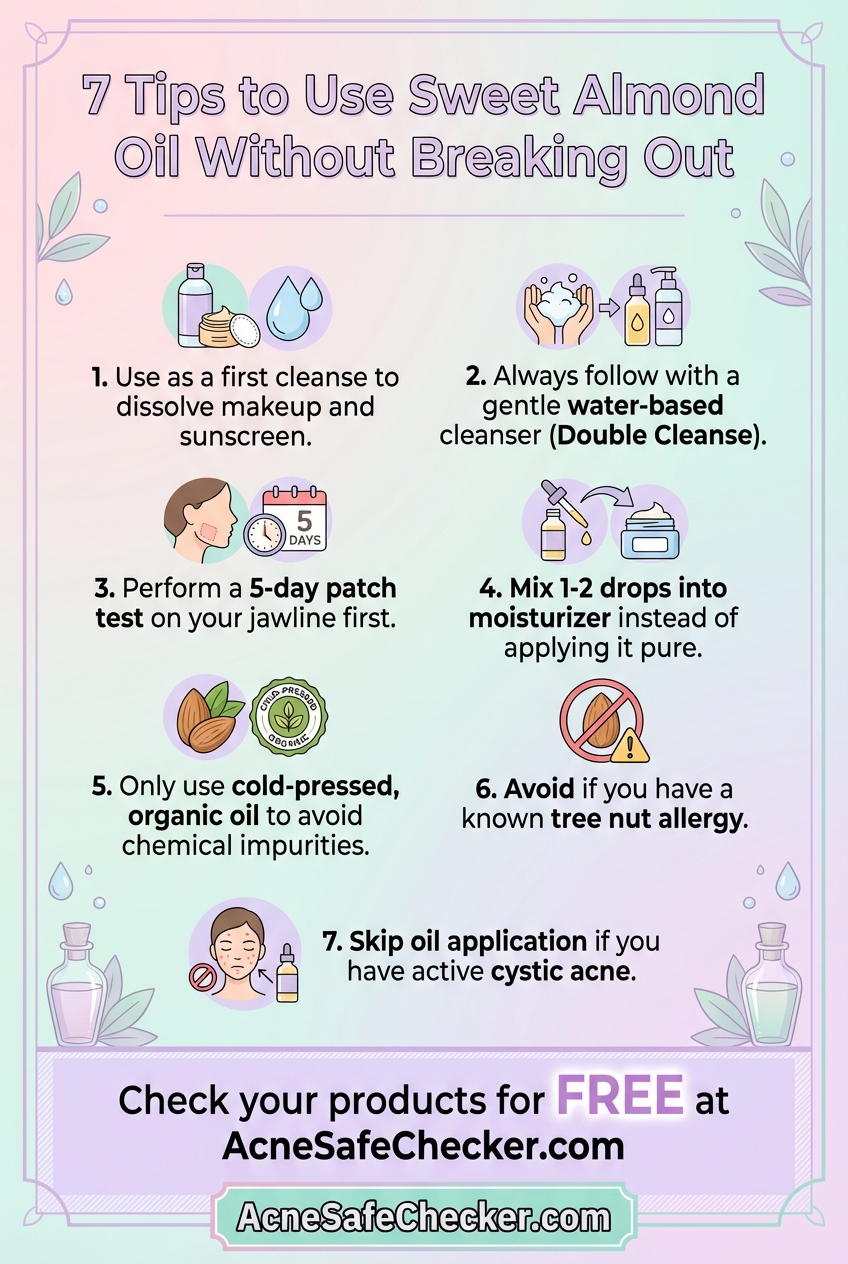
If you want to reap the benefits of sweet almond oil but are nervous about breakouts, follow these professional steps:
1. Use it as a First Cleanse
The safest way to use sweet almond oil for acne-prone skin is the Double Cleanse method. Massage the oil onto dry skin to dissolve makeup and sebum, then follow up with a gentle, water-based foaming cleanser. This ensures the oil does its job without leaving a film that could clog pores overnight.
2. The Patch Test
Never apply a new oil to your entire face at once. Apply a small amount to a localized area—like the side of your jawline—for three to five nights. If no small bumps or whiteheads appear, you are likely safe to use it more broadly.
3. Mix, Don’t Layer
Instead of applying pure sweet almond oil directly to your face, try adding one or two drops to your non-comedogenic moisturizer. This dilutes the oil and makes it more breathable while still providing an antioxidant boost.
4. Choose Cold-Pressed, Refined Oil
Look for "Cold-Pressed" and "Organic" on the label. High-heat processing can degrade the beneficial fatty acids and introduce impurities that are more likely to irritate the skin or cause breakouts.
Alternatives for Acne-Prone Skin
If you find that sweet almond oil is indeed too heavy for your skin, consider these lighter alternatives with lower comedogenic ratings:
- Hemp Seed Oil (Rating: 0): High in linoleic acid and will not clog pores.
- Argan Oil (Rating: 0): Highly moisturizing but structurally unlikely to cause congestion.
- Squalan (Rating: 0-1): A biomimetic oil that mimics the skin's natural lipids perfectly.
Conclusion
So, does sweet almond oil cause breakouts? The answer is: It depends on your unique skin chemistry. For the majority of users, it is a safe, nourishing, and affordable skincare staple. However, because of its oleic acid content and a comedogenic rating of 2, it can be problematic for those with naturally high sebum production or existing acne concerns.
Skincare is personal. By understanding the science of your skin and the profile of the ingredients you use, you can build a routine that glows without the fear of a breakout. If you’re unsure, start with a patch test or limit its use to a rinse-off cleanser.