
If you have ever spent twenty minutes in the skincare aisle staring at a long list of chemical names, you are not alone. For those struggling with acne, every new product feels like a gamble. One ingredient that frequently appears in both high-end and drugstore moisturizers is cetearyl alcohol.
Is Your Routine Acne-Safe?
Do not guess. Instantly check your products for pore-clogging ingredients with our AI-powered tool.
Check Ingredients NowBecause the word "alcohol" often triggers alarms for those with sensitive or oily skin, many wonder: Is cetearyl alcohol bad for acne? As a dermatologist, I see this question daily. The answer isn't a simple yes or no, but rather an understanding of how ingredients behave on your unique skin.
Understanding Cetearyl Alcohol: It’s Not the Alcohol You Think
When most people hear the word "alcohol" in skincare, they think of drying, stinging liquids like isopropyl (rubbing) alcohol or ethanol. These are "simple alcohols" used to make products dry quickly or feel weightless, but they can strip the skin of its natural oils, leading to irritation and a compromised skin barrier.
Fatty Alcohols vs. Simple Alcohols
Cetearyl alcohol belongs to a completely different family called fatty alcohols. Derived from natural fats (like coconut or palm oil) or produced synthetically, cetearyl alcohol is actually a mixture of cetyl and stearyl alcohols.
Unlike drying alcohols, fatty alcohols are:
- Emollients: They soften the skin and help maintain moisture.
- Emulsifiers: They keep the oil and water in a cream from separating.
- Thickeners: They give lotions that luxurious, creamy texture.
Scientifically speaking, cetearyl alcohol is a solid, waxy substance. Instead of drying your skin out, it helps to soothe and hydrate it.
Is Cetearyl Alcohol Comedogenic?
The term "comedogenic" refers to the likelihood of an ingredient to clog pores and cause "comedones" (blackheads and whiteheads). In the dermatological world, ingredients are often rated on a scale from 0 to 5, where 0 is non-pore-clogging and 5 is highly likely to cause breakouts.
Cetearyl alcohol typically carries a comedogenicity rating of 2.
A rating of 2 is considered "low-to-moderate." This means that for the vast majority of people, cetearyl alcohol will not cause acne. However, for individuals with extremely reactive skin or those prone to cystic acne, a level 2 ingredient can occasionally be a trigger if used in high concentrations.
The "Formulation" Rule: Why Labels Can Be Deceiving
As an SEO specialist and dermatologist, I must emphasize one crucial point: The ingredient list doesn't tell the whole story.
A product is more than the sum of its parts. Even if an ingredient has a comedogenic rating of 2, the final product's concentration, the other ingredients it is paired with, and how it is processed all matter.
For example, if cetearyl alcohol is the 15th ingredient on a list, its concentration is likely so low that it poses zero risk to your pores. However, if it is one of the first three ingredients in a heavy, thick night cream, someone with very oily skin might find it too occlusive.
The Rabbit Ear Test Limitation
It is also worth noting that comedogenicity ratings were historically developed using tests on rabbit ears, which are far more sensitive and reactive than human skin. Therefore, a "2" on the scale doesn't automatically mean you will break out; it is simply a guideline.
Who Should Avoid It?
While cetearyl alcohol is generally safe, there are two groups who should proceed with caution:
- Those with Fungal Acne: If you suffer from Malassezia folliculitis (often called fungal acne), fatty alcohols can sometimes "feed" the yeast that causes the condition, potentially worsening the bumps.
- The "Uber-Sensitive": A very small percentage of the population has a true contact allergy to fatty alcohols. If you find that almost every cream makes your skin red or itchy, you may be sensitive to this specific ingredient.
Practical Steps for Acne-Prone Skin
If you are worried about cetearyl alcohol but want the hydrating benefits it provides, follow these steps:
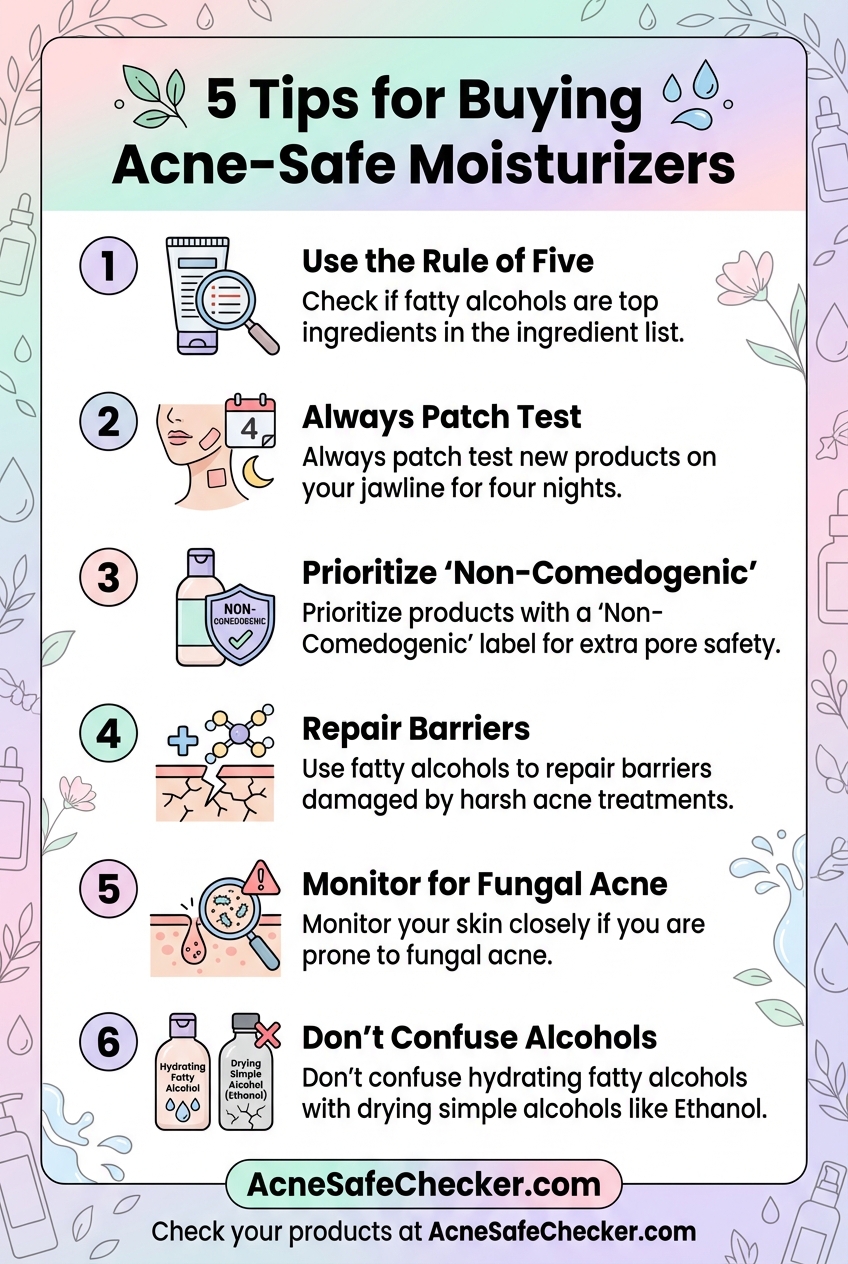
1. The "Rule of Five"
Look at where the ingredient falls on the label. If it is within the first five ingredients, the concentration is high. If you have active breakouts, look for products where cetearyl alcohol is lower down the list.
2. Patch Test Every Time
Before applying a new moisturizer to your entire face, apply a small amount to your jawline for three to four nights. If no new clogs appear in that specific area, the product is likely safe for you.
3. Look for "Non-Comedogenic" Labels
While not a legal guarantee, products labeled "non-comedogenic" have generally been formulated and tested to ensure they don't block pores, even if they contain fatty alcohols like cetearyl alcohol.
Conclusion: The Final Verdict
Is cetearyl alcohol bad for acne? For 90% of people, the answer is no. In fact, for many with acne-prone skin, it is a beneficial ingredient that helps repair the skin barrier, which is often damaged by harsh acne treatments like benzoyl peroxide or retinoids.
However, skincare is deeply personal. If you have been using a product containing cetearyl alcohol and notice a consistent pattern of