
If you have ever dealt with persistent, itchy, uniform bumps on your forehead, chest, or back that refuse to respond to traditional acne treatments, you might be dealing with Malassezia Folliculitis—commonly known as "fungal acne."
Is Your Routine Acne-Safe?
Do not guess. Instantly check your products for pore-clogging ingredients with our AI-powered tool.
Check Ingredients NowIn the world of skincare, hemp seed oil has gained a reputation as a "holy grail" for acne-prone skin due to its non-comedogenic properties and anti-inflammatory benefits. But when it comes to fungal acne, the rules of the game change entirely. As a dermatologist, I often see patients who unknowingly feed their fungal breakouts by using oils they believe are safe. Today, we will dive deep into the science of hemp seed oil to determine if it belongs in your fungal-acne-safe routine.
Understanding the Enemy: What is Fungal Acne?
To understand if hemp seed oil is safe, we first must understand what fungal acne is. Unlike "acne vulgaris," which is caused by the P. acnes bacteria and trapped sebum, fungal acne is caused by an overgrowth of Malassezia yeast.
This yeast is a normal part of the skin’s microbiome, but under certain conditions—like heat, humidity, or a compromised skin barrier—it can multiply uncontrollably within the hair follicle. The critical factor for skincare users is that Malassezia is "lipophilic," meaning it loves fat. Specifically, this yeast feeds on certain fatty acids to survive and reproduce.
The Chemistry of Hemp Seed Oil
Hemp seed oil is derived from the seeds of the Cannabis sativa plant. It is widely praised because it has a comedogenic rating of 0, meaning it is highly unlikely to clog pores. It is also rich in antioxidants and contains a high concentration of polyunsaturated fatty acids (PUFAs).
However, for fungal acne sufferers, the "food source" of the yeast is the most important metric. Malassezia typically thrives on fatty acids with carbon chain lengths ranging from C11 to C24.
Let’s look at the fatty acid profile of Hemp Seed Oil:
- Linoleic Acid (C18:2): Approx. 50–70%
- Alpha-Linolenic Acid (C18:3): Approx. 15–25%
- Oleic Acid (C18:1): Approx. 10–15%
- Palmitic Acid (C16:0): Approx. 5%
- Stearic Acid (C18:0): Approx. 2%
The Verdict: Is Hemp Seed Oil Safe for Fungal Acne?
Technically speaking, Hemp seed oil is NOT 100% fungal acne safe.
Because the vast majority of its composition consists of carbon chains in the C16 and C18 range (Linoleic, Linolenic, and Oleic acids), it provides a potential buffet for the Malassezia yeast. If you are in the middle of an active fungal acne flare-up, applying hemp seed oil may inadvertently provide the fuel the yeast needs to continue proliferating.
The "Linoleic" Nuance
There is a slight caveat that often confuses consumers. Some research suggests that while Malassezia can consume many fatty acids, it has a preference for saturated fats (like Palmitic and Stearic acid) and some monounsaturated fats (like Oleic acid). Linoleic acid is often considered less "tasty" for the yeast than others, but it still falls within the C11–C24 range that can stimulate growth.
Why Your Skin Might Still Like Hemp Seed Oil
If hemp seed oil isn't strictly "safe," why do some people with fungal acne claim it works for them? There are two main reasons:
- Anti-Inflammatory Properties: Hemp seed oil is incredibly soothing. It contains cannabinoids (in trace amounts) and vitamin E, which can reduce the redness and irritation associated with folliculitis.
- Barrier Repair: Sometimes, "fungal acne" is actually just a severely damaged skin barrier mimicking the appearance of yeast overgrowth. In these cases, the linoleic acid in hemp oil repairs the barrier, making the skin look better regardless of the yeast.
Practical Advice: How to Manage Your Skincare Routine
If you suspect you have fungal acne, follow these steps to ensure your products aren't making the problem worse:
1. The "Oil-Free" Rule
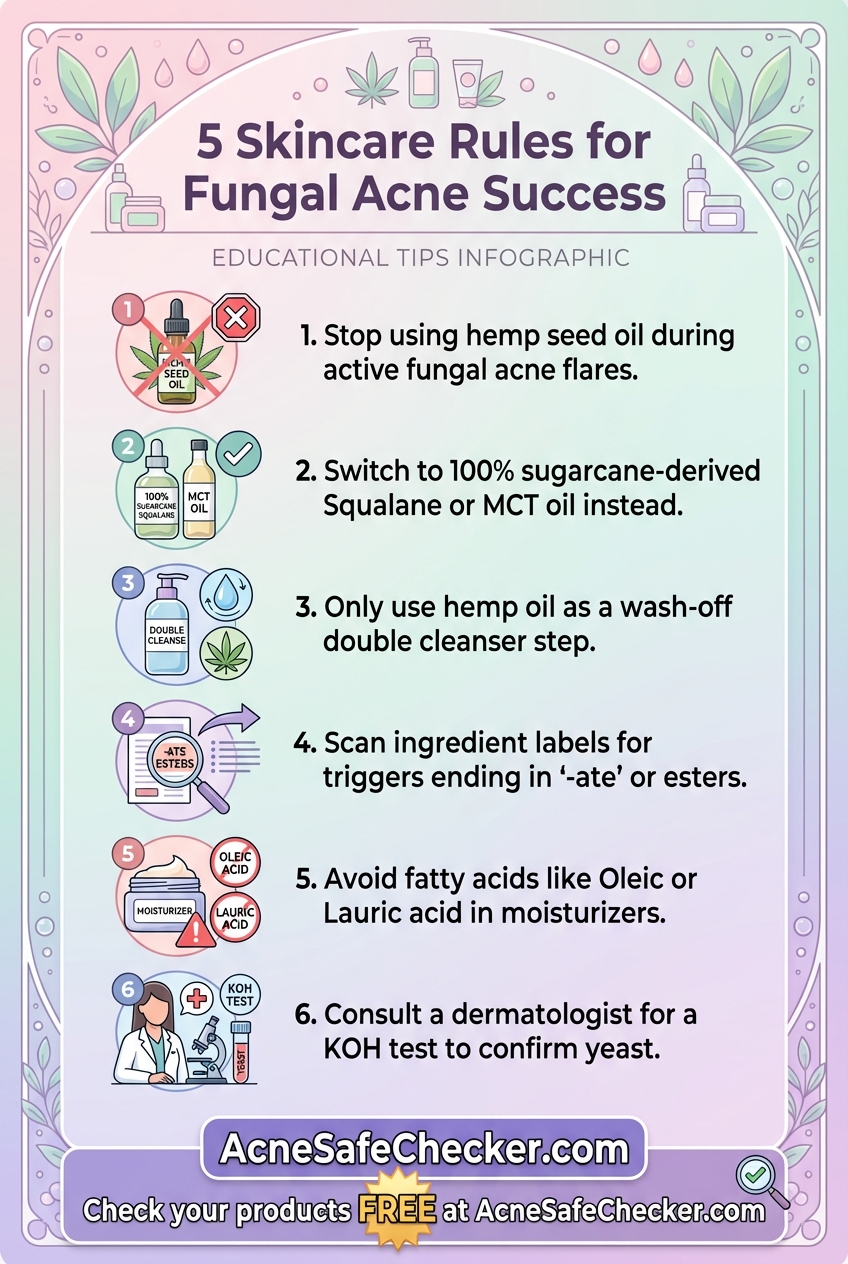
During an active flare, it is best to avoid all oils except for two notable exceptions: Squalane oil (derived from sugarcane, not olive) and MCT oil (caprylic/capric triglycerides, specifically those without Lauric acid/C12). These are the only oils that do not feed Malassezia.
2. Verify Your Ingredients
Check your moisturizers and cleansers for ingredients ending in "-ate" (like Isopropyl Palmitate) or oils like polysorbates and esters, as these are common fungal acne triggers.
3. How to Use Hemp Seed Oil Safely
If you are determined to use hemp seed oil, do not use it as a leave-on moisturizer. Instead, try it as the first step in a double-cleanse routine. Massaging the oil onto dry skin to break down sunscreen and makeup, then immediately following with a fungal-acne-safe foaming cleanser, minimizes the amount of fatty acid residue left for the yeast to consume.
4. Consult a Professional
Because fungal acne looks strikingly similar to bacterial acne and rosacea, it is essential to get a professional diagnosis. A dermatologist can perform a simple skin scraping (KOH test) to confirm the presence of yeast.
Conclusion
While hemp seed oil is a phenomenal ingredient for many skin types—especially those with traditional acne or dry skin—it is a risky choice for those specifically battling fungal acne. Its fatty acid profile falls directly into the category of nutrients that Malassezia yeast can utilize.
If your skin is currently clear and you want to use it for its anti-aging and anti-inflammatory benefits, proceed with caution and a patch test. However, if you are struggling with a persistent fungal flare, it is best to set the hemp oil aside and stick to truly "safe" alternatives like Squalane until your skin microbiome is back in balance.