
For those of us navigating the complexities of adult acne or sensitive, breakout-prone skin, reading a skincare label can feel like deciphering a secret code. You see a long list of chemical names, and your first thought is usually: "Will this cause a flare-up?"
Is Your Routine Acne-Safe?
Do not guess. Instantly check your products for pore-clogging ingredients with our AI-powered tool.
Check Ingredients NowOne ingredient that frequently appears in everything from micellar waters to high-end foundations is hexylene glycol. If you have been scanning your products for potential pore-cloggers, you might have seen conflicting information about this specific compound. In this guide, we will dive deep into the science of hexylene glycol, its comedogenic rating, and whether it deserves a place in your skincare routine.
What Exactly is Hexylene Glycol?
Hexylene glycol is a clear, colorless liquid that belongs to the glycol family. In the world of cosmetic chemistry, it wears many hats. It primarily functions as a solvent, helping to dissolve other ingredients to ensure a product has a smooth, consistent texture. It also acts as a surfactant (a cleansing agent) and a viscosity-decreasing agent, meaning it makes thick formulas easier to spread across your skin.
You will most commonly find it in:
- Makeup removers and cleansers
- Liquid foundations and concealers
- Moisturizers and serums
- Haircare products
Is Hexylene Glycol Comedogenic? The Short Answer
In the skincare community, we use a "comedogenic scale" ranging from 0 to 5 to rank how likely an ingredient is to clog pores. A 0 means it is highly unlikely to cause a comedone (whitehead or blackhead), while a 5 means it is almost certain to cause a breakout in most people.
Hexylene glycol typically receives a rating of 2 on the comedogenic scale.
What Does a Rating of 2 Mean?
A rating of 2 is considered low to moderately low. It is not "non-comedogenic" (which usually implies a rating of 0 or 1), but it is also not a high-risk ingredient like coconut oil (4) or isopropyl myristate (5). For the vast majority of people, hexylene glycol will not cause any issues. However, if you have extremely reactive skin or are prone to "cosmetic acne," a rating of 2 is just high enough to warrant a bit of caution.
The Nuance of the Comedogenic Scale
As a dermatologist, I often remind my patients that the comedogenic scale is not an absolute law. There are two major reasons why you shouldn't panic if you see hexylene glycol in your favorite moisturizer:
1. Concentration Matters
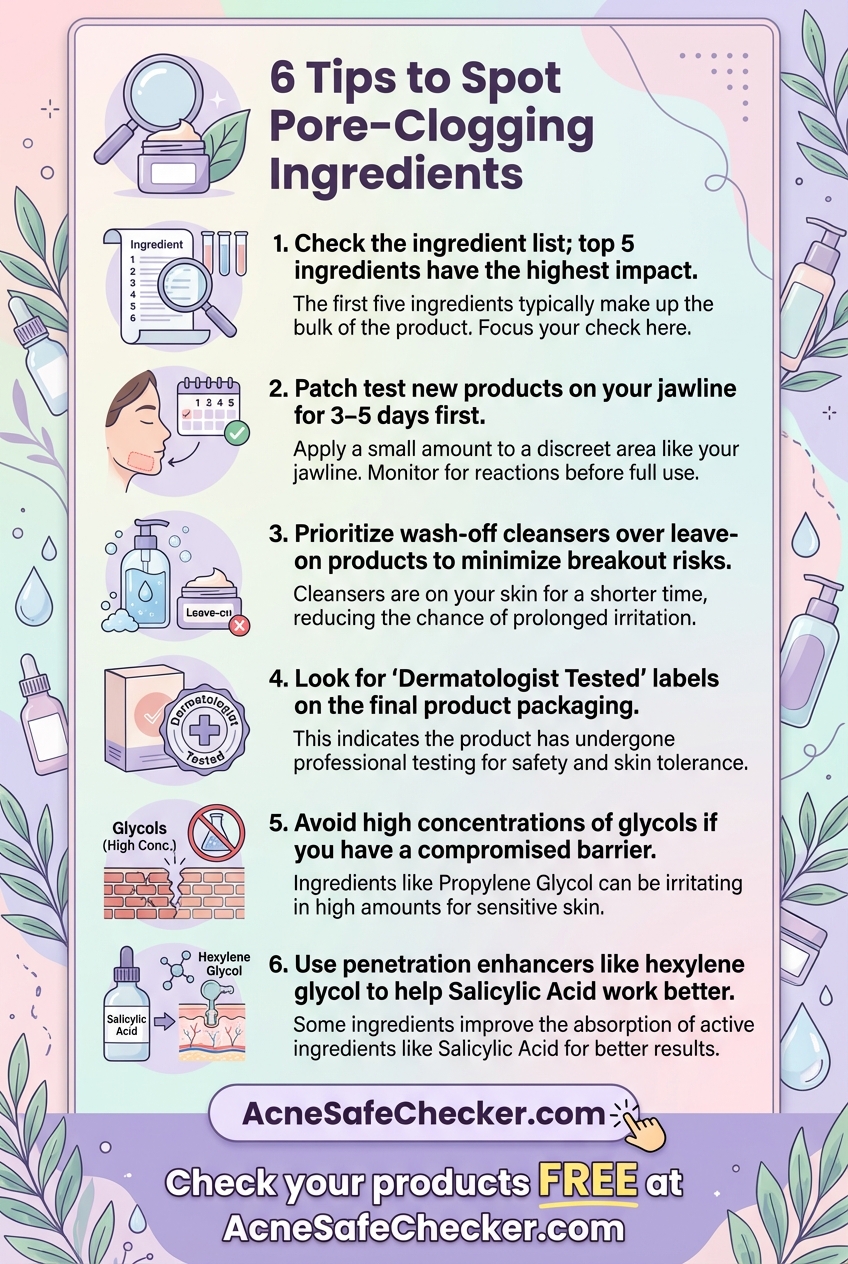
Ingredients are listed on labels by weight, from highest concentration to lowest. If hexylene glycol is near the very bottom of the list, its actual concentration in the product is likely less than 1%. At such low levels, even an ingredient with a higher rating is unlikely to clog your pores.
2. The Final Formulation
A product is more than the sum of its parts. Chemists formulate products so that ingredients interact. An ingredient that is slightly comedogenic on its own may become completely "safe" when diluted in a well-balanced formula. This is why some products containing hexylene glycol are still labeled as "non-comedogenic"—they have been clinically tested as a finished product and proven not to clog pores.
Why Hexylene Glycol is Used in Acne Products
It might seem counterintuitive to include a "level 2" ingredient in products meant for oily skin, but hexylene glycol has properties that are actually beneficial for acne sufferers:
- Thinning Agent: It helps heavy creams feel lighter and more breathable on the skin.
- Penetration Enhancer: It can help active ingredients, like salicylic acid or benzoyl peroxide, penetrate deeper into the pore to do their work.
- Antimicrobial Properties: It has mild preservative qualities, helping to keep your products free of bacteria that could worsen acne.
Potential Side Effects and Sensitivities
While pore-clogging is the primary concern for most, hexylene glycol can occasionally cause other issues. Because it is a penetration enhancer, it can sometimes make the skin more sensitive to other irritants. If you have a compromised skin barrier (due to over-exfoliating or conditions like eczema), hexylene glycol might cause a slight stinging or redness.
How to Determine if it’s Right for You
If you are currently struggling with persistent breakouts and you suspect your products are to blame, here is a professional approach to managing ingredients like hexylene glycol:
- The Patch Test: Apply the product to a small area of your jawline for 3–5 days. If no small bumps (closed comedones) appear, the hexylene glycol in that specific formula is likely safe for you.
- Check the Position: If hexylene glycol is in the first five ingredients of a product you leave on your skin all day (like a primer), and you are breaking out, it might be the culprit.
- Wash-Off vs. Leave-On: In cleansers or micellar waters, hexylene glycol is only on your skin for seconds before being rinsed away. In these cases, the risk of it clogging a pore is virtually zero.
Conclusion
Hexylene glycol is a versatile and generally safe ingredient. With a comedogenic rating of 2, it falls into a "gray area"—it is not a primary trigger for acne, but it isn't strictly invisible to the skin either.
If you have "normal" acne-prone skin, you likely don't need to avoid this ingredient. However, if you have tried everything and still suffer from mysterious whiteheads, looking for hexylene-glycol-free alternatives might be the final piece of your skincare puzzle. Always prioritize products that have been "Dermatologist Tested" and "Non-Comedogenic" on the final packaging, as these labels carry more weight than an individual ingredient's raw score.