
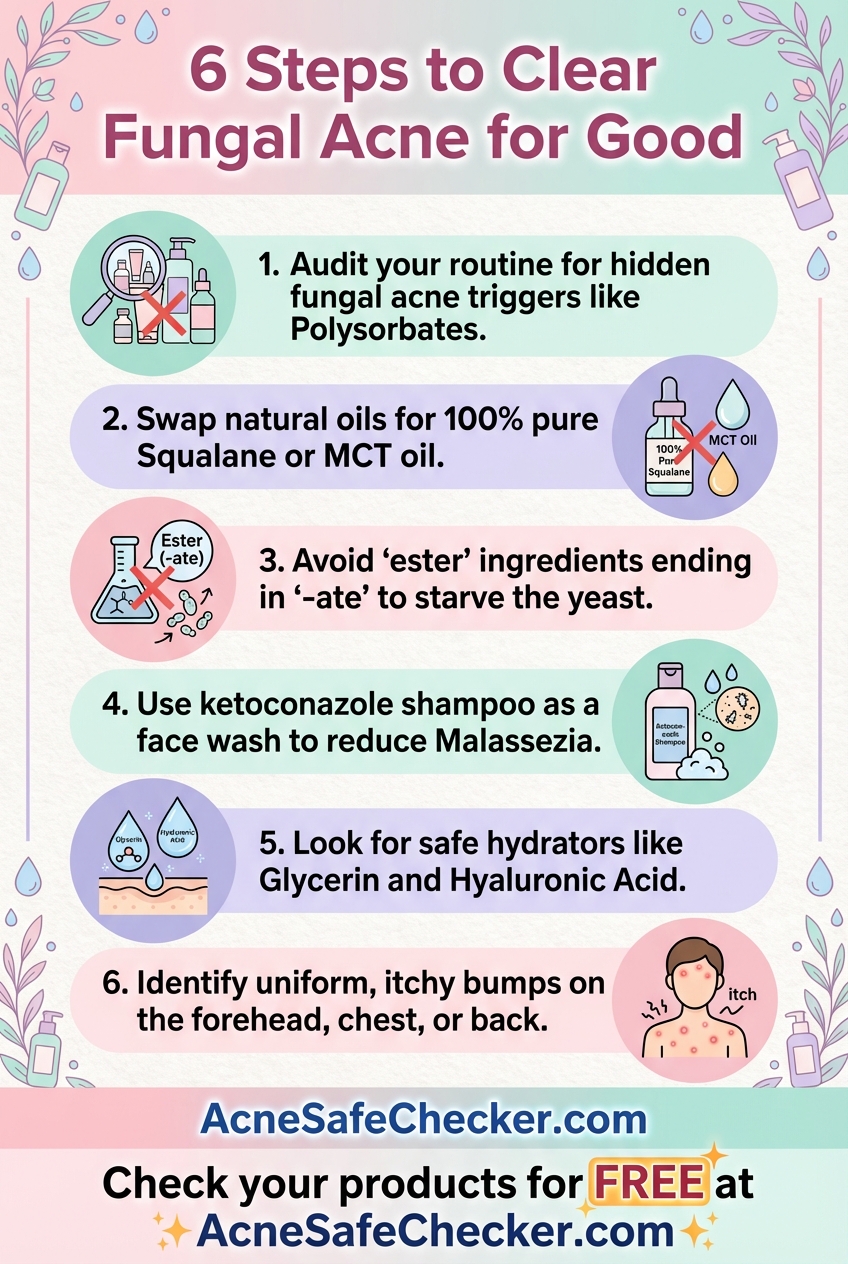
If you have ever dealt with stubborn, itchy, uniform bumps on your forehead, chest, or back that refuse to respond to traditional acne treatments, you might be dealing with Malassezia folliculitis, commonly known as "fungal acne."
Is Your Routine Acne-Safe?
Do not guess. Instantly check your products for pore-clogging ingredients with our AI-powered tool.
Check Ingredients NowUnlike traditional acne (acne vulgaris), which is caused by bacteria and clogged pores, fungal acne is caused by an overgrowth of yeast. Because this yeast feeds on specific ingredients found in many skincare products, checking your ingredient labels becomes a high-stakes game. One ingredient that frequently pops up in ingredient lists is Polysorbate 20.
Is Polysorbate 20 fungal acne safe? As a dermatologist, I am here to break down the science of why this common ingredient might be the hidden culprit behind your breakouts.
What is Polysorbate 20?
Polysorbate 20 is a surfactant and emulsifier used in a wide range of cosmetic products, including cleansers, toners, and moisturizers. Its primary job is to help oil and water mix, ensuring that your skincare products have a smooth, consistent texture and that active ingredients are evenly distributed.
In chemical terms, Polysorbate 20 is a polyoxyethylene sorbitan monolaurate. The "laurate" part is key here—it signifies that the molecule is derived from lauric acid, a fatty acid.
The Science: Why Polysorbate 20 Triggers Fungal Acne
To understand why Polysorbate 20 is problematic, we have to look at the biology of the yeast responsible for fungal acne: Malassezia.
The Malassezia Diet
Malassezia is a lipid-dependent yeast. This means it cannot produce its own fatty acids and must "scavenge" them from its environment—specifically, your skin’s sebum and the skincare products you apply. However, this yeast is a picky eater. It specifically thrives on fatty acids with carbon chain lengths ranging from 11 to 24.
The Carbon Chain Connection
When we look at the chemical structure of Polysorbate 20, we find it contains lauric acid. Lauric acid has a carbon chain length of C12. Since C12 falls directly within the C11–C24 range that Malassezia loves, Polysorbate 20 acts as a buffet for the yeast.
When you apply a product containing Polysorbate 20 to skin prone to fungal acne, you are essentially providing the fuel the yeast needs to multiply, leading to inflammation and those characteristic itchy bumps.
The Verdict: Is it Safe?
No, Polysorbate 20 is not considered fungal acne safe.
If you are currently struggling with a flare-up of Malassezia folliculitis, you should avoid products containing Polysorbate 20, as well as its cousins: Polysorbate 40, 60, and 80. Each of these contains different fatty acids (palmitic, stearic, and oleic acids, respectively) that also fall within the range that feeds fungal acne.
How to Identify Fungal Acne
Before you toss out your entire skincare vanity, it is important to ensure you are actually dealing with fungal acne. Here are the hallmark signs:
- Uniformity: The bumps are usually the same size and shape.
- Itching: Unlike bacterial acne, fungal acne is often very itchy.
- Location: It commonly appears on the forehead, hairline, chest, and back.
- No Comedones: You won't typically see blackheads or whiteheads associated with these specific bumps.
- Resistance: It does not get better with traditional benzoyl peroxide or salicylic acid treatments (though some acids can help, they often aren't enough on their own).
Practical Steps for Fungal Acne-Prone Skin
Managing fungal acne requires a strict elimination diet for your skin. Here is how to navigate your routine:
1. Audit Your Current Routine
Check your cleansers, serums, and sunscreens. Look for Polysorbates, but also look for other common triggers like:
- Fatty Acids: Lauric, Myristic, Palmitic, Stearic, Oleic, and Linoleic acids.
- Oils: Most natural oils (coconut, rosehip, avocado) are unsafe, with a few exceptions like Squalane (must be 100% pure) and MCT oil (caprylic/capric triglycerides).
- Esters: Ingredients ending in "-ate" (e.g., Isopropyl Palmitate, Glyceryl Stearate).
2. Switch to Fungal Acne-Safe Alternatives
Look for products that use synthetic thickeners or different types of emulsifiers that do not contain the problematic fatty acid chains. Ingredients like Propanediol, Glycerin, and Hyaluronic Acid are generally safe and provide hydration without feeding the yeast.
3. Use Antifungal Treatments
In addition to removing triggers like Polysorbate 20, you may need to actively reduce the yeast population. Dermatologists often recommend over-the-counter antifungal shampoos (containing ketoconazole) used as a face or body wash, or topical treatments like sulfur, which has natural antifungal properties.
Conclusion
While Polysorbate 20 is a perfectly safe and effective ingredient for most people, it is a "red flag" ingredient for anyone prone to fungal acne. Its C12 carbon chain provides the perfect nutrient source for Malassezia yeast to thrive.
If you suspect your skincare routine is working against you, try removing polysorbates and other fatty acid-rich ingredients for a few weeks. Consistency is key when dealing with fungal acne, and making the switch to a "fungal acne-safe" routine can often lead to a dramatic clearance of the skin where other treatments have failed.