
For anyone who has ever battled persistent breakouts, reading a makeup ingredient label can feel like navigating a minefield. You find a foundation that promises a flawless, matte finish, only to see 'Silica' listed near the top of the ingredients. Immediately, the question arises: Is this going to clog my pores and trigger a new cycle of acne?
Is Your Routine Acne-Safe?
Do not guess. Instantly check your products for pore-clogging ingredients with our AI-powered tool.
Check Ingredients NowAs a dermatologist, I see patients daily who are terrified that their cosmetic choices are undermining their skincare routines. Silica is one of those ubiquitous ingredients that sounds chemical but is actually a natural powerhouse. Today, we are going to dive deep into the science of silica to determine if it belongs in your acne-safe beauty kit.
What Exactly is Silica?
Silica, also known as silicon dioxide ($SiO_2$), is a naturally occurring mineral found most commonly in quartz and sand. In the world of cosmetics, silica is ground into an ultra-fine, spherical powder. It is prized by formulators for its unique ability to absorb moisture and oil (sebum) while providing a 'soft-focus' or blurring effect on the skin.
There are two main types of silica you will encounter:
- Crystalline Silica: Primarily used in industrial applications (like glass making or construction) and not used in skincare due to safety concerns.
- Amorphous Silica: This is the skin-safe, cosmetic-grade version. It is non-toxic and widely used in everything from setting powders to toothpastes.
Is Silica Pore Clogging? The Scientific Verdict
The short answer is: No, silica is generally considered non-comedogenic.
In dermatology, we use a comedogenicity scale (ranging from 0 to 5) to determine how likely an ingredient is to clog pores. Silica typically scores a 0. This means it does not possess the chemical properties required to physically 'plug' the follicular opening or mix with sebum to form a comedone (whitehead or blackhead).
How Silica Interacts with Your Skin
Unlike heavy oils or thick waxes, silica particles are chemically inert. They sit on the surface of the skin. Their primary function in makeup—specifically in 'oil-control' products—is to act like tiny sponges. They soak up excess oil as it is produced, which can actually help prevent the 'oil slick' that often contributes to the migration of bacteria and the formation of acne.
Silica vs. Silicones: Clearing the Confusion
One reason silica gets a bad reputation is that it is often confused with silicones (like Dimethicone or Cyclopentasiloxane). While silica is a mineral, silicones are synthetic polymers.
Many patients assume that because the names sound similar, they behave the same way. While most silicones are also non-comedogenic, they have a 'film-forming' quality that can trap sweat or other irritating ingredients against the skin. Silica does not form this type of occlusive seal; it remains a porous powder, allowing the skin to 'breathe' more effectively than heavy silicone-based primers might.
Why Silica is a Holy Grail for Oily and Acne-Prone Skin
If you struggle with acne, silica can actually be a beneficial addition to your makeup routine for several reasons:
- Oil Regulation: By absorbing excess sebum throughout the day, silica prevents the oxidized oil from irritating the pores.
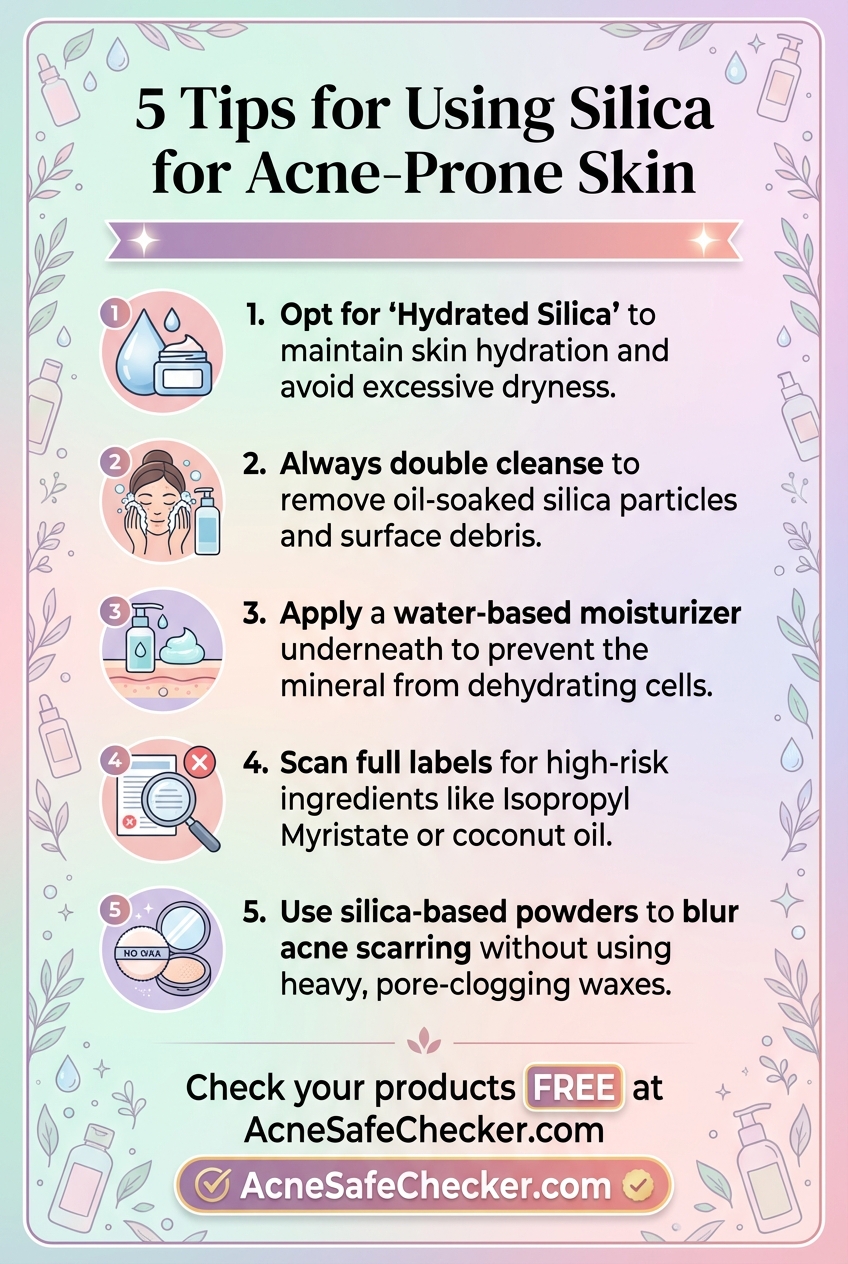
- Texture Improvement: Acne-prone skin often has enlarged pores or scarring. Silica’s light-diffusing properties help blur these imperfections without the need for heavy, pore-clogging waxes.
- Matte Finish: It reduces the shine that often highlights active breakouts.
Potential Pitfalls: When Silica Might Cause Issues
While silica itself doesn't clog pores, it isn't necessarily perfect for every skin type. There are two scenarios where silica might cause 'pseudo-breakouts' or irritation:
1. Excessive Dryness
Because silica is so efficient at absorbing oil, it can be too drying for individuals with combination or sensitive skin. When the skin becomes overly dehydrated, the skin barrier can become compromised. This lead to 'reactive seborrhea'—where your skin produces even more oil to compensate—which can lead to breakouts.
2. Improper Removal
Silica is designed to 'grip' onto oil. If you do not thoroughly cleanse your face at the end of the day, the silica particles (laden with the oil and dirt they've absorbed) can sit on the skin's surface. While the silica isn't the clogger, the debris it’s holding onto can eventually irritate the pore.
Practical Advice for Choosing and Using Silica
If you are worried about breakouts, follow these dermatologist-approved steps for using silica-based makeup:
- Check for 'Hydrated Silica': This version is often gentler and less drying than 'Silica Dimethyl Silylate.'
- Look at the Overall Formula: An ingredient list is a recipe. Even if silica is non-comedogenic, the product might also contain isopropyl myristate or coconut oil, which are highly comedogenic. Always check the full list.
- The Double Cleanse: If you use high-silica 'HD' powders or long-wear foundations, use a micellar water or an oil-based cleanser first, followed by a gentle foaming cleanser. This ensures all oil-soaked particles are removed.
- Hydrate Underneath: Use a non-comedogenic, water-based moisturizer before applying silica-rich products to prevent the mineral from pulling too much moisture from your skin cells.
Conclusion
Is silica in makeup pore-clogging? The science says no. Silica is a safe, effective, and non-comedogenic mineral that offers significant benefits for those dealing with excess oil and acne. It provides a beautiful aesthetic finish without the risks associated with heavier, occlusive ingredients.
As always, skin health is holistic. If you find your skin reacting to a product containing silica, it is likely due to another ingredient in the formulation or a result of surface dehydration. By understanding the ingredients in your vanity, you can make empowered choices that lead to clearer, more confident skin.