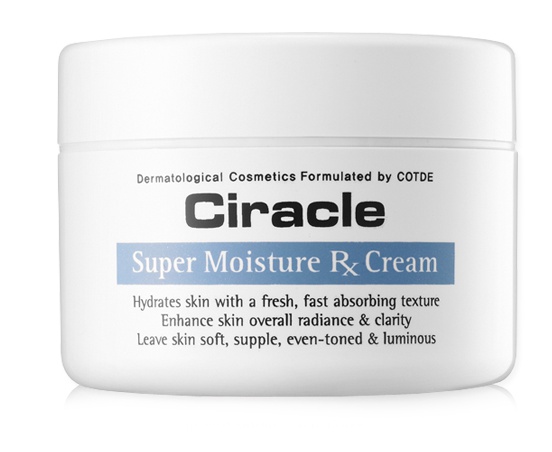
Ciracle Super Moisture Rx Cream
Ciracle Super Moisture Rx Cream is a high-performance moisturizer formulated to deliver intense hydration without the heavy, greasy feel associated with traditional creams. This product centers its formula on Beta-Glucan and Rosa Davurica Bud Extract, two powerhouse ingredients known for their ability to soothe irritation and strengthen the skin's moisture barrier. By utilizing humectants such as Butylene Glycol and Pentylene Glycol, the cream draws moisture deep into the skin's layers, ensuring a plump and refreshed complexion. The texture is lightweight and absorbs quickly, making it a versatile addition to any skincare routine. Unlike many moisturizers that rely on occlusive waxes or oils, Ciracle focuses on breathable hydration that won't feel suffocating on the skin. It is specifically designed to provide relief for dehydrated skin while maintaining a clean profile that respects pore health. Whether you are dealing with environmental stressors or a compromised barrier, this cream provides the essential nutrients needed for a healthy, radiant glow without the risk of heavy residue.
Our Analysis
Our analysis of the Ciracle Super Moisture Rx Cream reveals a remarkably clean profile with zero flagged comedogenic ingredients. This earns the product a 'Low Risk' rating, making it an excellent choice for those who are highly sensitive to pore-clogging additives. The absence of common triggers like isopropyl myristate, synthetic waxes, or heavy oils ensures that the formula remains breathable. Instead, it relies on skin-identical hydrators and soothing botanicals. By prioritizing ingredients like Beta-Glucan, Ciracle offers a safe haven for acne-prone individuals seeking deep hydration without the fear of triggering new breakouts.
Skin Type Recommendations
This cream is best suited for sensitive, acne-prone, and combination skin types. Its lightweight, non-comedogenic formula is a dream for those who suffer from dehydration but fear heavy textures. While oily skin types will appreciate the breathable finish, very dry skin types may find it most effective when used as a soothing base.
Flagged Ingredients
This product does not contain known high-risk comedogenic ingredients.
MACR Analysis
5-Axis AI-Powered Risk Assessment
The MACR analysis found moderate concerns not captured by traditional comedogenic ratings, such as barrier disruption or irritation potential.
Recommendations
This serum is not recommended for individuals prone to acne, especially fungal acne, or those with sensitive skin.
Oily skin, Acne-prone skin, Sensitive skin, Fungal acne-prone skin
Individuals with a history of severe comedonal acne, Individuals with Malassezia folliculitis, Those highly sensitive to pH adjusters or unstable Vitamin C
- •Patch test thoroughly before applying to the entire face.
- •Use sparingly, especially if you have oily or acne-prone skin.
- •Avoid using with other heavy or occlusive products.
- •Store in a cool, dark place to minimize Ascorbic Acid oxidation.
Overall Risk Score
Lower is better
Score by Skin Type
Lower is better
Same product, different risks based on your skin type
This leave-on serum presents a moderate to high risk for acne-prone and oily skin types due to a combination of barrier-disrupting penetration enhancers, multiple occlusive silicones, and ingredients that can support fungal acne. Sensitive skin may also react to the unstable Vitamin C and pH adjuster.
Risk Breakdown
Ingredient Interactions
These ingredients may interact to increase risk beyond their individual scores.
The combination of two potent penetration enhancers can drive other ingredients deeper into the skin, increasing the risk of irritation and barrier disruption.
Both Pentylene Glycol and Butylene Glycol are known to enhance the penetration of other cosmetic ingredients. When present together in a formulation, their combined effect can be synergistic, potentially leading to increased absorption of potentially comedogenic or irritating ingredients, exacerbating breakouts and barrier damage.
Multiple silicones and a long-chain olefin contribute to a significant occlusive film, which could trap sebum and debris in pores.
The presence of multiple silicone ingredients (Dimethicone, Cyclomethicone, Stearoxytrimethylsilane, Phenyl Methicone) alongside C30-45 Olefin creates a substantial occlusive layer on the skin. This can prevent natural sebum and cellular debris from escaping the pores, increasing the likelihood of pore blockage and subsequent breakouts.
Combination of emulsifiers that can be broken down into fungal food sources and a long-chain hydrocarbon that supports fungal growth.
Polysorbate 60 and Sorbitan Sesquioleate are emulsifiers that can be hydrolyzed by Malassezia yeast into fatty acids, serving as a food source. C30-45 Olefin, with its long carbon chain, also falls into the 'danger zone' for Malassezia. Together, these ingredients create a more supportive environment for fungal overgrowth.
Why This Score?
The overall risk score of 49 is driven primarily by the combined impact of penetration enhancers (Pentylene Glycol, Butylene Glycol) on barrier function, the extensive use of silicones creating an occlusive film, and ingredients known to promote fungal growth (Polysorbate 60, Sorbitan Sesquioleate, C30-45 Olefin). The instability of Ascorbic Acid also contributes to the oxidation risk.
Main factors:
- •Barrier Disruption (BR) due to penetration enhancers
- •Fungal Risk (FR) from emulsifiers and hydrocarbons
- •Plugging Risk (PR) from occlusive silicones and film-formers
Reducing factors:
- •The presence of stable, non-comedogenic ingredients like Squalane and Beta-Glucan helps.
- •Ascorbic Acid and some botanical extracts are in the lower half of the INCI, suggesting lower concentrations.
- •The product is a leave-on, meaning its full potential for contact time is realized, unlike a rinse-off.
Skin Type Considerations
This analysis uses the Multi-Axis Comedogenic Risk (MACR) system. Results are AI-estimated and cannot account for actual ingredient concentrations. Individual reactions may vary. Consult a dermatologist for personalized advice.