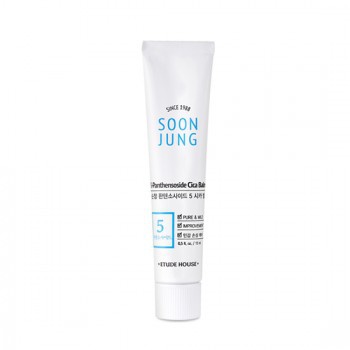
Etude House Soon Jung 5-Panthensoside Cica Balm
Etude House Soon Jung 5-Panthensoside Cica Balm is a cult-favorite concentrated treatment designed to soothe and repair compromised skin barriers. This Etude House staple is formulated with 5% Panthenol and Madecassoside (Cica), two powerhouses for calming inflammation and promoting skin healing. The inclusion of Squalane provides deep hydration by mimicking the skin’s natural oils, preventing moisture loss without leaving a heavy, greasy residue. Its texture is uniquely balanced—rich enough to act as a protective barrier, yet smooth enough for comfortable application on sensitized skin. For those navigating an acne-prone journey, this product adheres to the 'Soon Jung' (meaning pure/innocent) philosophy, focusing on a minimalist ingredient list free from fragrance, parabens, and mineral oil. While it contains moisturizing lipids, the formula is specifically designed to be non-irritating, making it an excellent companion for those using drying acne medications or chemical exfoliants that require additional barrier support.
Our Analysis
Our analysis of the Etude House Soon Jung 5-Panthensoside Cica Balm reveals a Low comedogenic risk level. We flagged Cetearyl Alcohol and Stearic Acid, which both carry a low-moderate rating of 2/5. It is important to note that while Cetearyl Alcohol can become highly comedogenic (rating of 4) when combined with Ceteareth-20, this formula does not contain that specific emulsifier, maintaining its safety for most users. The high concentration of Panthenol (5%) and Squalane works to hydrate and heal the skin without the high risk of pore clogging typically associated with thicker balms.
Skin Type Recommendations
This balm is ideal for sensitive, dry, and irritated skin types in need of barrier repair. While its low comedogenic rating makes it safe for acne-prone skin, those with very oily skin may prefer using it as a spot treatment for dry patches rather than an all-over daily moisturizer.
Flagged Ingredients
Fatty alcohol emollient with low-moderate comedogenicity on its own. However, when combined with Ceteareth-20, the synergistic effect can significantly increase pore-clogging potential (combined rating of 4).
Found in many butters; thickening agent with low-moderate risk.
Want Deeper Analysis?
Run our MACR (Multi-Axis Comedogenic Risk) analysis to get a comprehensive 5-axis risk assessment. This AI-powered analysis evaluates ingredients for Plugging Risk, Barrier Damage, Fungal Acne Risk, Oxidation Risk, and real-world User Reports — giving you personalized scores for your skin type.