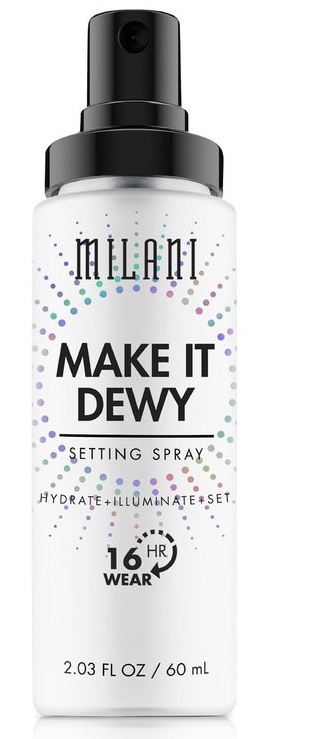

Milani Make It Last Setting Spray
Milani Make It Last Setting Spray is a multi-tasking 3-in-1 formula designed to prime, set, and correct your makeup for up to 16 hours of wear. This lightweight mist goes beyond simple longevity; it is enriched with Niacinamide, a powerhouse ingredient known for its ability to refine the appearance of pores, soothe redness, and balance oil production. The inclusion of Pentylene Glycol provides a subtle boost of hydration, while the film-former PVP ensures your makeup stays locked in place without smudging or fading. The texture is an ultra-fine, refreshing mist that dries down quickly thanks to the presence of Alcohol Denat., leaving a natural finish that never feels sticky or heavy. Unlike many setting sprays that rely on heavy oils or waxes to create a barrier, Milani uses a breathable approach that feels weightless on the skin. It is an excellent choice for anyone looking to extend their makeup wear while keeping their complexion looking fresh and vibrant throughout the day.
Our Analysis
Our analysis of the Milani Make It Last Setting Spray confirms a low comedogenic risk level, making it a safe addition to an acne-conscious beauty routine. After reviewing the full ingredient list, we found zero flagged ingredients known to clog pores or trigger breakouts. The formula is notably free of common irritants like isopropyl myristate or heavy coconut derivatives. Instead, it utilizes skin-friendly Niacinamide to support the skin barrier while setting makeup. This lack of pore-clogging components ensures that your skin can breathe even while your makeup is locked in for long-term wear.
Skin Type Recommendations
This product is best suited for oily, combination, and acne-prone skin types, as it helps control shine and contains no comedogenic oils. While it is safe for most, those with extremely dry or sensitive skin should be mindful of the Alcohol Denat. content, which may feel slightly drying with daily use.
Flagged Ingredients
This product does not contain known high-risk comedogenic ingredients.
MACR Analysis
5-Axis AI-Powered Risk Assessment
The MACR analysis found moderate concerns not captured by traditional comedogenic ratings, such as barrier disruption or irritation potential.
Recommendations
This treatment is not recommended for individuals with oily, acne-prone, dry, or sensitive skin due to high risks of barrier disruption, pore occlusion, and irritation.
Individuals with highly resilient, non-reactive skin seeking mild exfoliation/treatment benefits, provided they are not sensitive to fragrance.
Oily skin types who can tolerate moderate levels of alcohol and fragrance., Individuals looking for barrier support or soothing effects.
Acne-prone skin, Oily skin prone to active breakouts, Dry skin, Sensitive skin, Skin with compromised barrier function
- •Patch test on a small, inconspicuous area of skin before applying to the entire face.
- •Use sparingly, perhaps only a few times a week.
- •Follow with a very gentle, barrier-repairing moisturizer.
- •Discontinue use immediately if any redness, stinging, or increased breakouts occur.
Overall Risk Score
Lower is better
Score by Skin Type
Lower is better
Same product, different risks based on your skin type
This leave-on treatment presents a moderate overall risk, primarily driven by Alcohol Denat. and PVP at high concentrations. It poses a significant risk of barrier disruption and potential pore occlusion for oily and acne-prone skin types. Sensitive skin may also react to fragrance and the combination of alcohol and penetration enhancers.
Risk Breakdown
Ingredient Interactions
These ingredients may interact to increase risk beyond their individual scores.
Alcohol Denat. can disrupt the skin barrier, making it more permeable. Pentylene Glycol, acting as a penetration enhancer, can then drive other potentially irritating or comedogenic ingredients deeper into the skin.
The dehydrating and barrier-compromising effects of Alcohol Denat. create a less robust skin barrier. This compromised state allows Pentylene Glycol to more effectively facilitate the penetration of other ingredients in the formulation, increasing the risk of irritation or pore occlusion.
Alcohol Denat. strips the lipid barrier, while fragrance can cause irritation and inflammation, exacerbating damage and sensitivity.
Alcohol Denat. removes essential lipids from the skin's surface, weakening its protective barrier. Simultaneously, fragrance compounds can elicit an irritant or allergic response, leading to inflammation. Together, they create a cascade of barrier damage, increasing susceptibility to external aggressors and internal sensitivities.
Why This Score?
The overall score is calculated by weighting each axis (PR, BR, FR, OR, UR) by its importance and summing them. In this formula, the highest contributors were the Barrier Risk (BR) due to Alcohol Denat.'s potency, and the Plugging Risk (PR) due to PVP's film-forming nature at a high position. User-Reported (UR) and Oxidation Risk (OR) also play a role, with fragrance being a moderate concern for irritation and oxidative stress. Synergistic effects between Alcohol Denat. and penetration enhancers further elevate the risk.
Main factors:
- •Barrier Risk (BR) - Alcohol Denat. is a major driver.
- •Plugging Risk (PR) - PVP's high concentration and position.
- •Synergistic effects - Alcohol Denat. and penetration enhancers.
Reducing factors:
- •The product is a leave-on, so ingredients are not significantly diluted by water as in a rinse-off. However, the absence of a rinse-off reduction means the full impact is assessed.
- •Several safe humectants and soothing ingredients like Niacinamide and Glycerin are present, which can offer some counter-benefits.
- •The concentration of potentially problematic ingredients like Poloxamer 407 and PEG-60 Hydrogenated Castor Oil is further down the list.
Skin Type Considerations
This analysis uses the Multi-Axis Comedogenic Risk (MACR) system. Results are AI-estimated and cannot account for actual ingredient concentrations. Individual reactions may vary. Consult a dermatologist for personalized advice.