
There is nothing more frustrating than investing in a high-end skincare product promised to "clear your skin," only to wake up forty-eight hours later with a fresh cluster of whiteheads. As a dermatologist, I see this daily. The reality is that the term "non-comedogenic" is not strictly regulated by the FDA, meaning many brands use it as a marketing buzzword rather than a scientific guarantee.
Is Your Routine Acne-Safe?
Do not guess. Instantly check your products for pore-clogging ingredients with our AI-powered tool.
Check Ingredients NowTo achieve clear skin, you must look beyond the front of the bottle and master the ingredient list on the back. This guide explores the science of acne-safe ingredients and provides a blueprint for navigating the complex world of cosmetic chemistry.
Understanding the Comedogenic Scale
To understand what makes an ingredient "acne-safe," we first look at the comedogenic scale. This scale ranges from 0 to 5, indicating how likely an ingredient is to clog pores:
- 0: Will not clog pores
- 1: Very low probability of clogging
- 2: Moderately low probability
- 3: Moderate probability
- 4: Fairly high probability
- 5: High probability
While the scale originated from rabbit ear assays in the 1970s and has its limitations—such as not accounting for the concentration of an ingredient or how it interacts with other chemicals—it remains a valuable baseline for those with acne-prone skin. Generally, for acne-prone patients, I recommend sticking to ingredients rated 0 to 2.
Top Acne-Safe Ingredients Your Skin Will Love
When shopping for moisturizers, serums, and cleansers, look for these "green flag" ingredients that support the skin barrier without inducing follicular occlusion (the fancy medical term for pore-clogging).
1. Hyaluronic Acid
Hyaluronic acid is a humectant that can hold up to 1,000 times its weight in water. Unlike heavy oils, it provides essential hydration without adding any grease or occluding the pore. It is a 0 on the comedogenic scale, making it safe for even the most sensitive, acne-prone skin types.
2. Niacinamide (Vitamin B3)
Niacinamide is a powerhouse for acne sufferers. Not only is it non-comedogenic, but it also helps regulate sebum production, reduces redness (post-inflammatory erythema), and strengthens the skin's lipid barrier. It works synergistically with most acne treatments to reduce irritation.
3. Squalane (Sugar or Plant-Derived)
Do not confuse Squalane with Squalene. Squalene is a natural component of human sebum that can oxidize and lead to breakouts. However, Squalane is the hydrogenated, stable version. It is a lightweight, non-greasy emollient that mimics the skin’s natural oils without the risk of clogging. Look for plant-derived squalane for the safest results.
4. Salicylic Acid (BHA)
This is the gold standard for acne prevention. As a lipid-soluble beta-hydroxy acid, salicylic acid can penetrate deep into the pore to dissolve the "glue" holding dead skin cells together. It is inherently acne-safe because its primary function is to clear the very pores other ingredients might clog.
5. Glycerin
Often overlooked because it is inexpensive, glycerin is one of the most effective and safest humectants available. It mimics the skin's Natural Moisturizing Factor (NMF) and provides hydration without any risk of comedogenicity.
Red Flags: Ingredients to Avoid
If you have acne-prone skin, I suggest being cautious with the following ingredients, which frequently rank 3 or higher on the comedogenic scale:
- Coconut Oil (Cocos Nucifera Oil): Often touted as a natural miracle, it is highly comedogenic and a frequent cause of "skincare-induced" acne.
- Isopropyl Palmitate and Isopropyl Myristate: Common in many foundations and creams, these fatty acid esters are notorious for causing congestion.
- Algae Extract: While some versions are fine, many algae extracts are rich in iodine, which can irritate the pore lining and trigger breakouts in some individuals.
- Cocoa Butter: This is excellent for body skin but far too occlusive for the face, typically ranking a 4 on the scale.
The Role of Formulation Science
It is important to remember that the entire formula matters. A product might contain a tiny amount of a comedogenic ingredient but remain acne-safe because the overall concentration is low and the vehicle is lightweight. Conversely, a product full of "safe" ingredients could be poorly formulated and lead to irritation that triggers a breakout.
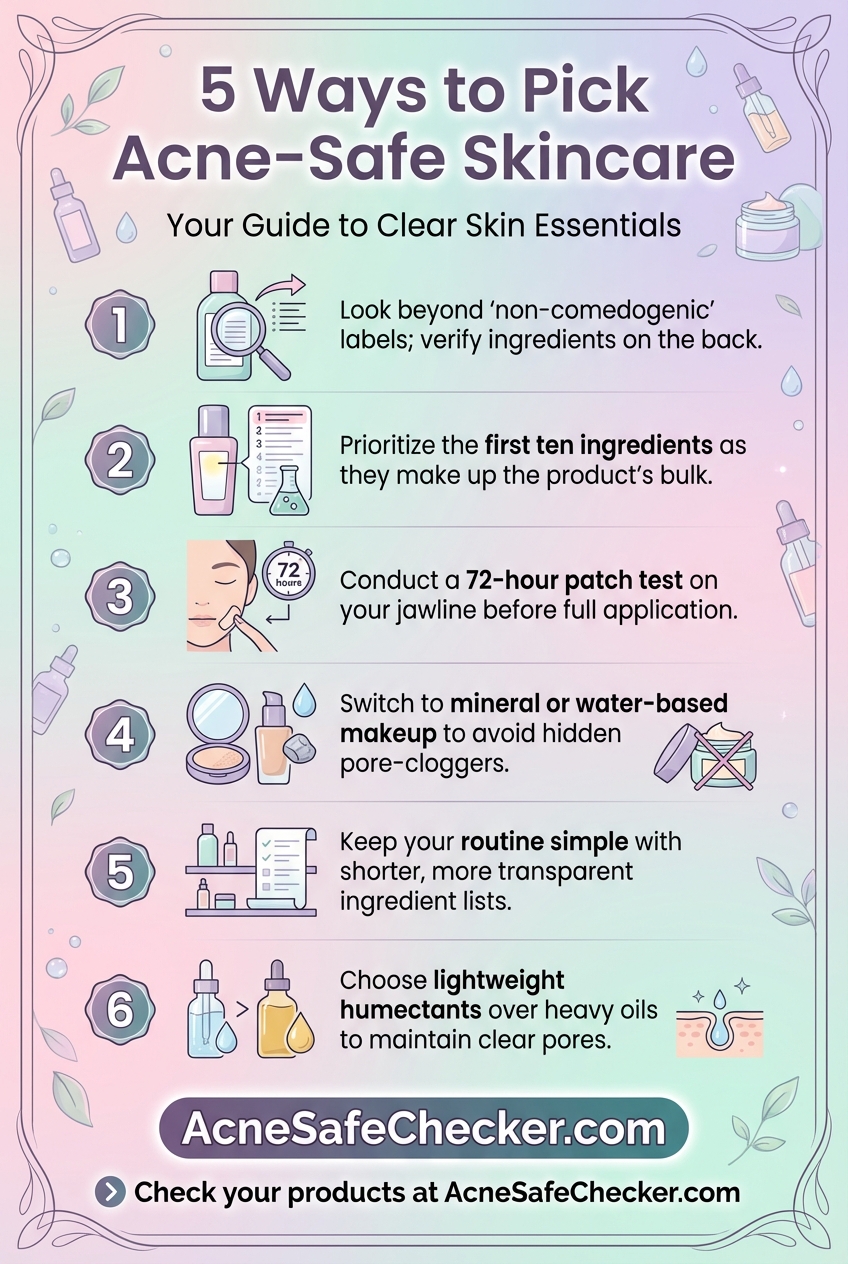
As a general rule, look for "oil-free" and "non-comedogenic" labels, but verify them by ensuring the first five to ten ingredients—the bulk of the product—are low on the comedogenic scale.
Practical Steps for an Acne-Safe Routine
- Check Your Makeup: Many people use medical-grade skincare but sabotage their results with comedogenic foundations or primers. Switch to mineral-based or water-based cosmetics.
- The 72-Hour Patch Test: Before applying a new product to your whole face, apply a small amount to your jawline for three consecutive nights. If you see tiny bumps (closed comedones) forming, the product is likely not acne-safe for you.
- Simplify: The more ingredients in a product, the higher the chance of one of them causing a reaction. Aim for shorter ingredient lists where possible.
Conclusion
Navigating the world of skincare with acne-prone skin requires a mix of scientific curiosity and patience. By focusing on proven humectants like Hyaluronic Acid and Glycerin, and being wary of heavy oils and esters, you can build a routine that nourishes your skin without the fear of breakouts. Remember, clear skin isn't just about what you put on your face—it’s about knowing exactly what is in those bottles. If you continue to struggle with persistent acne despite using safe ingredients, consult with a board-certified dermatologist to rule out underlying hormonal or inflammatory issues.