
Introduction: Why Your Skincare Might Be Working Against You
Is Your Routine Acne-Safe?
Do not guess. Instantly check your products for pore-clogging ingredients with our AI-powered tool.
Check Ingredients NowYou’ve followed the 10-step routines, invested in luxury serums, and meticulously washed your face every night, yet those stubborn breakouts and tiny bumps persist. As a dermatologist, one of the most common frustrations I hear from patients is: "I’m doing everything right, so why is my skin still breaking out?"
The answer often lies hidden in the fine print of your ingredient deck. Even products labeled "dermatologist-tested" or "natural" can contain high concentrations of comedogenic ingredients—substances specifically known to clog pores and trigger acne. Understanding what these ingredients are and how they interact with your unique skin chemistry is the first step toward achieving the clear, healthy complexion you deserve.
What Does "Comedogenic" Actually Mean?
The term "comedogenic" refers to the likelihood that a substance will cause a comedo—the clinical term for a clogged pore. Comedones manifest in two primary ways:
- Open Comedones: Commonly known as blackheads.
- Closed Comedones: Known as whiteheads or small, flesh-colored bumps.
The Comedogenic Scale
In the dermatological world, ingredients are often rated on a scale from 0 to 5:
- 0: Will not clog pores
- 1: Very low probability of clogging
- 2: Moderately low probability
- 3: Moderate probability
- 4: Fairly high probability
- 5: Highly likely to clog pores
While this scale provides a helpful baseline, it is important to remember that it is not an absolute science. The original testing was often performed on rabbit ears, which are more sensitive than human skin. Furthermore, the overall formulation of a product—how ingredients are mixed and their concentration—can change how an individual ingredient behaves on your skin.
The Top Comedogenic Ingredients to Watch Out For
If you are prone to acne or congestion, these are the primary culprits you should look for on your product labels.
1. Coconut Oil (Cocos Nucifera Oil)
Despite its reputation as a "natural wonder," coconut oil is highly comedogenic (rating a 4 or 5). While it is excellent for body skin or hair, it is a nightmare for facial pores. It contains high levels of lauric acid, which can be heavy and occlusive, trapping sebum and bacteria inside the follicle.
2. Isopropyl Myristate and Its Derivatives
Isopropyl Myristate is a synthetic oil used to enhance product penetration and provide a "slick" feel. While it makes your moisturizer feel silky, it is notorious for deep pore penetration that can lead to irritation and significant clogging. Others in this family include Isopropyl Isostearate and Myristyl Myristate.
3. Cocoa Butter (Theobroma Cacao Seed Butter)
Frequently found in heavy creams and "rich" moisturizers, cocoa butter is a thick emollient. While it’s great for preventing stretch marks on the body or treating extremely dry elbows, its molecular size is often too large for facial pores to handle, leading to stagnation and breakouts.
4. Algae Extract and Seaweed
Often marketed as a detoxifying or mineral-rich ingredient, certain types of algae (like Red Algae or Laminaria Digitata) are high in iodine. When applied topically, iodine can irritate the pore lining and accelerate the production of keratin, leading to a "clogged" effect. These often rate a 5 on the scale.
5. Lanolin and Acetylated Lanolin
Lanolin is a fatty substance derived from sheep's wool. While it is an incredible occlusive for dry, cracked lips, it is highly comedogenic for many. Acetylated lanolin is even more problematic, as it is processed to be more easily absorbed by the skin, carrying its pore-clogging potential deeper into the follicle.
6. D&C Red Dyes
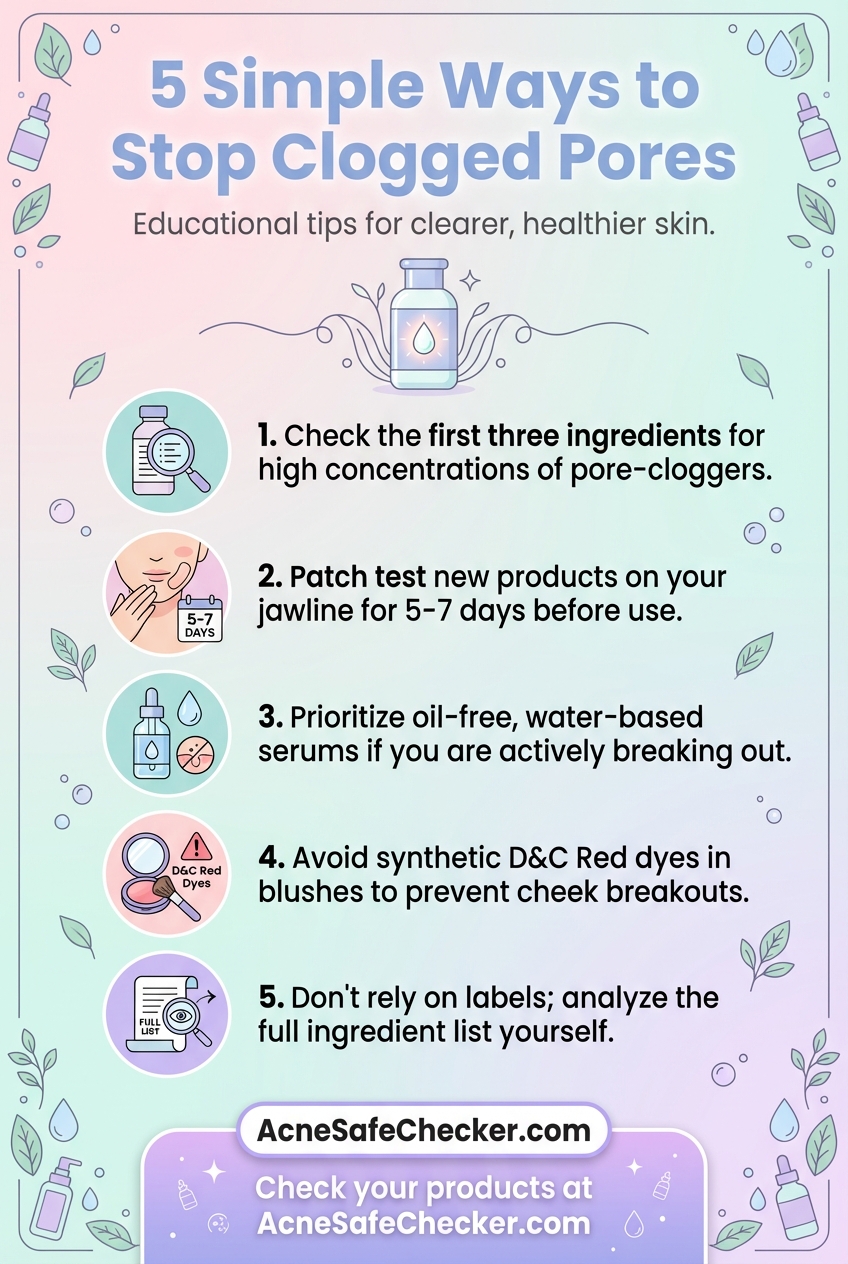
Commonly found in blushes and lip products, certain synthetic dyes—specifically D&C Red #17, #21, and #30—are highly comedogenic. If you notice breakouts specifically in the "cheek zone" where you apply blush, your makeup pigment might be the cause.
The Science of the Clog: How It Happens
Pore clogging isn't just about "grease." It is a biological process called retention hyperkeratosis. In normal skin, dead skin cells are shed and pushed out of the pore by sebum. When a highly comedogenic ingredient is introduced, it can act as a "glue," causing those dead skin cells to stick together. This creates a plug (microcomedo). Once the plug forms, P. acnes bacteria thrive in the oxygen-free environment, leading to inflammation and the visible pimples we all recognize.
Why "Non-Comedogenic" Labels Can Be Misleading
Unlike the FDA's strict regulations on drug facts, the term "non-comedogenic" is not strictly regulated for skincare. A company can claim a product is non-comedogenic even if it contains a level 4 ingredient, provided the overall formula didn't cause breakouts in their specific (and often small) test group. This is why being your own advocate and reading the full ingredient list is essential.
Practical Steps for Acne-Prone Skin
- The "First Three" Rule: Ingredients are listed in order of concentration. If a comedogenic ingredient like Coconut Oil is in the first three to five ingredients, avoid it. If it is the very last ingredient, it may be diluted enough to not cause an issue.
- Patch Test Everything: Apply a small amount of a new product to a specific area (like the jawline) for 5-7 days before applying it to your entire face.
- Choose Water-Based Serums: Look for formulations where "Aqua" (water) is the first ingredient, and prioritize "oil-free" labels if you are actively breaking out.
- Listen to Your Skin: Science provides the map, but your skin provides the territory. If a "safe" product makes you break out, stop using it. Genetics, hormones, and environment all play a role in how you react to ingredients.
Conclusion: Empowering Your Skincare Journey
Navigating the world of skincare can feel like a minefield, but identifying top comedogenic ingredients gives you back control. You don't need a 10-step routine to have clear skin; you simply need a routine that respects your skin’s biology. By weeding out heavy oils, synthetic esters, and irritating dyes, you allow your skin to breathe and function as it was meant to. Remember, clear skin is a marathon, not a sprint—be patient with your progress and mindful of what you put on your face.