
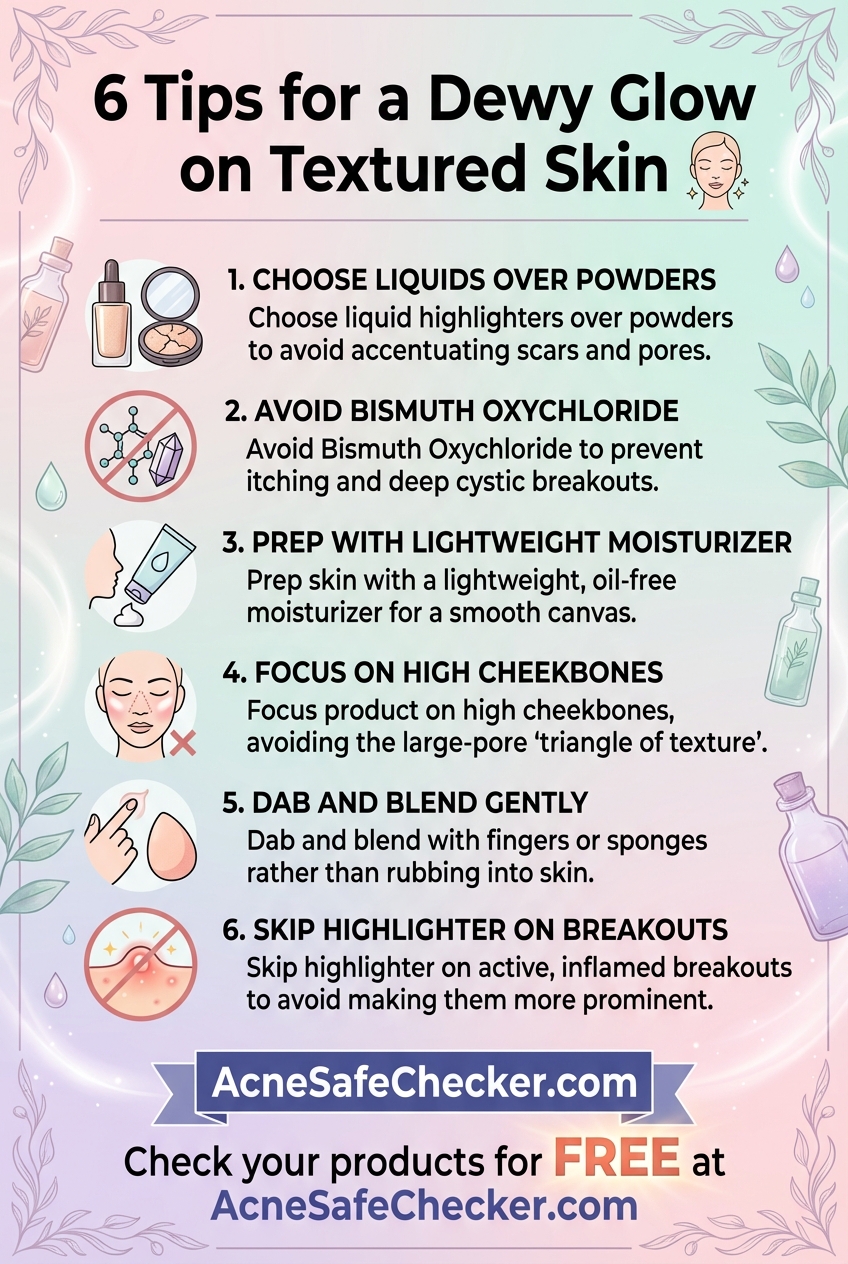
Finding the perfect glow when you have acne-prone or textured skin often feels like a catch-22. On one hand, you want that luminous, lit-from-within radiance that defines modern beauty. On the other, many highlighters—especially those formulated with heavy oils or shimmering particles—can settle into pores, accentuate bumps, and trigger a fresh cycle of breakouts.
Is Your Routine Acne-Safe?
Do not guess. Instantly check your products for pore-clogging ingredients with our AI-powered tool.
Check Ingredients NowAs a dermatologist, I often see patients who have given up on highlighters entirely because they fear the 'texture-enhancing' effect of traditional makeup. However, with the right formulation and a focus on non-comedogenic ingredients, you can achieve a sophisticated glow that actually flatters your skin. This guide explores the science behind acne-safe liquid highlighters and how to choose the best options for textured complexions.
What Makes a Highlighter ‘Acne-Safe’?
The term 'acne-safe' isn't just a marketing buzzword; it refers to products formulated without ingredients known to clog pores (comedogenic) or irritate the follicular lining. For liquid highlighters, this is particularly important because these products are often designed to 'melt' into the skin, meaning their ingredients have direct, prolonged contact with your pores.
Decoding Non-Comedogenic Labels
When shopping for a liquid highlighter, your first step is looking for 'non-comedogenic' on the label. This indicates the product has been tested to show it does not cause comedones (clogged pores). However, as a specialist, I recommend going a step further and auditing the ingredient list yourself. Look for the absence of heavy waxes, certain oils, and synthetic esters that provide 'slip' but can trap sebum.
Common Culprits to Avoid
Many traditional highlighters use specific ingredients to achieve their shimmer and staying power that are problematic for acne-prone individuals:
- Bismuth Oxychloride: This is a common mineral byproduct used to create a pearlescent finish. However, its crystalline structure can be sharp and heavy, often causing itching and cystic breakouts in sensitive or acne-prone skin.
- Isopropyl Myristate and its Derivatives: These are used to enhance product absorption but are highly comedogenic.
- Coconut Oil (Cocos Nucifera): While great for the body, it is a high-ranking comedogen that can be disastrous for facial acne.
- Heavy Silicones: While not all silicones are bad, high concentrations of dimethicone in some 'blurring' highlighters can trap sweat and bacteria underneath the makeup.
Liquid vs. Powder: Why Liquid Wins for Textured Skin
If you have uneven skin texture—whether from active acne, enlarged pores, or atrophic scarring—the formulation type matters just as much as the ingredients.
Powder highlighters are composed of dry particles that sit on top of the skin. These particles tend to migrate and congregate in the 'valleys' of the skin (scars and pores) while clinging to the 'peaks' (dry patches and active bumps). This creates a spotlight effect on the very texture you might be trying to disguise.
Liquid highlighters, conversely, act more like skincare. They provide a hydration-based glow that mimics the skin's natural moisture. Because they are fluid, they can be blended out into a thin, even veil that reflects light across the surface of the skin rather than highlighting the depth of the texture.
The Science of ‘Skin-First’ Highlighting Ingredients
Modern liquid highlighters often bridge the gap between makeup and dermatology. When searching for an acne-safe option, look for these 'skin-first' ingredients:
1. Squalane
Unlike heavy oils, squalane is a biomimetic lipid that mimics the skin's natural oils without clogging pores. It provides a beautiful, dewy finish while actually helping to repair the skin barrier.
2. Niacinamide (Vitamin B3)
Some high-end liquid highlighters now include niacinamide. This is a powerhouse for textured skin as it helps regulate oil production, reduces the appearance of pore size, and calms redness associated with active breakouts.
3. Hyaluronic Acid and Glycerin
These humectants draw moisture into the skin. By plumping the skin with hydration, they naturally smooth out fine lines and minor texture, making the highlighting pigments sit more evenly.
4. Synthetic Fluorphlogopite
Also known as 'synthetic mica,' this is often preferred for textured skin over natural mica. The particles are more uniform and smoother, providing a 'soft-focus' glow rather than a 'glittery' finish that can look harsh on uneven skin.
Dermatologist-Approved Application Tips for Textured Skin
How you apply your acne-safe liquid highlighter is just as important as the product itself. To minimize the appearance of texture, follow these steps:
- Prep with Hydration: Never apply highlighter to dry, flaky skin. Use a lightweight, oil-free moisturizer first to create a smooth canvas.
- Strategic Placement: Avoid the 'triangle of texture' (the area on the cheeks next to the nose where pores are usually largest). Instead, focus the liquid highlighter on the high points of the cheekbones, the brow bone, and the bridge of the nose.
- The 'Dab and Blend' Method: Use a damp makeup sponge or your ring finger to tap the product into the skin. Avoid rubbing, which can disturb your foundation and emphasize flakiness.
- Avoid Active Lesions: If you have an active, inflamed breakout, do not apply highlighter directly on top of it. Highlighting a bump only makes it more prominent.
Conclusion: Radiant Skin is Possible
Having acne or textured skin doesn't mean you have to skip the glow. By choosing a liquid highlighter formulated with non-comedogenic ingredients like squalane and avoiding irritants like bismuth oxychloride, you can achieve a luminous finish that supports your skin health. Remember, the goal of a great highlighter for textured skin is to create a 'soft-focus' effect—reflecting light in a way that blurs imperfections rather than magnifying them. Always patch-test new products and look for formulations that treat your skin as much as they beautify it.