
You’ve likely been there: you buy a new moisturizer or foundation labeled "non-comedogenic" or "dermatologist-tested," only to find yourself dealing with a fresh crop of breakouts a week later. It is a frustrating cycle that leaves many people wondering if any product is truly safe for their skin.
Is Your Routine Acne-Safe?
Do not guess. Instantly check your products for pore-clogging ingredients with our AI-powered tool.
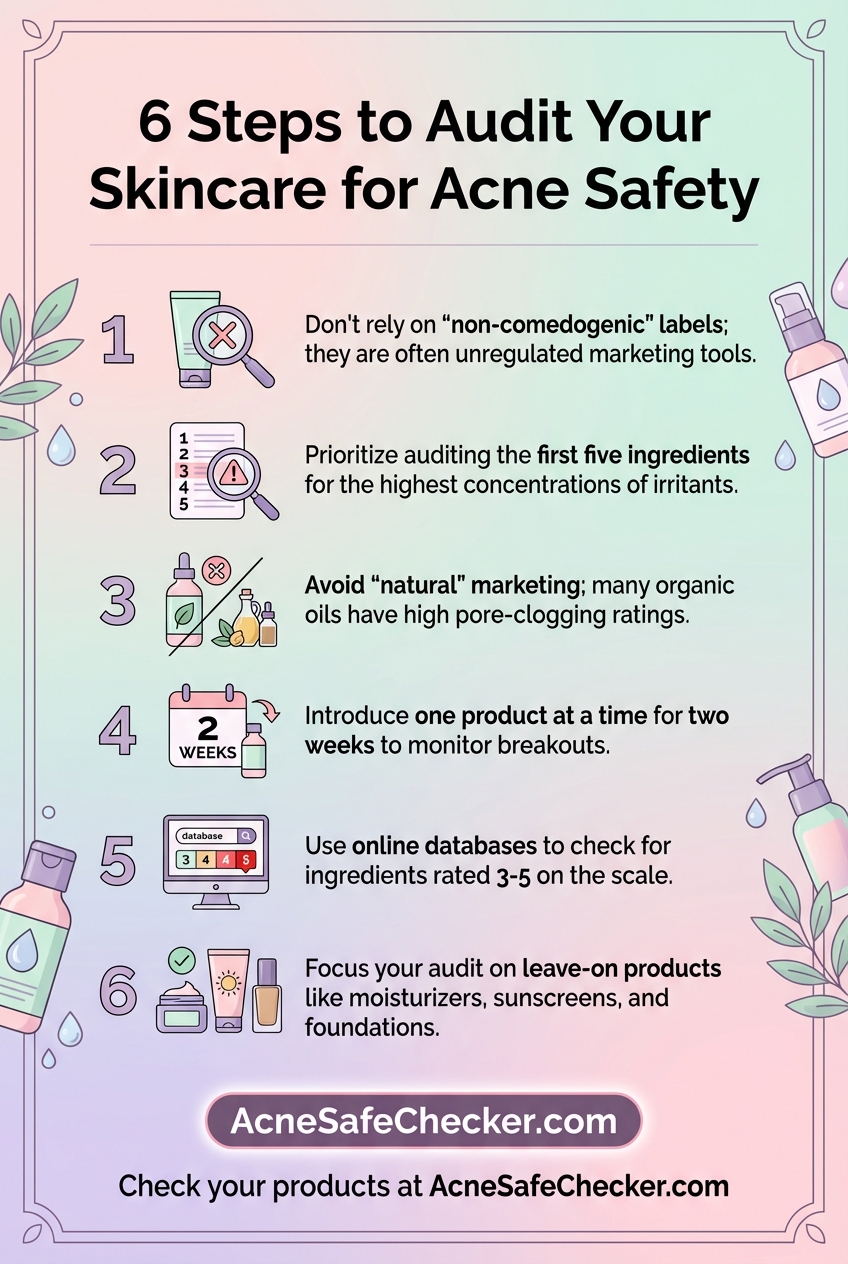
Check Ingredients NowAs a dermatologist, I see this daily. The reality is that the term "non-comedogenic" is not strictly regulated by the FDA, meaning brands can often use it as a marketing tool rather than a scientific guarantee. To achieve clear skin, you must move beyond the front of the bottle and learn how to audit the Ingredient Control Identification (INCI) list. This guide will teach you the science of pore-clogging ingredients and how to systematically check your products for acne safety.
Understanding Comedogenicity: The Science of the Clog
At the heart of the "acne-safe" conversation is a concept called comedogenicity. A comedo is the clinical term for a clogged pore—either a blackhead (open comedo) or a whitehead (closed comedo).
How Pores Become Clogged
When we talk about an ingredient being comedogenic, we are describing its tendency to trigger "retention hyperkeratosis." In healthy skin, dead skin cells are shed and pushed out of the follicle by sebum (oil). However, certain ingredients can cause these cells to stick together more than usual. This creates a "plug" that traps oil and bacteria inside the pore, leading to inflammation and, eventually, a visible pimple.
The Comedogenic Scale
Researchers use a scale from 0 to 5 to rate ingredients:
- 0: Will not clog pores
- 1-2: Low probability of clogging pores
- 3: Moderate probability (often the "tipping point" for acne-prone individuals)
- 4-5: High probability of clogging pores
While this scale provides a helpful baseline, it is important to remember that it is based on testing ingredients in their raw, concentrated form. The final formulation of a product matters significantly.
The Red Flags: Common Pore-Clogging Ingredients
If you have acne-prone skin, you should look for these common offenders. While not everyone reacts to these, they are the most frequent culprits behind cosmetic-induced breakouts.
1. Specific Oils and Butters
Contrary to popular belief, not all oils are bad for acne. However, some have high molecular weights that sit heavily on the skin.
- Coconut Oil (Cocos Nucifera Oil): Frequently rated a 4 on the comedogenic scale.
- Cocoa Butter: Highly emollient but notoriously pore-clogging.
- Wheat Germ Oil: One of the few ingredients that hits a 5 on the scale.
2. Synthetic Esters and Fatty Acids
These are often added to give skincare a silky, luxurious feel, but they can be problematic for the acne-prone.
- Isopropyl Myristate and Isopropyl Palmitate: These are excellent for texture but are highly comedogenic and can penetrate the pore easily.
- Acetylated Lanolin: A derivative of wool fat that is a common trigger for cystic acne.
3. Certain Algae and Marine Extracts
While marketed as "detoxifying," some algae extracts (like Red Algae) are high in iodides, which can irritate the follicle and trigger breakouts when used in leave-on products.
Practical Steps to Check Your Products
Auditing your vanity doesn’t have to be overwhelming. Follow these steps to ensure your routine is truly acne-safe.
Step 1: Read the First Five Ingredients
In skincare labeling, ingredients are listed in descending order of concentration. If a potentially comedogenic ingredient like Isopropyl Myristate is in the first five slots, it is much more likely to cause an issue than if it is at the very bottom of the list.
Step 2: Use Online Ingredient Analyzers
You don't need to memorize every chemical name. Several reputable databases allow you to copy and paste an ingredient list to check for comedogenic ratings. Look for tools that provide citations or clear definitions of why an ingredient is flagged.
Step 3: Beware of "Natural" Marketing
Many consumers assume "natural" or "organic" means safer for acne. In reality, many natural ingredients (like Marula Oil or certain essential oils) can be more reactive than synthetic, medical-grade silicones. Focus on the chemistry of the ingredient rather than the origin.
Step 4: The 2-Week Trial
When starting a new product, introduce only one at a time. It takes about two weeks for a comedo to form and reach the surface of the skin. If you start three new products at once and break out, you won’t know which one is the culprit.
Formulations vs. Single Ingredients
It is vital to provide a small caveat: the "dose makes the poison." An ingredient that is comedogenic at 100% concentration might be perfectly safe at 1% in a well-formulated cleanser that you rinse off.
If you find a product you love that contains a "yellow-flag" ingredient, observe your skin. If your skin is clear, the formulation is likely working for you. However, if you are struggling with persistent "under-the-skin" bumps or texture, your ingredients are the first place you should look.
Conclusion: Empower Your Skincare Routine
Achieving clear skin is often as much about what you don't put on your face as what you do. By learning to check ingredients for acne safety, you transition from being a passive consumer to an informed advocate for your skin health.
Start by checking your heaviest products—moisturizers, sunscreens, and liquid foundations—as these stay on the skin the longest. With a little bit of diligence and a scientific approach to your INCI lists, you can build a routine that supports a clear, radiant complexion without the fear of unexpected breakouts.