
The Hidden Culprits in Your Beauty Cabinet
Is Your Routine Acne-Safe?
Do not guess. Instantly check your products for pore-clogging ingredients with our AI-powered tool.
Check Ingredients NowThere is nothing more frustrating than investing in a high-end moisturizer or a viral foundation only to wake up forty-eight hours later with a cluster of painful breakouts. As a dermatologist, I see this daily: patients who are doing "everything right" with their routine, yet their skin remains congested.
Often, the culprit isn't your hormones or your diet—it’s a specific ingredient lurking in your skincare products that is physically blocking your pores. This is where a comedogenic ingredient analyzer becomes an essential tool in your skincare arsenal. These free digital resources allow you to cross-reference product labels against known pore-cloggers, helping you make informed decisions before you spend a dime.
What Does "Comedogenic" Actually Mean?
In dermatology, a "comedo" is the clinical term for a clogged pore. A blackhead is an open comedo, while a whitehead is a closed comedo. Therefore, a comedogenic ingredient is a substance that has a high probability of triggering the formation of these blockages.
When you apply a product, the ingredients interact with your skin’s natural sebum and dead skin cells. Some ingredients are molecularly too large or too "sticky," causing them to get trapped within the follicular opening. Over time, this debris hardens, bacteria proliferate, and an acne lesion is born.
The Science of the Comedogenic Scale
Most free ingredient analyzers are based on the Comedogenic Scale, a ranking system from 0 to 5 that assesses the likelihood of an ingredient causing a breakout:
- 0: Will not clog pores
- 1: Very low probability of clogging pores
- 2: Moderately low probability
- 3: Moderate probability (the "tipping point" for acne-prone individuals)
- 4: Fairly high probability
- 5: High probability of clogging pores
The Historical Context
It is important to understand that these ratings often stem from historical studies performed on rabbit ear tissue. While modern science has evolved, these benchmarks remain a gold standard for identifying potential irritants. However, a "5" on the scale doesn't guarantee a breakout for everyone—human skin is complex, and your unique skin chemistry plays a significant role.
Why "Non-Comedogenic" Labels Can Be Misleading
You might be wondering: "Why do I need an analyzer if my bottle says 'Non-Comedogenic' on the front?"
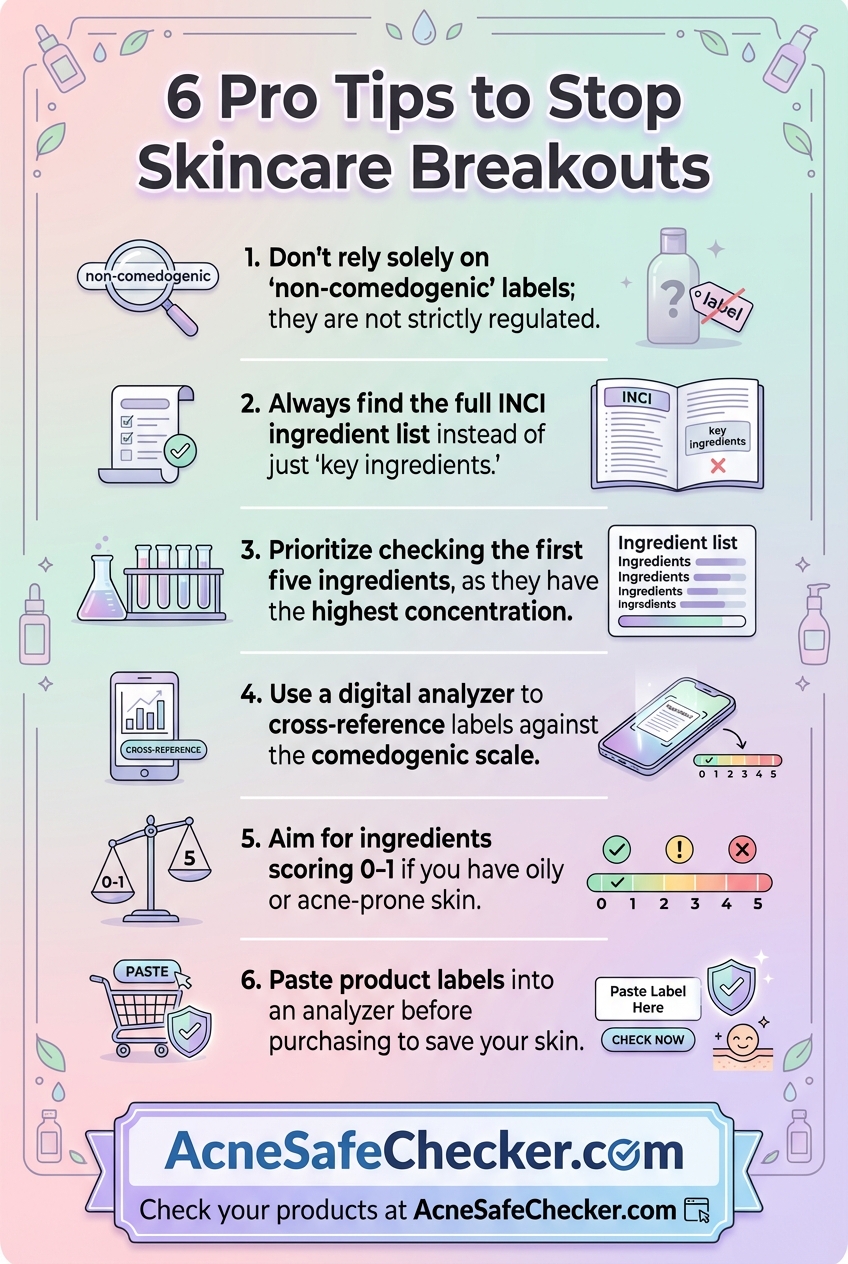
As a specialist, this is one of the most important lessons I teach: The term "non-comedogenic" is not strictly regulated by the FDA. A brand can claim a product is non-pore-clogging without undergoing rigorous third-party testing. Furthermore, a product may contain individual ingredients that are highly comedogenic, but the brand argues that the final formulation is safe. For those with highly reactive or acne-prone skin, relying solely on marketing claims is a risky gamble.
Common Red-Flag Ingredients to Look For
When you run your product through a free comedogenic ingredient analyzer, keep an eye out for these frequent offenders:
- Coconut Oil (Cocos Nucifera Oil): While great for hair and body, it is a 4 on the scale and a common cause of cystic acne on the face.
- Isopropyl Myristate & Palmitate: These are fatty acid esters often used to give products a silky feel, but they are notorious for penetrating the pores and causing blockages.
- Algae Extract: Frequently found in "natural" or "luxury" skincare, certain types are highly comedogenic due to their high mineral and salt content.
- Lanolin: A wax secreted by the sebaceous glands of wool-bearing animals. While hydrating, it is often too heavy for acne-prone skin types.
- Potassium Chloride: Often used as a thickener, this inorganic salt can be highly irritating to the follicle.
How to Use a Free Ingredient Analyzer Effectively
Using these tools is straightforward, but there is a "professional" way to interpret the results:
Step 1: Find the INCI List
Locate the full ingredient list (often called the INCI list) on the back of the packaging or the brand's website. Do not just look at the "Key Ingredients" section, as this usually only highlights the beneficial actives.
Step 2: Copy and Paste
Simply copy the entire text block and paste it into a reputable free analyzer. These tools will instantly scan the database and highlight ingredients with a score of 3 or higher.
Step 3: Analyze the Concentration
Ingredients are listed in descending order of concentration. If a comedogenic ingredient (like Ethylhexyl Palmitate) is one of the first five ingredients, it is much more likely to cause issues than if it appears at the very end of the list (usually less than 1% concentration).
Step 4: Cross-Reference with Your Skin Type
If you have dry skin, you might tolerate a level 2 or 3 ingredient well. However, if you have oily or Grade II acne-prone skin, you should strictly aim for products where every ingredient scores a 0 or 1.
The Limitations: Formulas vs. Ingredients
While a free analyzer is a powerful preventative tool, it isn't a crystal ball. Skincare chemistry is about synergy. Sometimes, a potentially comedogenic ingredient is used in such a small amount, or paired with ingredients that promote cell turnover (like salicylic acid), that the overall effect is neutralized. Conversely, a product with all "0" ratings might still cause a breakout if it contains high levels of fragrance or essential oils that trigger inflammatory responses.
Conclusion: Empowerment Through Information
Achieving clear skin is often a process of elimination. By using a free comedogenic ingredient analyzer, you take the guesswork out of your beauty routine. You move from being a frustrated consumer to an empowered advocate for your own skin health.
Next time you're tempted by a new product, take sixty seconds to scan the label. Your pores will thank you. If you find that you are using "pore-safe" products but still struggling with persistent acne, it is time to consult with a board-certified dermatologist to explore underlying hormonal or inflammatory factors.