
Introduction: The Frustration of the New Product ‘Glow-Down’
Is Your Routine Acne-Safe?
Do not guess. Instantly check your products for pore-clogging ingredients with our AI-powered tool.
Check Ingredients NowWe have all been there: you spend weeks researching the perfect serum or moisturizer, wait for it to arrive, and incorporate it into your routine with high hopes of achieving a radiant complexion. Fast forward three days, and you are staring at a fresh crop of blemishes in the mirror.
Determining whether a product is helping your skin or actively harming it is one of the most common challenges in dermatology. Is your skin simply ‘purging’ toxins, or is the formula fundamentally incompatible with your pores? As a dermatologist, I see this confusion daily. Understanding the physiological difference between a temporary reaction and a full-blown breakout is essential for maintaining your skin barrier and achieving long-term clarity.
The Great Debate: Skin Purging vs. Breaking Out
Before you toss your expensive new cream in the trash, you need to understand the concept of skin purging.
What is Skin Purging?
Purging occurs when you use active ingredients that increase skin cell turnover. Common culprits include Retinoids (Tretinoin, Retinol), Alpha Hydroxy Acids (AHAs like Glycolic or Lactic acid), and Beta Hydroxy Acids (Salicylic acid).
Scientifically, these ingredients speed up the rate at which your skin sheds dead cells. If you have underlying microcomedones (clogged pores that aren't visible yet), the accelerated turnover brings them to the surface much faster than usual. This results in a temporary flare-up of acne. The key here is that these spots were already forming; the product just sped up the process.
What is a Product-Induced Breakout?
A true breakout (clinically referred to as acne cosmetica) happens when a product contains ingredients that physically clog the pore (comedogenicity) or cause irritation that leads to inflammation. Unlike purging, this is not a 'necessary' phase. It is a sign that the product is either too heavy, too irritating, or chemically unsuitable for your skin type.
4 Ways to Identify if a Product is Breaking You Out
If you aren’t sure which category your skin falls into, look for these specific red flags.
1. Location, Location, Location
One of the most reliable indicators is where the acne appears.
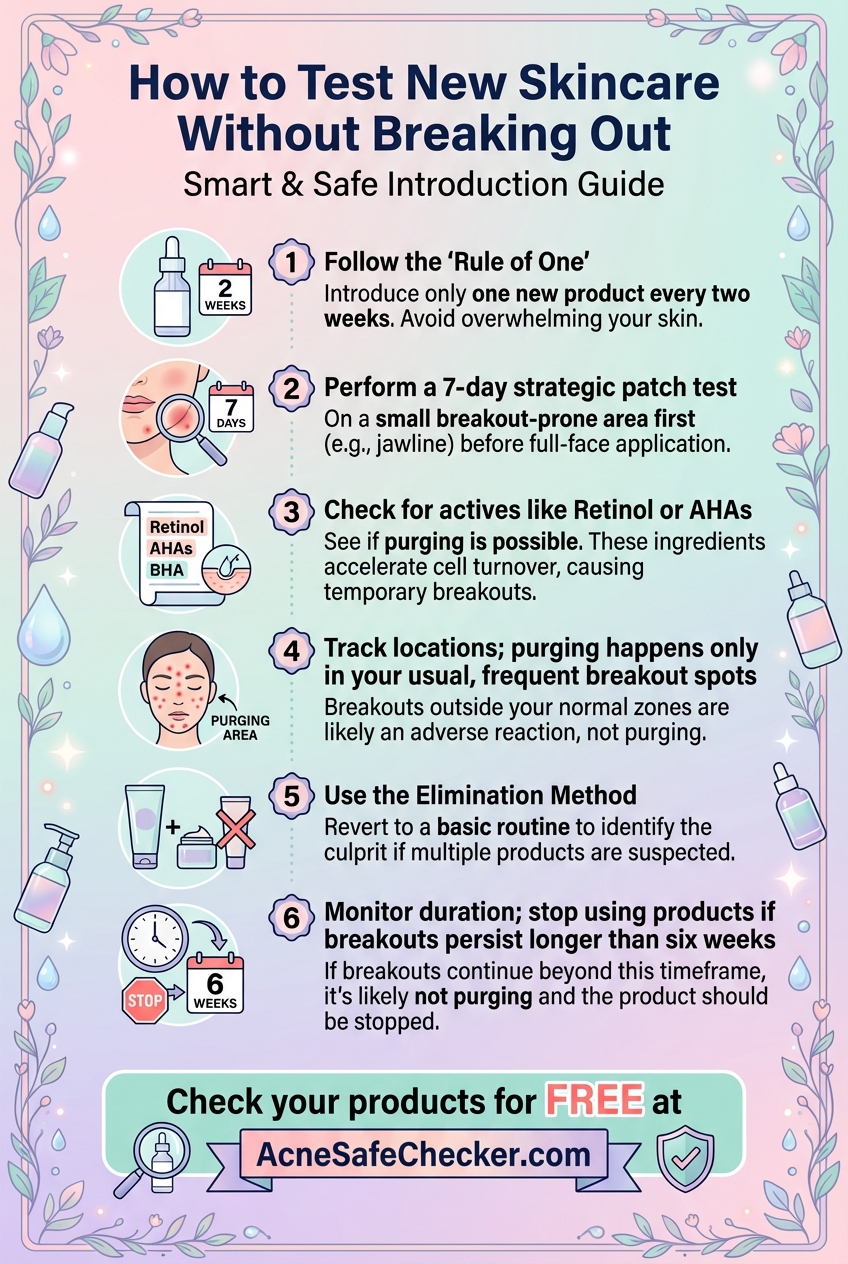
- Purging: Usually occurs in areas where you frequently break out. If you always get blackheads on your chin, a purge will manifest there.
- Breaking Out: If you suddenly have clusters of whiteheads or cystic bumps in areas where your skin is usually clear (like your forehead or cheeks), the product is likely the culprit.
2. The Type of Acne
Pay attention to the morphology of the lesions. Purging typically looks like small inflammatory bumps or whiteheads that disappear relatively quickly. If you are experiencing deep, painful cysts or a rash-like texture that feels itchy or hot, this is more likely a reaction or a breakout caused by ingredient sensitivity.
3. Duration of the Flare-up
A 'purge' follows the natural skin cycle, which is roughly 28 days. While it can be discouraging, a purge should begin to subside after 4 to 6 weeks as your skin adjusts. If your skin is still breaking out or getting worse after the 6-week mark, it is no longer a purge; it is a persistent breakout caused by the product.
4. Check the Ingredient List
If you are using a simple hydrating moisturizer or a basic sunscreen—products with no active exfoliating ingredients—your skin cannot 'purge.' Only actives can cause a purge. If a basic moisturizer is causing bumps, it is simply breaking you out.
Common Culprits: Ingredients That Clog Pores
While every individual’s skin chemistry is unique, certain ingredients are known as 'high-risk' for acne-prone individuals. These are often rated on a comedogenic scale (0–5). Look out for:
- Coconut Oil (Cocos Nucifera): Highly comedogenic and often used in 'natural' skincare.
- Isopropyl Myristate: A common emollient that can trigger deep clogs.
- D&C Red Dyes: Often found in blushes and bronzers; some are highly comedogenic.
- Silicones: While not technically comedogenic for everyone, heavy silicones (like Dimethicone) can trap sweat and bacteria against the skin in some individuals.
The Dermatologist’s Strategy: How to Test New Products Safely
To avoid a total skin disaster, I recommend the 'Rule of One' and the 'Patch Test' methods.
The Rule of One
Never introduce more than one new product into your routine at a time. Wait at least two weeks between new additions. If you start a new cleanser, toner, and serum on the same night and wake up with a pimple, you will have no way of knowing which one caused it.
The Strategic Patch Test
Rather than applying a new product to your entire face, choose a small 'test zone' for one week. Pick an area that is prone to breakouts (like a small patch on the jawline). If the area remains clear after 7 days of daily use, you can safely expand to the rest of your face.
The Elimination Method
If you suspect a product is currently breaking you out, stop using it immediately. Go back to a 'safe' baseline routine (cleanser, moisturizer, SPF) for two weeks. Once your skin has calmed down, you can re-introduce the suspect product. If the breakouts return within 48 to 72 hours, you have found your answer.
Conclusion: Listening to Your Skin
Skincare is not one-size-fits-all. A 'cult favorite' moisturizer might work wonders for your friend but wreak havoc on your sebum production. The most important thing you can do is be patient and observant.
If a product causes persistent inflammation, pain, or breakouts in new areas, don't try to 'push through it.' Your skin barrier is your first line of defense; listen to it when it tells you a formula isn't the right fit. When in doubt, consult a board-certified dermatologist who can help you identify your specific triggers and curate a non-comedogenic routine tailored to your unique skin profile.