
Understanding Fungal Acne: It’s Not Actually Acne
Is Your Routine Acne-Safe?
Do not guess. Instantly check your products for pore-clogging ingredients with our AI-powered tool.
Check Ingredients NowIf you have been struggling with small, itchy, uniform bumps on your forehead, chest, or back that simply won’t budge with traditional acne treatments like salicylic acid or benzoyl peroxide, you might not be dealing with acne at all. Instead, you could be experiencing Malassezia folliculitis, more commonly known as fungal acne.
As a dermatologist, I see many patients frustrated by persistent breakouts that seem to worsen despite a rigorous skincare routine. The culprit is often hidden in plain sight: the very ingredients in your moisturizers, cleansers, and sunscreens might be “feeding” the yeast on your skin. To clear your complexion, you must first understand the relationship between specific cosmetic ingredients and fungal growth.
The Science: Why Certain Ingredients Trigger Fungal Acne
Fungal acne is caused by an overgrowth of Malassezia, a genus of yeast that lives naturally on everyone’s skin. Under normal conditions, it is harmless. However, when the skin’s microbiome is imbalanced—due to humidity, sweat, or specific topical products—this yeast can multiply rapidly within the hair follicles, leading to inflammation and those characteristic small bumps.
Unlike the bacteria that cause inflammatory acne (P. acnes), Malassezia is lipophilic, meaning it "loves fat." Specifically, it feeds on fatty acids with carbon chain lengths ranging from 12 to 24. When you apply skincare products containing these specific lipids, you are essentially providing a feast for the yeast, allowing it to thrive and colonize your pores.
The "No" List: Common Ingredients to Avoid
Identifying fungal acne triggers requires a keen eye for ingredient labels. Here are the primary categories of ingredients that typically exacerbate the condition.
1. Fatty Acids
Fatty acids are the most direct fuel for Malassezia. Any ingredient with a carbon chain length between C12 and C24 should be avoided if you are prone to fungal acne. Common examples include:
- Lauric Acid (C12)
- Myristic Acid (C14)
- Palmitic Acid (C16)
- Stearic Acid (C18)
- Oleic Acid (C18)
- Linoleic Acid (C18)
2. Most Natural Oils and Butters
While many natural oils are celebrated for their moisturizing properties, the majority of them are rich in the fatty acids mentioned above. Coconut oil, for instance, is roughly 50% lauric acid, making it one of the most significant triggers for fungal acne. Other oils to avoid include:
- Shea Butter
- Cocoa Butter
- Sweet Almond Oil
- Avocado Oil
- Olive Oil
- Rosehip Oil
3. Fatty Acid Esters
Esters are a combination of an alcohol and a fatty acid. They are used in skincare as emollients or thickeners. You can often spot them by their suffixes (usually ending in “-ate”). Avoid ingredients such as:
- Isopropyl Myristate
- Isopropyl Palmitate
- Glyceryl Stearate
- Ethylhexyl Palmitate
4. Polysorbates and Fermented Ingredients
Polysorbates (like Polysorbate 20, 40, 60, and 80) are emulsifiers that contain fatty acids and are known to support fungal growth. Additionally, fermented ingredients—while popular in K-Beauty for their brightening effects—can be problematic. Ingredients like Galactomyces or Saccharomyces are types of fungi themselves or products of fermentation that can cross-react or provide a hospitable environment for Malassezia.
Safe Alternatives: What You Can Use Instead
It can be discouraging to realize how many products contain triggers, but there are plenty of fungal acne-safe alternatives that provide hydration and protection without feeding the yeast.
- Squalane Oil: Not to be confused with squalene, pure Squalane is a saturated oil that is generally safe because its carbon chain length (C30) falls outside the range that Malassezia can metabolize.
- Caprylic/Capric Triglycerides: Also known as MCT (Medium Chain Triglyceride) oil (specifically the C8 and C10 varieties), this is a lightweight emollient that does not trigger fungal acne.
- Mineral Oil and Petrolatum: These are hydrocarbons, not fatty acids. While some find them heavy, they are chemically "invisible" to the yeast.
- Glycerin and Hyaluronic Acid: These humectants are excellent for drawing moisture into the skin without providing a lipid source for fungi.
Practical Steps for Managing Fungal Acne
If you suspect your skincare routine is the problem, follow these steps to reset your skin:
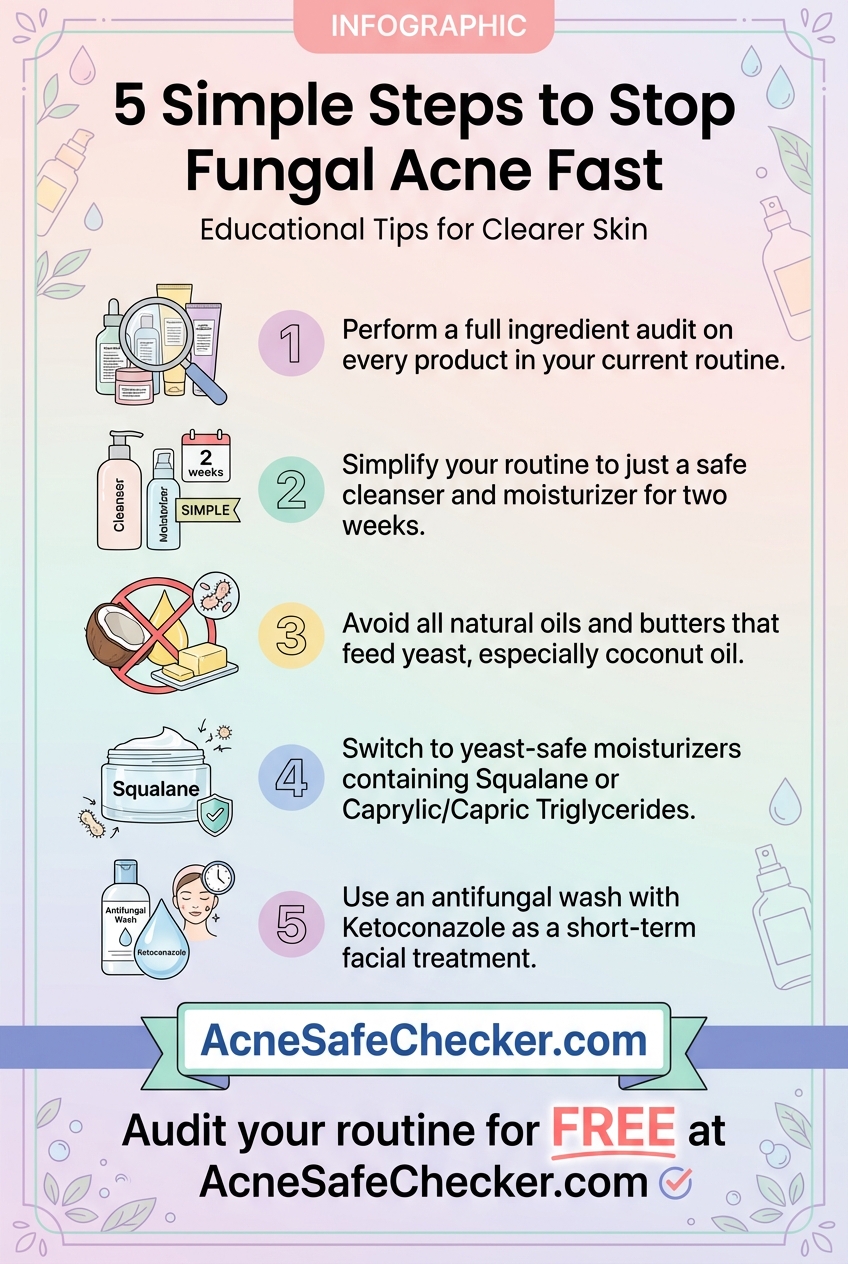
- The Ingredient Audit: Go through every product in your routine—cleanser, toner, serum, moisturizer, and makeup. Use an online ingredient checker specifically designed for fungal acne to identify hidden triggers.
- Simplify Your Routine: Strip back to a "safe" cleanser and moisturizer for at least two weeks. This allows the skin barrier to stabilize and the yeast population to decrease.
- Introduce Antifungals: Over-the-counter treatments like Ketoconazole (often found in dandruff shampoos) can be used as a short-term face wash. Apply it to the affected areas, let it sit for 3–5 minutes, and rinse thoroughly.
- Consult a Professional: If your skin doesn't improve with an ingredient-safe routine, visit a dermatologist. We can perform a skin scraping (KOH test) to confirm the presence of yeast and prescribe oral or topical antifungal medications.
Conclusion
Fungal acne is a frustrating condition, primarily because many of the most popular and "healthy" skincare ingredients—like coconut oil and fermented ferments—are its primary fuel sources. By learning to read labels and prioritizing ingredients like squalane and MCT oil, you can starve the yeast and restore your skin’s balance. Remember, patience is key; once you stop feeding the Malassezia, your skin often begins to clear remarkably fast. Stay consistent, stay informed, and your clear skin will follow.