
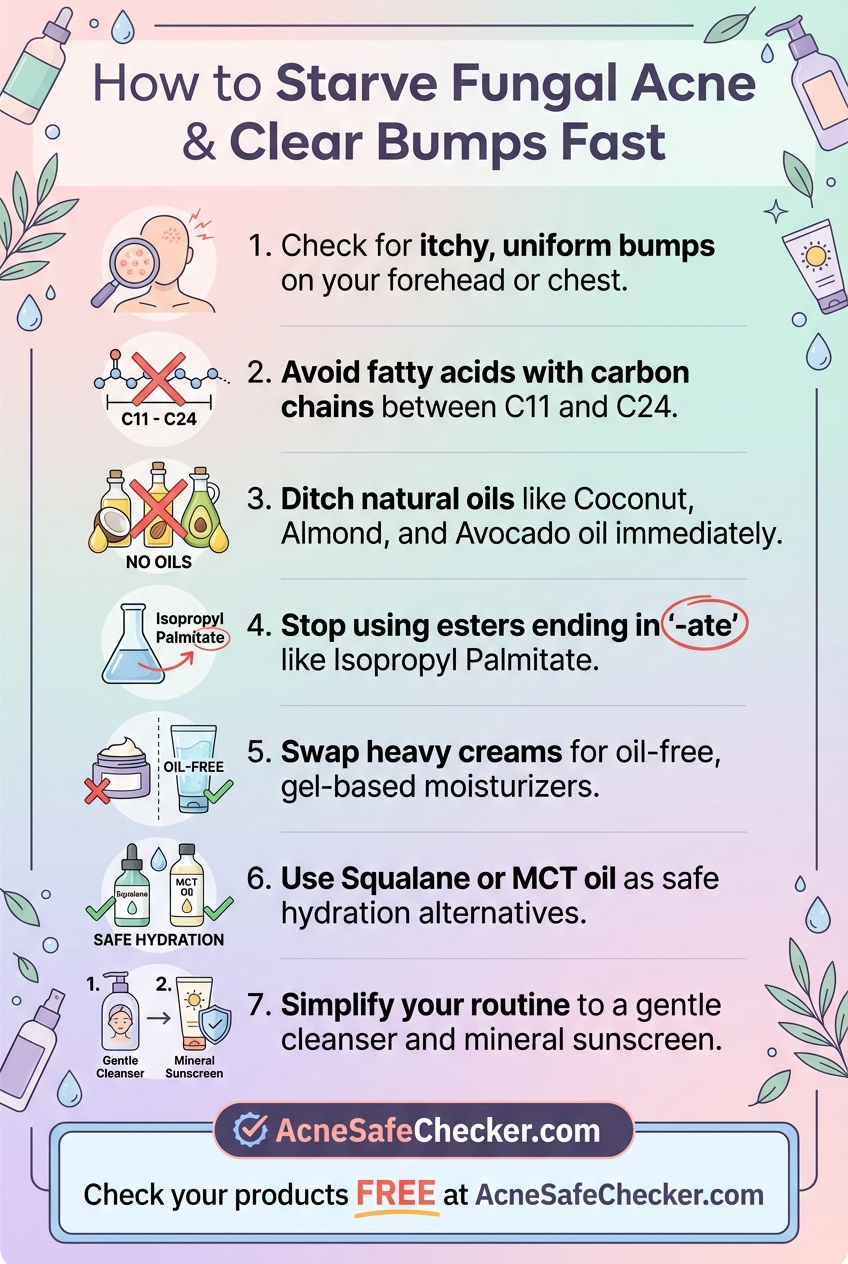
If you have been battling stubborn, itchy, uniform bumps on your forehead, chest, or back that refuse to respond to traditional acne treatments like benzoyl peroxide or salicylic acid, you might not be dealing with acne at all. Instead, you could be facing Malassezia folliculitis—commonly known as "fungal acne."
Is Your Routine Acne-Safe?
Do not guess. Instantly check your products for pore-clogging ingredients with our AI-powered tool.
Check Ingredients NowAs a dermatologist, I often see patients who inadvertently worsen their skin condition by using products they believe are healing their skin. The hard truth is that fungal acne is triggered by a yeast that literally "feeds" on many common skincare ingredients. To clear your skin, you must starve the yeast. This guide will detail exactly which ingredients to avoid and the science behind why they are problematic.
Understanding the Enemy: What is Fungal Acne?
Fungal acne is not true acne (acne vulgaris). While traditional acne is caused by bacteria (C. acnes) trapped in pores, fungal acne is an infection of the hair follicles caused by an overgrowth of Malassezia yeast.
Malassezia is a normal part of the skin’s microbiome. However, when the environment is right—hot, humid, and oily—it multiplies rapidly. This yeast produces enzymes called lipases that break down the oils on your skin into fatty acids. If you apply skincare products containing specific lipids, you are essentially providing an all-you-can-eat buffet for the yeast, leading to inflammation and those characteristic itchy bumps.
The "Lipid Rule": Why Chain Length Matters
Scientific research has shown that Malassezia thrives on fatty acids with carbon chain lengths between C11 and C24. If an ingredient falls within this range, it can fuel the growth of the yeast. This is the most critical concept to understand when scanning ingredient labels.
1. Fatty Acids to Avoid
Fatty acids are the primary food source for fungal acne. Even if a product claims to be "organic" or "natural," it can still be highly problematic. Avoid the following:
- Lauric Acid (C12)
- Myristic Acid (C14)
- Palmitic Acid (C16)
- Stearic Acid (C18)
- Oleic Acid (C18)
- Linoleic Acid (C18)
2. Oils and Butters
Most vegetable and seed oils are composed of the fatty acids listed above. If you have fungal acne, you must be extremely cautious with oils. Avoid:
- Coconut Oil: High in Lauric acid, it is a major trigger.
- Sweet Almond Oil
- Avocado Oil
- Shea Butter and Cocoa Butter
- Olive Oil
- Rosehip Oil
3. Esters (The "-ates")
Esters are combinations of a fatty acid and an alcohol or glycerin. They are used as emollients and thickeners. You can usually spot them by their suffix "-ate." Common culprits include:
- Isopropyl Palmitate
- Isopropyl Myristate
- Glyceryl Stearate
- Ethylhexyl Palmitate
- Decyl Oleate
4. Polysorbates and Fermented Ingredients
While often used as emulsifiers, Polysorbates (like Polysorbate 20, 40, 60, and 80) contain fatty acids that Malassezia can consume. Additionally, some fermented ingredients like Galactomyces ferment filtrate can exacerbate fungal acne in certain individuals by providing nutrients that support yeast growth.
Practical Steps: How to Audit Your Routine
Transitioning to a fungal acne-safe routine can feel overwhelming, but it is the most effective way to see results. Follow these steps to clear your complexion:
Use an Ingredient Checker
Instead of memorizing every chemical name, use online databases. You can copy and paste your product’s ingredient list into "Fungal Acne Checkers" like Sezia or Folliculitis Scout. These tools cross-reference ingredients against known triggers.
Look for Safe Alternatives
While many oils are forbidden, there are a few exceptions that do not feed the yeast:
- Squalane Oil: Specifically, 100% sugarcane-derived squalane. Unlike squalene, squalane is a saturated oil that the yeast cannot break down.
- Caprylic/Capric Triglycerides (MCT Oil): These are medium-chain triglycerides (C8 and C10). Because they fall below the C11 threshold, they are generally considered safe.
- Mineral Oil and Petrolatum: These are hydrocarbons, not fatty acids, making them safe for fungal acne sufferers (though they can be heavy for oily skin types).
Simplify Your Routine
When dealing with a flare-up, less is more. Stick to a gentle, oil-free cleanser, a Malassezia-safe moisturizer (often gel-based), and a mineral sunscreen. If you need treatment, look for products containing Ketoconazole (found in anti-dandruff shampoos used as a face wash), Sulfur, or Azelaic Acid, all of which have anti-fungal properties.
Conclusion: Patience is Key
Fungal acne is frustrating because it mimics traditional acne but requires the exact opposite treatment strategy. By eliminating these 15+ triggers and focusing on a "yeast-safe" diet for your skin, you should begin to see the bumps flatten and the itching subside within 2 to 4 weeks.
Remember, your skin's microbiome is a delicate ecosystem. If your condition persists despite changing your ingredients, consult a board-certified dermatologist for a formal diagnosis and a prescription-strength treatment plan. You don't have to fight this battle alone.