
You have likely been there: you invest in a new, luxurious moisturizer or a highly-rated foundation, hoping for a glowing complexion, only to find a cluster of new breakouts a few days later. When your skin reacts poorly to a product, the culprit is often hidden deep within the ingredient list.
Is Your Routine Acne-Safe?
Do not guess. Instantly check your products for pore-clogging ingredients with our AI-powered tool.
Check Ingredients NowOne of the most frequent offenders in the world of skincare-induced acne is Isopropyl Palmitate. While it provides a silky texture and immediate softening effects, its reputation among dermatologists is complicated—especially for those with acne-prone skin. In this guide, we will dive into the science of Isopropyl Palmitate, why its comedogenic rating is a red flag, and how to navigate your skincare routine without clogging your pores.
What is Isopropyl Palmitate?
Isopropyl Palmitate (IPP) is an ester of isopropyl alcohol and palmitic acid (a fatty acid found naturally in plants and animals). In the cosmetic industry, it is prized as a highly effective emollient, thickening agent, and lubricant.
From a formulation standpoint, IPP is a dream. It helps products spread easily across the skin, leaves a smooth, non-greasy finish, and can help other active ingredients penetrate the skin barrier. You will frequently find it in:
- Night creams and moisturizers
- Liquid foundations and concealers
- Sunscreen lotions
- Hair conditioners and styling products
- Aftershave balms
The Comedogenic Scale: Why a '4' is a Warning Sign
To understand if Isopropyl Palmitate is "bad" for acne, we have to look at the comedogenic scale. This scale ranks ingredients from 0 to 5 based on their likelihood of clogging pores:
- 0: Will not clog pores
- 1: Very low probability of clogging pores
- 2: Moderately low probability
- 3: Moderate probability
- 4: High probability of clogging pores
- 5: Extremely high probability
Isopropyl Palmitate carries a comedogenic rating of 4. For a dermatologist, this is a significant warning. An ingredient with a rating of 4 is considered highly comedogenic, meaning it has a strong tendency to trigger the formation of comedones (blackheads and whiteheads) by blocking the follicular opening.
The Science of Pore Clogging
Acne occurs when sebum (oil) and dead skin cells become trapped in a hair follicle. Isopropyl Palmitate exacerbates this process in two ways. First, its molecular structure allows it to bind effectively with the skin's natural oils, but its thickness can create a "plug" within the pore. Second, because it is an effective penetration enhancer, it can carry other potentially irritating ingredients deeper into the pore, increasing the likelihood of inflammation.
Is It Bad for Everyone?
Not necessarily. Skincare is rarely "one size fits all."
If you have severely dry or compromised skin and are not prone to acne, Isopropyl Palmitate can be a beneficial ingredient. It provides an occlusive layer that prevents trans-epidermal water loss (TEWL), helping to repair a damaged skin barrier.
However, if you have oily, combination, or acne-prone skin, Isopropyl Palmitate is generally considered an ingredient to avoid. For these skin types, the risk of developing "acne cosmetica"—a form of acne caused by topical products—is simply too high.
How to Spot It and What to Do
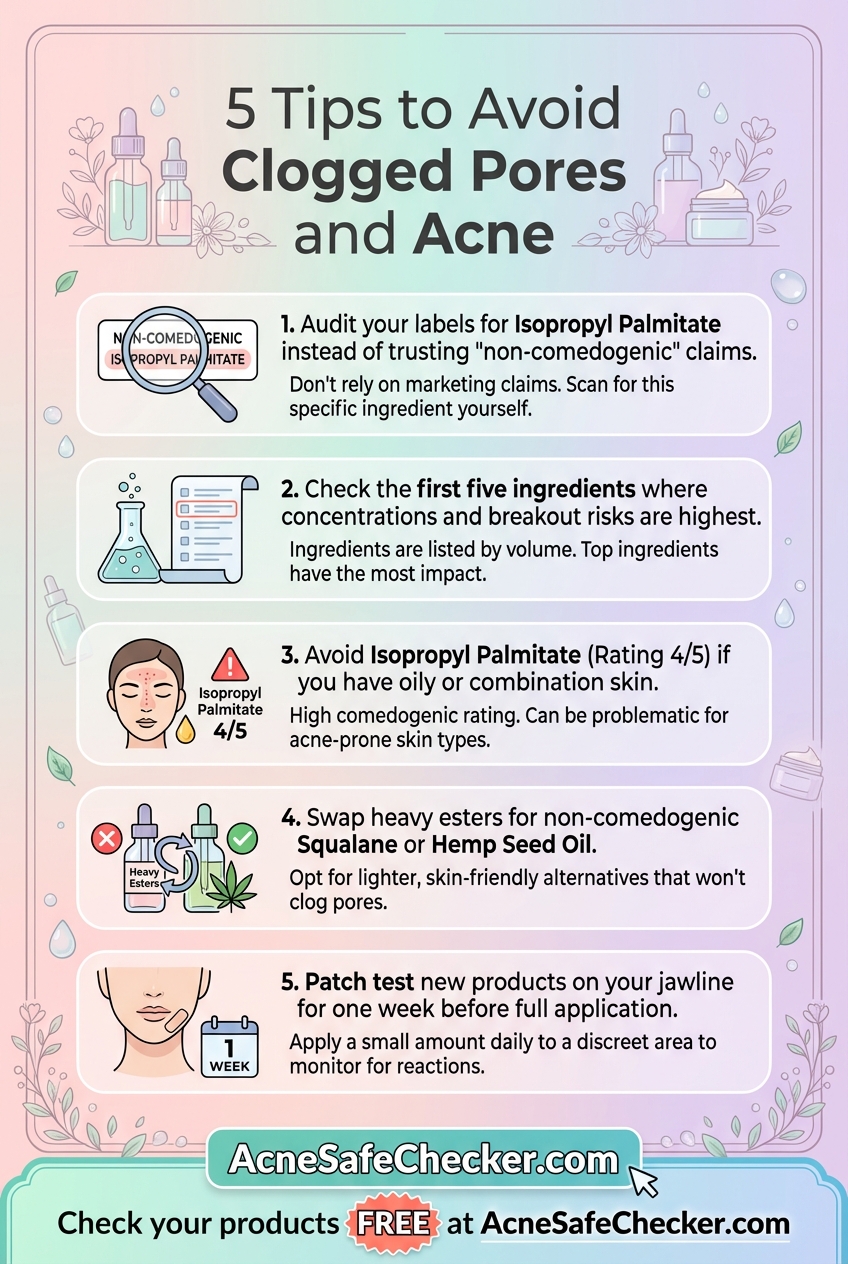
If you suspect your products are causing breakouts, the first step is an ingredient audit.
1. Read the Label
Don't just look for "Non-Comedogenic" on the front of the bottle. This term is not strictly regulated by the FDA, meaning a brand can claim a product won't clog pores even if it contains high-rated ingredients like Isopropyl Palmitate. Look at the full INCI (International Nomenclature of Cosmetic Ingredients) list.
2. Check the Position
Ingredients are listed in order of concentration. If Isopropyl Palmitate is in the first five ingredients, its concentration is high, and its pore-clogging potential is at its peak. If it is at the very end of the list, the risk is lower, though still present for highly sensitive individuals.
3. Look for Safer Alternatives
If you need a moisturizer that provides that same silky feel without the risk, look for ingredients with low comedogenic ratings (0-2), such as:
- Squalane: A lightweight oil that mimics the skin's natural sebum without clogging pores.
- Glycerin: A humectant that hydrates without oiliness.
- Hemp Seed Oil: A non-comedogenic oil (rating of 0) that calms inflammation.
- Caprylic/Capric Triglyceride: Derived from coconut oil but processed to be much less comedogenic than pure coconut oil.
The Dermatologist’s Verdict
As a general rule for acne patients: If you see Isopropyl Palmitate on the label, put the product back on the shelf.
While the ingredient isn't "toxic" or "dangerous," it is a known trigger for many people struggling with clear skin. In the battle against acne, the goal is to reduce unnecessary obstacles. By removing highly comedogenic esters like Isopropyl Palmitate from your routine, you give your skin the breathing room it needs to heal and stay clear.
Conclusion
Managing acne-prone skin requires a proactive approach to ingredient transparency. Isopropyl Palmitate is an excellent emollient for some, but for the acne-prone individual, its high comedogenic rating of 4 makes it a primary suspect for persistent breakouts.
Always prioritize ingredients that support your skin barrier without suffocating your pores. When in doubt, perform a patch test on a small area of your jawline for a week before applying a new product to your entire face. Your pores will thank you.