
Finding the perfect moisturizer can feel like a high-stakes game of trial and error, especially when you are prone to breakouts. You scan labels for the word "non-comedogenic," yet all too often, a product that promises clear skin leads to a frustrating flare-up of whiteheads and congestion.
Is Your Routine Acne-Safe?
Do not guess. Instantly check your products for pore-clogging ingredients with our AI-powered tool.
Check Ingredients NowOne of the most frequent culprits hidden in these formulations is Myristyl Myristate. While it provides a luxurious, velvety feel to creams and lotions, it carries a reputation in the dermatological community as one of the most pore-clogging ingredients on the market. In this guide, we will break down the science behind the Myristyl Myristate comedogenic rating and help you decide if it’s time to purge it from your vanity.
What is Myristyl Myristate?
Myristyl Myristate is a naturally derived ester formed by the combination of myristic acid (a fatty acid) and myristyl alcohol (a fatty alcohol). In the world of cosmetic chemistry, it is classified as an emollient and skin-conditioning agent.
Why Do Brands Use It?
Manufacturers love Myristyl Myristate because of its "sensory profile." It is a solid wax at room temperature but melts instantly upon contact with the warmth of the skin. This creates a specific "glide" that makes a moisturizer feel expensive and easy to spread. It also acts as an opacifying agent, giving thin lotions a thicker, more opaque, and premium appearance.
The Comedogenic Rating: Why a '5' Matters
The comedogenic scale is a tool used by dermatologists and cosmetic scientists to rank how likely an ingredient is to clog pores. The scale ranges from 0 to 5:
- 0: Will not clog pores
- 1: Very low probability of clogging pores
- 2: Moderately low probability
- 3: Moderate probability
- 4: Fairly high probability
- 5: High probability
Myristyl Myristate consistently scores a 5 out of 5 on the comedogenic scale.
This means that in clinical testing (historically the Rabbit Ear Assay and later human patch testing), Myristyl Myristate demonstrated a significant ability to induce the formation of comedones (blackheads and whiteheads). For individuals with oily or acne-prone skin, an ingredient with a rating of 5 is often considered a "red zone" ingredient that should be avoided entirely.
The Science: How It Clogs Your Pores
To understand why Myristyl Myristate is so problematic, we have to look at its chemical structure. As an ester of a fatty acid and a fatty alcohol, it is inherently "heavy."
When applied to the skin, Myristyl Myristate doesn't just sit on the surface; it can penetrate the follicular opening. In people with acne-prone skin, the process of desquamation (shedding dead skin cells) is often already impaired. The heavy, waxy nature of Myristyl Myristate acts like a glue, binding these dead skin cells together inside the pore. This creates a plug, or a microcomedone, which eventually turns into a visible breakout or provides a breeding ground for C. acnes bacteria.
Furthermore, because it is an occlusive emollient, it can trap heat and sebum beneath the skin surface, further exacerbating inflammatory acne in sensitive individuals.
Is It Ever Safe to Use?
You might wonder why an ingredient with a rating of 5 is allowed in skincare at all. The answer lies in skin type and concentration.
- Very Dry Skin: For individuals with extremely dry, alipidic skin (skin that produces almost no oil), Myristyl Myristate can provide much-needed lipid replenishment without causing breakouts.
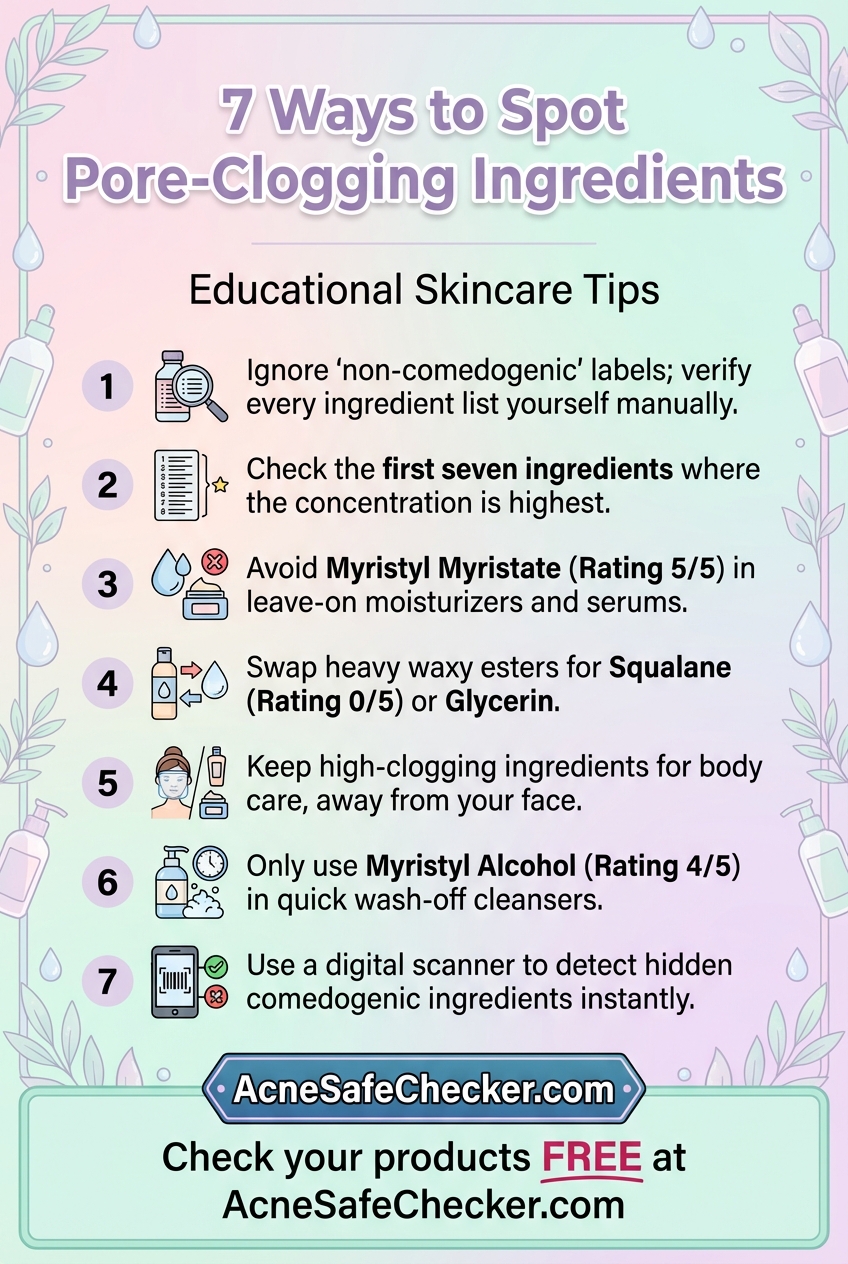
- Wash-off Products: In cleansers that stay on the skin for only 30 seconds, the risk of pore-clogging is significantly lower than in a leave-on night cream.
- Body Care: The skin on your legs and arms has fewer sebaceous glands than your face, chest, and back. Myristyl Myristate is often perfectly fine in a body butter, even for those who break out on their face.
Practical Advice: How to Spot and Avoid It
If you struggle with persistent congestion or adult acne, being a "label detective" is your best defense.
1. Check the Top of the List
Ingredients are listed in order of concentration. If Myristyl Myristate is in the first five to seven ingredients, its concentration is high, and the risk of clogging is at its peak. If it is at the very bottom of the list (below preservatives like Phenoxyethanol), the risk is lower, though still present for highly sensitive individuals.
2. Look for Safer Alternatives
If you want that silky emollient feel without the 5/5 comedogenic risk, look for products containing:
- Squalane: A 0/5 rated oil that mimics human sebum but is non-comedogenic.
- Caprylic/Capric Triglyceride: Derived from coconut oil but processed to be much thinner and less likely to clog pores (usually rated a 2).
- Hemi-Squalane: An even lighter version of squalane perfect for oily skin.
- Glycerin: A humectant that provides moisture without any waxy residue.
3. Do Not Trust the "Non-Comedogenic" Label
Legally, the term "non-comedogenic" is not strictly regulated by the FDA. A brand can label a product as such even if it contains Myristyl Myristate. Always verify the ingredient deck yourself rather than relying on marketing claims.
Conclusion
In the world of dermatology, Myristyl Myristate is a classic example of an ingredient that "feels" good but "acts" poorly for those with acne-prone skin. Its high comedogenic rating of 5 makes it a primary suspect for anyone dealing with unexplained texture and breakouts.
By switching to lighter, more breathable emollients, you can achieve the hydration your skin needs without the unwanted side effect of clogged pores. Remember, your skin's health is determined more by the quality of your ingredients than the luxury of the texture. Be patient, read your labels, and your pores will thank you.