
For many makeup enthusiasts, achieving that perfect, lit-from-within glow is the ultimate goal. From highlighters to shimmering eyeshadows, the secret ingredient behind that radiance is almost always mica. However, if you are someone who battles persistent acne or sensitive skin, every new product feels like a gamble. You might find yourself scouring ingredient labels, wondering if that beautiful shimmer is the hidden culprit behind your latest breakout.
Is Your Routine Acne-Safe?
Do not guess. Instantly check your products for pore-clogging ingredients with our AI-powered tool.
Check Ingredients NowAs a dermatologist, I frequently hear the question: "Is mica in makeup pore clogging?" The answer isn't a simple yes or no, but rather a nuanced look at mineral science, skin irritation, and formulation. Let’s dive into the facts to determine if mica deserves a place in your beauty routine.
What Exactly is Mica?
Mica is a naturally occurring group of silicate minerals that are mined from the earth. Once processed, it is ground into a fine, sparkling powder. Because of its ability to reflect light, it is the primary ingredient used to create "shimmer," "frost," or "glow" in cosmetics. You will find it in everything from foundation and bronzer to toothpaste and body lotions.
In the world of INCI (International Nomenclature Cosmetic Ingredient) lists, it is simply listed as "Mica" or sometimes "CI 77019."
The Scientific Verdict: Is Mica Comedogenic?
In dermatology, we use the "comedogenic scale" to rate how likely an ingredient is to clog pores. This scale ranges from 0 (completely non-comedogenic) to 5 (highly likely to cause blackheads and whiteheads).
Mica carries a comedogenic rating of 0.
Scientifically speaking, mica is chemically inert. This means it does not react with your skin’s sebum, and its particles are generally too large to physically enter and get stuck inside the pore lining in the way that heavy oils or waxes do. If you are looking at mica in isolation, it is not a pore-clogging ingredient.
Why Does Mica Sometimes Cause Breakouts?
If mica isn’t pore-clogging, why do so many people with acne-prone skin report “mica sensitivity”? There are three primary reasons why your shimmering makeup might be causing issues:
1. Micro-Irritation and "Mechanical" Acne
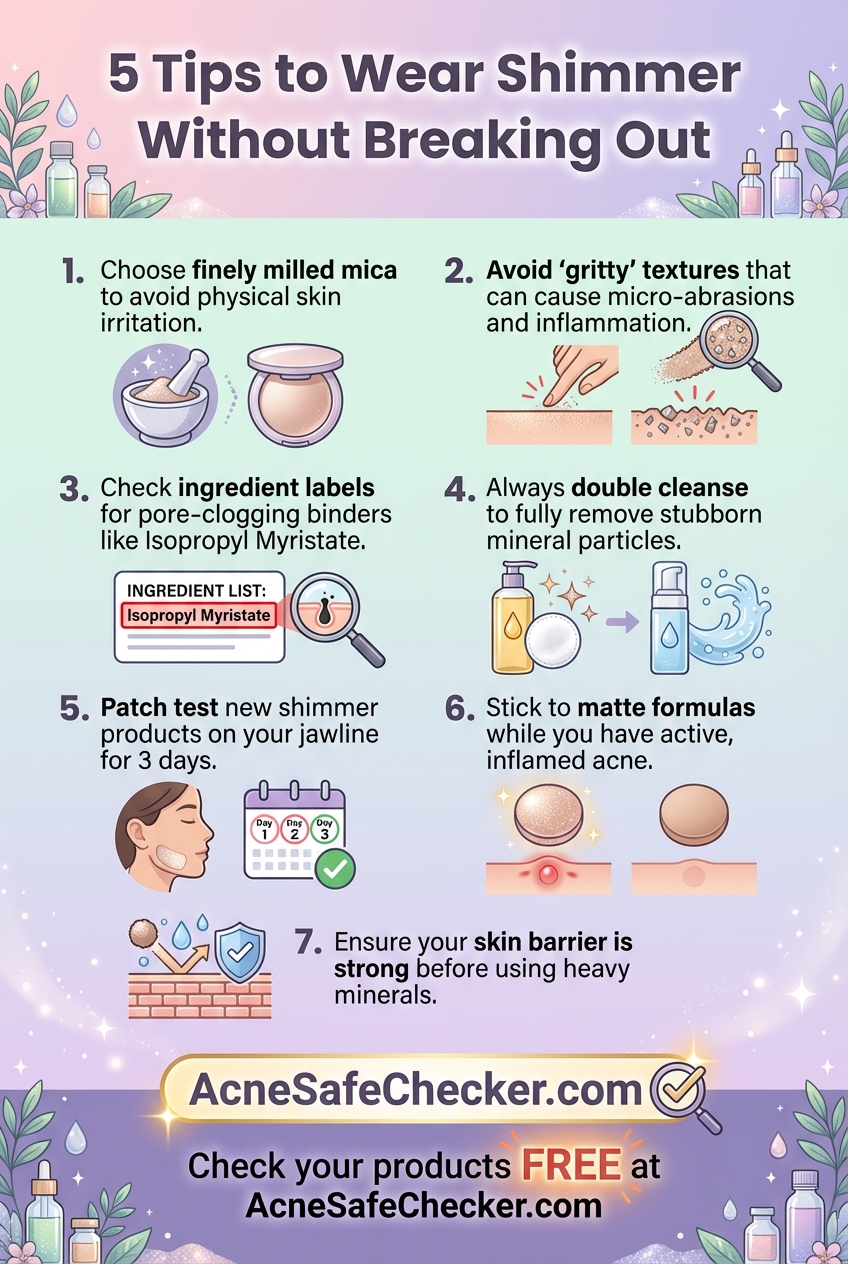
While mica doesn't clog the pore from the inside, its physical structure can be problematic. Under a microscope, mica particles can have jagged, sharp edges. If the mica isn't "finely milled" (ground into an ultra-fine powder), these tiny edges can cause micro-abrasions on the skin's surface. This constant friction leads to inflammation. For someone with acne-prone skin, inflammation is the precursor to a breakout. This is often referred to as acne mechanica—acne caused by physical irritation rather than a chemical blockage.
2. The "Free-Rider" Effect (Co-Ingredients)
Rarely is mica used alone. To make mica stick to your skin and feel creamy, brands often mix it with "binders." These binders frequently include ingredients like ethylhexyl palmitate, coconut oil derivatives, or heavy silicones—many of which are high on the comedogenic scale. If you break out after using a shimmery bronzer, the mica is likely the innocent bystander, while the oily binder is the true offender.
3. Impurities and Heavy Metals
Because mica is a natural mineral mined from the earth, it can sometimes contain trace amounts of heavy metals like lead, arsenic, or mercury if not properly purified. While reputable brands use "cosmetic-grade" mica that has been cleaned, lower-quality products may contain impurities that trigger allergic contact dermatitis, which can look very similar to a cluster of small acne bumps.
How to Safely Use Mica with Acne-Prone Skin
You don't have to give up your glow entirely. If you have sensitive or acne-prone skin, follow these professional guidelines to minimize the risk of irritation:
Look for "Finely Milled" Formulas
Quality matters. High-end, dermatologically tested brands typically use more refined, smaller mica particles. These are less likely to scratch the skin surface. If a product feels "gritty" or "chunky" to the touch, it is more likely to cause micro-irritation.
Check the Binders
Before purchasing, run the ingredient list through a comedogenic checker. Look for the presence of isopropyl myristate, laureth-4, or cocoa butter. If these are near the top of the list alongside mica, the product is likely to clog your pores.
The Importance of the Double Cleanse
Because mica is a mineral, it can be stubborn to remove. If you leave shimmering particles on your skin overnight, they can trap sweat and bacteria against your pores. I recommend a double-cleansing routine: use a micellar water or an oil-based cleanser first to break down the minerals, followed by a gentle, pH-balanced foaming cleanser to wash everything away.
Patch Test Every Time
If you are prone to reactions, apply a small amount of the shimmering product to the side of your jawline for three consecutive days. If you notice redness, itching, or small bumps, the physical texture of that specific mica formulation is likely too harsh for your skin barrier.
Conclusion: The Final Word on Mica
Is mica in makeup pore-clogging? No. By itself, mica is a safe, inert mineral that won't settle into your pores and cause a blockage. However, it is not always "acne-safe" in practice. Due to the potential for physical irritation and the comedogenic ingredients often paired with it, mica can be a trigger for those with a compromised skin barrier.
If you have active, inflamed acne, I suggest opting for matte formulations until your skin has healed. Once your barrier is strong, you can reintroduce finely milled, high-quality mica products, ensuring you cleanse thoroughly at the end of the day. You deserve to glow—just make sure your products are working with your skin, not against it.