
Searching for the root cause of persistent breakouts can feel like an endless game of detective work. You’ve swapped your pillowcases, perfected your double-cleansing routine, and yet, those stubborn comedones—the tiny bumps that turn into full-blown blemishes—keep appearing. Often, the culprit isn't your routine, but a single ingredient hidden in your favorite moisturizer or foundation.
Is Your Routine Acne-Safe?
Do not guess. Instantly check your products for pore-clogging ingredients with our AI-powered tool.
Check Ingredients NowToday, we are putting a spotlight on Oleth-3. If you have acne-prone skin, this is an ingredient you need to know about. In this guide, we will break down the science of Oleth-3, its comedogenicity rating, and why it might be the reason your skin isn't clearing up.
What Exactly is Oleth-3?
Before we dive into its effects on the skin, let’s look at what Oleth-3 actually is. In the world of cosmetic chemistry, Oleth-3 is a synthetic ingredient derived from oleyl alcohol and ethylene oxide. It functions primarily as an emulsifier and a surfactant.
Emulsifiers are the "glue" that keeps oil and water-based ingredients from separating in a bottle. Because of its ability to create smooth, elegant textures, Oleth-3 is frequently found in everything from luxury face creams and hair conditioners to liquid foundations and cleansers.
The Comedogenicity Rating: A Red Flag for Acne
In dermatology, we use a scale from 0 to 5 to measure how likely an ingredient is to clog pores (comedogenicity).
- 0: Will not clog pores
- 1-2: Low risk
- 3: Moderate risk
- 4-5: High risk
Oleth-3 consistently earns a rating of 5.
This means it is among the most comedogenic ingredients used in the beauty industry. For individuals with narrow pores or a genetic predisposition to acne, an ingredient with a rating of 5 is almost a guarantee of follicular blockage.
Why is Oleth-3 So Pore-Clogging?
The reason Oleth-3 is so problematic for acne-prone skin lies in its molecular structure and its origin. It is derived from oleic acid, a fatty acid that is naturally found in various oils. While oleic acid is excellent for dry, compromised skin barriers, it can be a nightmare for those with oily skin.
1. Follicular Retention
Oleth-3 is a "sticky" molecule. It has a high affinity for the sebum (oil) produced by your sebaceous glands. When applied to the skin, it can mix with your natural oils and dead skin cells, creating a thick plug inside the pore. This is the definition of a comedone.
2. Disruption of the Skin’s Oil Balance
Research suggests that acne-prone individuals often have a higher ratio of oleic acid to linoleic acid in their sebum. By adding a concentrated derivative like Oleth-3 to the skin, you are further tipping the scale toward a thick, pore-clogging oil consistency, making it harder for your skin to shed dead cells naturally.
3. Penetration Enhancement
As a surfactant, Oleth-3 can slightly disrupt the skin barrier to help other ingredients penetrate deeper. While this is sometimes intentional, in the case of a highly comedogenic substance, it means the ingredient is getting deep into the follicle where it can do the most damage.
How to Identify Oleth-3 in Your Routine
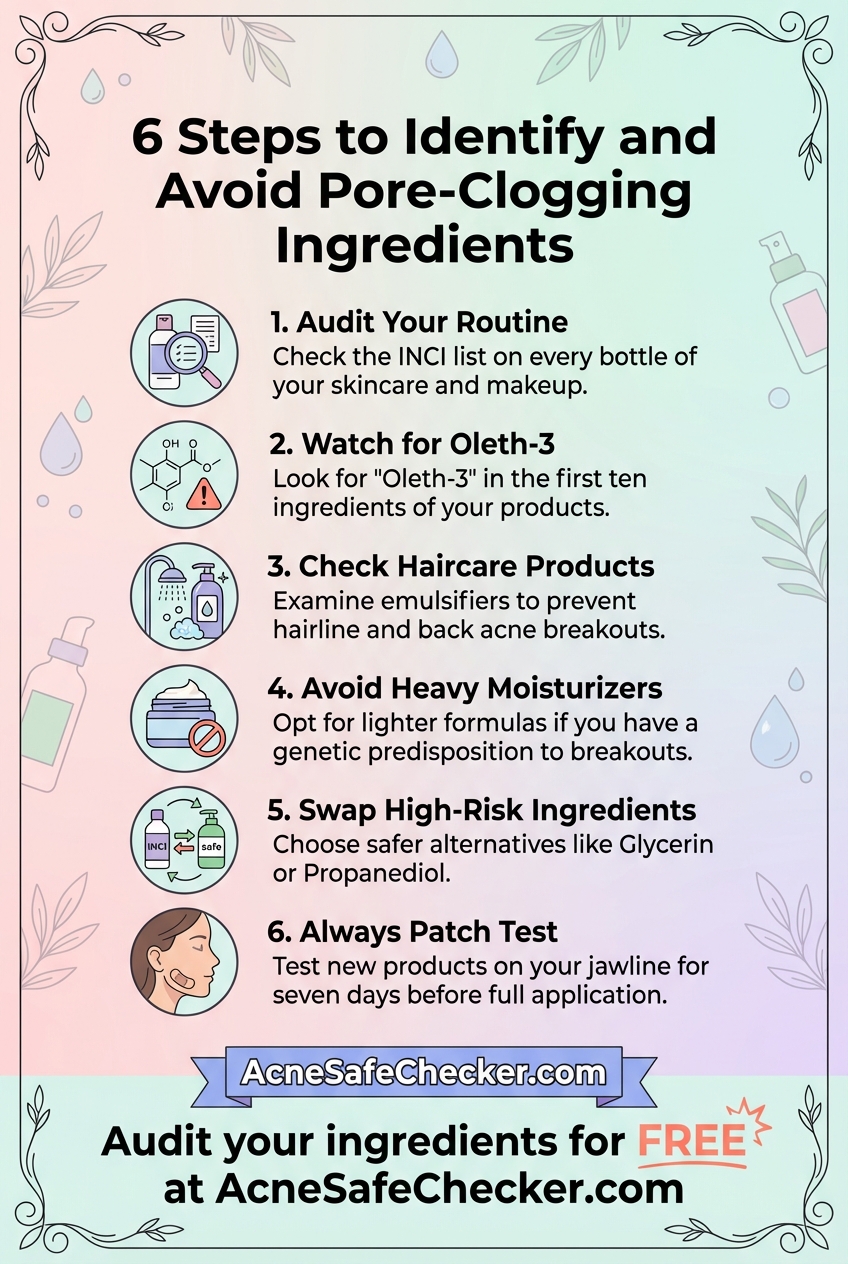
You won't always see "Oleth-3" in big letters on the front of a bottle. You have to look at the INCI (International Nomenclature of Cosmetic Ingredients) list on the back.
It is most commonly found in:
- Haircare products: Shampoos and conditioners (which can cause "pomade acne" along the hairline and back).
- Rich moisturizers: Often marketed for "glowy" or "dewy" skin.
- Liquid Foundations: Used to give the makeup a smooth, spreadable consistency.
- Cleansing oils: Surprisingly, some cleansers use it as an emulsifier to help the oil rinse off with water.
Expert Advice: What Should You Do?
If you have active acne, blackheads, or whiteheads, my professional recommendation is to avoid Oleth-3 entirely. Here is how to transition to an acne-safe routine:
Step 1: Audit Your Current Products
Take every product you apply to your face and check the ingredient list. If Oleth-3 is within the first seven to ten ingredients, the concentration is likely high enough to cause significant issues. If it's at the very end of the list, it may be less problematic, but for sensitive, acne-prone skin, it’s still best to eliminate it.
Step 2: Look for Safer Alternatives
If you need an emulsifier or a smooth texture, look for products that use ingredients with a lower comedogenicity rating, such as:
- Glycerin (Rating: 0)
- Caprylic/Capric Triglyceride (Rating: 2)
- Propanediol (Rating: 0)
- Polysorbates (Usually low risk, though varies by type)
Step 3: Patch Test New Products
Even if a product is labeled "non-comedogenic," the term is not strictly regulated by the FDA. Always patch test a new product on a small area of your jawline for at least 5-7 days to see if any small bumps (closed comedones) begin to form.
Conclusion
While Oleth-3 is a functional and effective ingredient for many, it is a high-risk choice for anyone prone to acne. Its 5/5 comedogenicity rating makes it a common culprit behind persistent skin congestion. By becoming a conscious consumer and learning to read your ingredient labels, you can filter out these hidden triggers and pave the way for clearer, healthier skin.
Remember, skincare is not one-size-fits-all. What works for a friend with dry skin might be the very thing causing your breakouts. When in doubt, stick to minimal, non-comedogenic formulas and consult with a board-certified dermatologist to tailor a plan specifically for your skin's needs.