
For anyone who has spent years battling breakouts, the idea of applying oil to the face can feel counterintuitive—if not downright terrifying. We have been conditioned to look for 'oil-free' labels on every bottle, fearing that a single drop might lead to a fresh crop of comedones. However, not all oils are created equal.
Is Your Routine Acne-Safe?
Do not guess. Instantly check your products for pore-clogging ingredients with our AI-powered tool.
Check Ingredients NowIn recent years, squalane oil has emerged as a 'holy grail' ingredient in the skincare world. But does it live up to the hype for those with oily or acne-prone complexions? As a dermatologist, I often see patients who are hesitant to try it. Today, we will break down the science of squalane, its relationship with acne, and why it might actually be the missing piece in your skincare routine.
Squalene vs. Squalane: The Critical Difference
To understand why squalane is safe, we first have to talk about its predecessor: squalene (with an 'e').
Squalene is a natural lipid produced by your skin’s sebaceous glands. It makes up about 10–13% of your skin’s sebum and plays a vital role in maintaining the skin barrier. However, squalene is highly unstable. When exposed to oxygen, it undergoes a process called oxidation. Oxidized squalene is highly comedogenic; it thickens the sebum, clogs pores, and creates an environment where Cutibacterium acnes (the bacteria responsible for acne) thrives.
Squalane (with an 'a'), on the other hand, is the hydrogenated version of squalene. Through the hydrogenation process, the oil is converted from an unsaturated fat to a saturated fat. This makes it 100% stable and resistant to oxidation. Because it won't oxidize on your skin, it does not contribute to the pore-clogging cycle that its raw counterpart does.
Is Squalane Comedogenic?
In dermatology, we use a comedogenicity scale from 0 to 5 to rate how likely an ingredient is to clog pores. A 0 means it will not clog pores, while a 5 means it is highly likely to cause breakouts.
Squalane typically sits at a 0 or 1 on this scale. It is considered a non-comedogenic oil. Its molecular weight is very light, and its structure is bio-identical to the lipids already found in human skin. This allows it to penetrate deeply without sitting on the surface and suffocating the pore.
Why Acne-Prone Skin Needs Hydration
A common mistake among acne sufferers is over-cleansing and using harsh actives like benzoyl peroxide or salicylic acid without replenishing the skin barrier. This leads to 'reactive seborrhea'—where the skin, sensing it is too dry, overproduces its own (often inflammatory) oil to compensate.
Squalane helps break this cycle by providing weightless hydration. Here is why it is particularly beneficial for acne-prone individuals:
1. Barrier Repair
Acne-prone skin often has a compromised lipid barrier. Squalane acts as an emollient, filling in the gaps between skin cells to prevent transepidermal water loss (TEWL) and keeping irritants out.
2. Anti-Inflammatory Properties
While it isn't a direct acne treatment like a retinoid, squalane has been shown to have mild anti-inflammatory properties. It can help soothe the redness and swelling associated with inflammatory acne lesions.
3. Balancing Oil Production
By providing the skin with a stable, high-quality lipid, you send a signal to your sebaceous glands that the skin is sufficiently hydrated. Over time, this can help regulate and balance your natural oil production.
How to Use Squalane Oil for Best Results
If you are ready to incorporate squalane into your routine, follow these dermatologist-recommended steps to ensure your skin stays clear:
Choose the Right Source
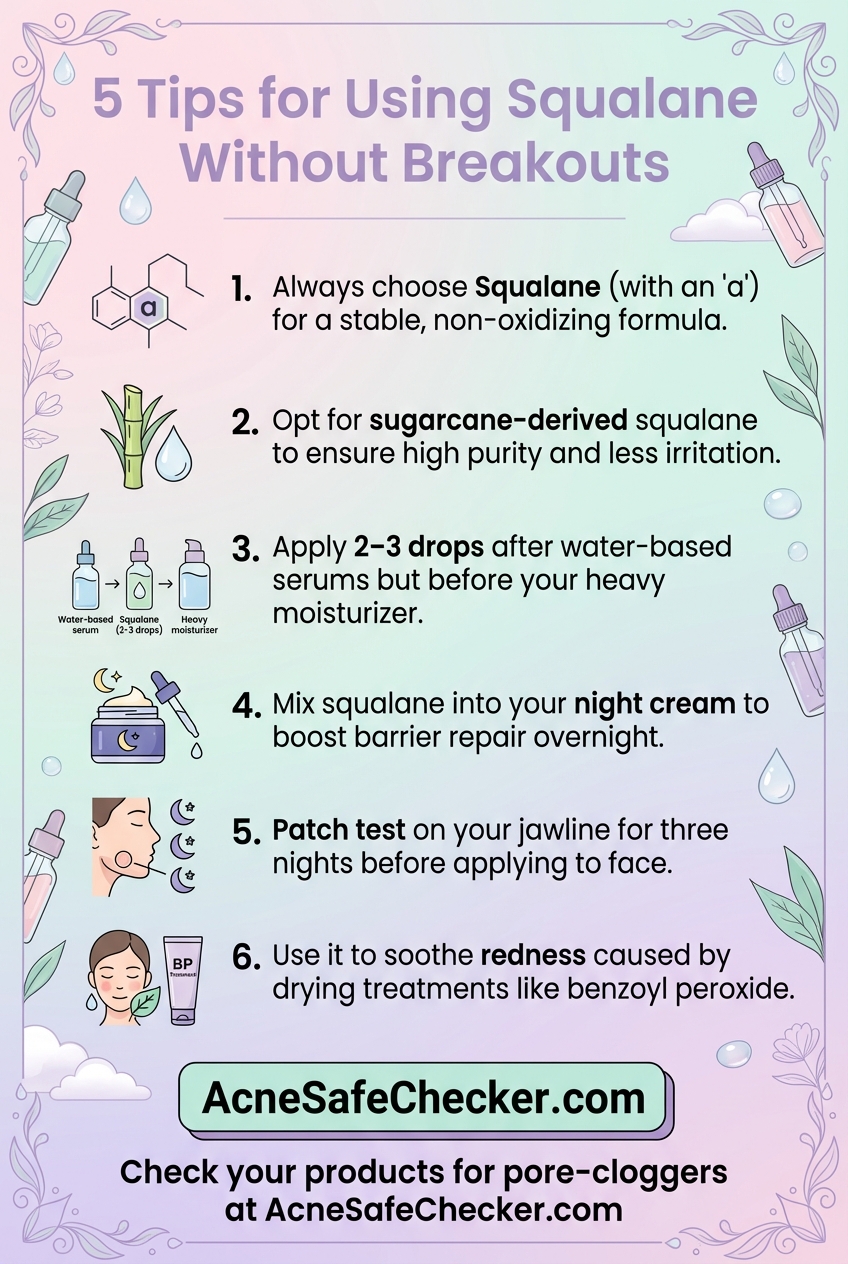
Squalane can be derived from olives, sugarcane, or shark liver (though most modern brands are now vegan). While olive-derived squalane is common, some individuals with highly sensitive skin find that sugarcane-derived squalane is 'cleaner' and less likely to contain residual impurities that might cause irritation.
Sequence Matters
Squalane is an occlusive emollient. It should be applied after your water-based serums (like Hyaluronic Acid or Vitamin C) but before or mixed into your moisturizer. If you have very oily skin, you may find that 2–3 drops of squalane can replace your traditional cream moisturizer entirely at night.
The Patch Test
Even though squalane is generally safe, everyone’s skin is unique. Apply a small amount to your jawline for three consecutive nights. If you don't see any redness or tiny whiteheads, it is likely safe for your entire face.
The Verdict
Is squalane oil safe for acne-prone skin? Yes.
Unlike many botanical oils (such as coconut or cocoa butter) that can be disastrous for acne, squalane offers the hydration the skin needs without the risk of oxidation and pore-clogging. It is an excellent companion to drying acne treatments, helping to maintain a healthy, resilient skin barrier while you work on clearing your complexion.
If you have been avoiding oils out of fear, squalane is the perfect place to start. It is lightweight, biocompatible, and—most importantly—breathes with your skin rather than against it.