
For anyone who has spent years battling breakouts, the idea of applying a thick, green, nutty-smelling oil to their face can feel like an invitation for a skincare disaster. We have been conditioned to believe that oil equals acne. However, in the world of botanical skincare, Tamanu oil—often referred to as "Green Gold"—has gained a cult following for its purported ability to heal acne scars and soothe inflammation.
Is Your Routine Acne-Safe?
Do not guess. Instantly check your products for pore-clogging ingredients with our AI-powered tool.
Check Ingredients NowBut the burning question remains: Is Tamanu oil pore-clogging? As a dermatologist, I see patients daily who are caught between wanting natural healing and fearing a massive breakout. Today, we will look at the science of comedogenicity, the unique chemical profile of Tamanu oil, and how to determine if it belongs in your skincare routine.
Understanding the Comedogenic Scale
To answer whether an oil will clog your pores, we first look at the comedogenic scale. This scale ranges from 0 to 5:
- 0: Will not clog pores
- 1: Very low chance of clogging
- 2: Moderately low (most people are fine)
- 3: Moderate (potential for clogs)
- 4: Fairly high
- 5: High probability of clogging
Tamanu oil typically sits at a 2 on the comedogenic scale.
A rating of 2 means that for the vast majority of people, Tamanu oil is considered non-comedogenic. It is unlikely to cause issues for those with normal or dry skin. However, if you are highly sensitive or have extremely active, grade-4 cystic acne, even a "2" requires a cautious approach.
The Science of Tamanu Oil: Why It’s Different
Unlike many oils that simply sit on the surface of the skin providing an occlusive barrier, Tamanu oil (extracted from the nut of the Calophyllum inophyllum tree) is biologically active. It contains a unique fatty acid profile and specific compounds that explain its healing powers.
1. The Oleic vs. Linoleic Acid Balance
Every vegetable oil is composed of fatty acids. Generally, acne-prone skin is deficient in linoleic acid, which makes the skin's natural sebum thick and sticky, leading to clogs. Oils high in linoleic acid are usually better for acne.
Tamanu oil is roughly balanced between Oleic acid (rich and moisturizing) and Linoleic acid (thinner and acne-friendly). This balance is why it feels thicker than rosehip oil but is still relatively safe for many acne sufferers.
2. Calophyllolide and Schealing
Tamanu oil contains a unique fatty acid called calophyllic acid and a non-steroidal anti-inflammatory agent called calophyllolide. In clinical observations, these compounds have shown significant wound-healing and antibiotic properties. This is why Tamanu is so famous for "schealing"—the process of healing a wound while simultaneously reducing the appearance of the resulting scar.
Can Tamanu Oil Actually Help Acne?
It may seem counterintuitive, but for many, Tamanu oil is an ally against acne rather than a cause of it. Because it is naturally antimicrobial, antibacterial, and antifungal, it can help neutralize Cutibacterium acnes (the bacteria responsible for breakouts).
Its real strength, however, lies in Post-Inflammatory Hyperpigmentation (PIH). The oil promotes cell proliferation and the production of collagen and glycosaminoglycans (GAGs), which are essential for fading those stubborn dark spots left behind after a pimple has healed.
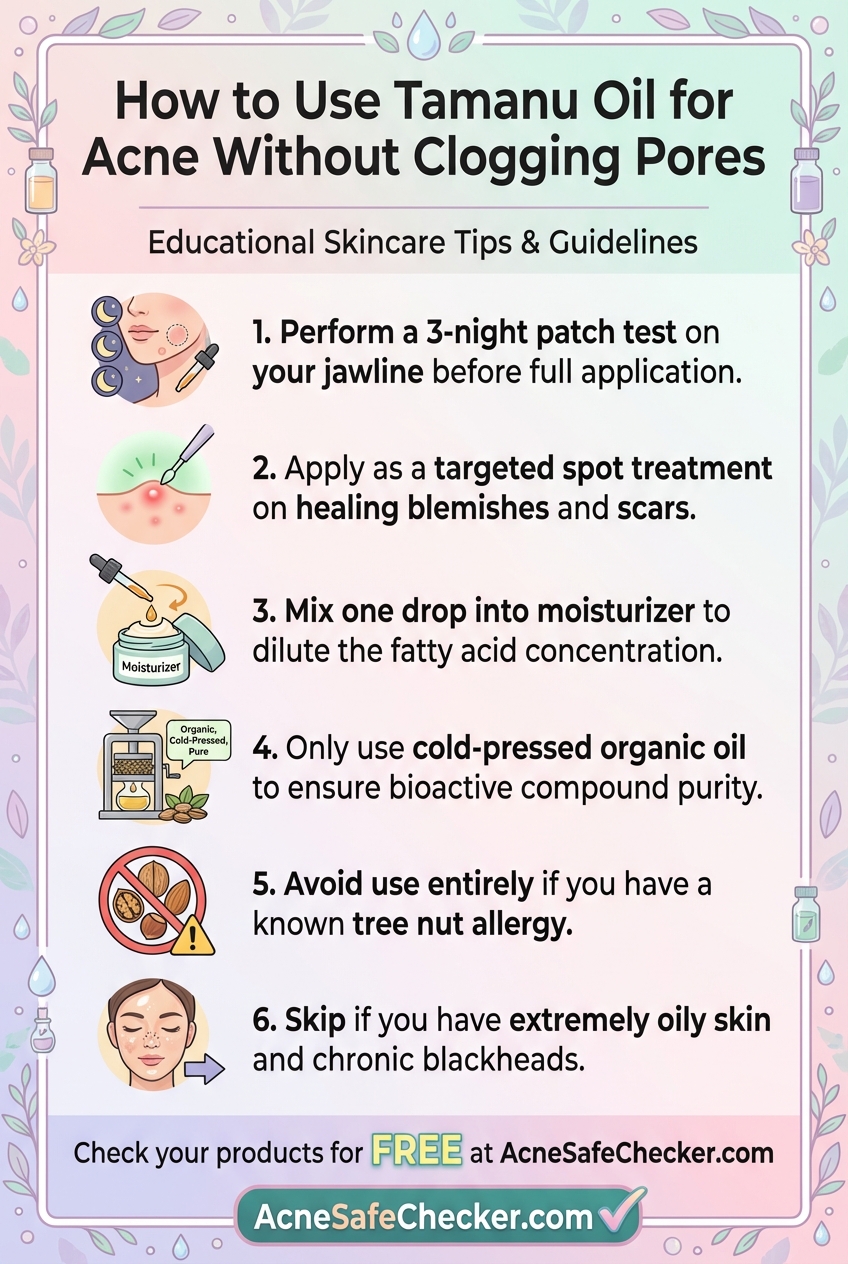
How to Use Tamanu Oil Without Clogging Your Pores
If you are nervous about clogs but want the healing benefits, follow these professional guidelines:
The Patch Test is Non-Negotiable
Apply a small amount of the oil to a localized area of your jawline for three consecutive nights. If no closed comedones (tiny white bumps) or redness appear, you are likely safe to use it on larger areas.
Use it as a Spot Treatment
You do not need to slather your entire face in Tamanu oil. Because it is so potent, it works beautifully as a spot treatment. Apply it directly to a healing blemish or a dark scar at the end of your nighttime routine.
Mix, Don’t Layer
If the oil feels too heavy, try mixing one drop into your oil-free moisturizer. This dilutes the concentration of fatty acids while still allowing the anti-inflammatory properties to work on the skin barrier.
Choose Cold-Pressed and Organic
The quality of the oil matters. Refined or heat-treated Tamanu oil loses its bioactive compounds and can sometimes contain impurities that irritate the skin, mimicking a breakout.
Who Should Avoid Tamanu Oil?
While Tamanu oil is safe for most, I recommend avoidance or extreme caution for two groups:
- Nut Allergy Sufferers: Since Tamanu is derived from a tree nut, those with severe nut allergies should consult an allergist first.
- The "Oil-Slick" Skin Type: If your skin is naturally very oily and you struggle with chronic blackheads, a rating of 2 might still be too much. You may be better served by a lighter oil with a rating of 0 or 1, such as Squalane or Hemp Seed Oil.
Final Verdict
Is Tamanu oil pore-clogging? For most people, no. With a comedogenic rating of 2, it is a relatively safe, high-performance oil that offers incredible benefits for skin regeneration and acne scar reduction.
In my professional opinion, the benefits of its anti-inflammatory and wound-healing properties often outweigh the slight risk of clogging, provided it is used correctly. If you are struggling with the aftermath of acne—redness, scarring, and slow-to-heal spots—Tamanu oil is a worthy addition to your skincare arsenal. Just remember: start slow, patch test, and let the "Green Gold" do its work.