
Finding the perfect moisturizer is often the most challenging step in a skincare routine, especially for those with acne-prone or sensitive skin. You apply a cream to soothe dryness, only to wake up the next morning with tiny, pearly-white bumps scattered across your face. It feels like a betrayal—the very product meant to protect your skin barrier is seemingly destroying your complexion.
Is Your Routine Acne-Safe?
Do not guess. Instantly check your products for pore-clogging ingredients with our AI-powered tool.
Check Ingredients NowAs a dermatologist, I frequently see patients who are caught in this cycle of hydration and irritation. If you suspect your moisturizer is causing whiteheads, you aren't imagining it. In the skincare world, this phenomenon is often linked to 'comedogenicity' and the delicate balance of your skin’s natural oils. Here is everything you need to know about why your moisturizer might be triggering whiteheads and how to find a formula that works for you.
What Exactly Are Whiteheads?
In clinical terms, a whitehead is known as a closed comedone. Unlike blackheads (open comedones), which are open to the air and oxidize into a dark color, whiteheads occur when a pore is completely blocked by a combination of sebum (oil) and dead skin cells.
Because the pore is sealed, the debris remains trapped beneath the surface, creating a small, raised white or flesh-colored bump. While they aren't as painful as cystic acne, whiteheads indicate that your skin’s natural shedding process is being obstructed, often by external products like heavy moisturizers.
The Science: How Moisturizers Clog Pores
To understand why a moisturizer causes whiteheads, we have to look at how these products interact with the skin barrier. Most moisturizers use three types of ingredients: humectants (which draw water in), emollients (which smooth the surface), and occlusives (which seal moisture in).
1. The Occlusive Trap
Occlusives—like petrolatum, lanolin, or heavy oils—form a physical film over the skin. While this is excellent for someone with extremely dry or compromised skin, it can be disastrous for someone with an oily or combination profile. If the occlusive layer is too thick, it doesn't just trap moisture; it traps sweat, bacteria, and sebum, creating the perfect environment for a closed comedone to form.
2. Comedogenic Ingredients
Comedogenicity refers to the likelihood of an ingredient to clog pores. Every individual’s skin reacts differently, but certain ingredients are notorious for triggering whiteheads. If your moisturizer contains high concentrations of isopropyl myristate, cocoa butter, or certain algae extracts, it may be physically 'plugging' the follicular opening.
3. Formulation Incompatibility
Sometimes it isn't a single ingredient, but the overall formulation. A moisturizer that is too 'rich' for your skin type provides more lipids than your skin can process. When your skin is over-saturated with heavy oils it doesn’t need, it loses its ability to shed dead cells efficiently, leading to a buildup that manifests as whiteheads.
Common Culprits: Ingredients to Watch For
When scanning your ingredient list, keep an eye out for these common offenders often found in thick creams:
- Isopropyl Myristate and its derivatives: Used to give products a 'slick' feel, but highly comedogenic.
- Coconut Oil (Cocos Nucifera): While great for the body, it is a frequent cause of facial breakouts for many.
- Lanolin: A sheep-wool derivative that can be too heavy for acne-prone individuals.
- Sodium Lauryl Sulfate (SLS): Sometimes used as an emulsifier, it can irritate the pore lining.
- Heavy Silicones: While not technically comedogenic for everyone, some people find that heavy silicones (like dimethicone in high concentrations) trap debris underneath.
How to Transition to a Whitehead-Free Routine
If you believe your current moisturizer is the culprit, you don't have to give up on hydration entirely. Use these steps to reset your skin:
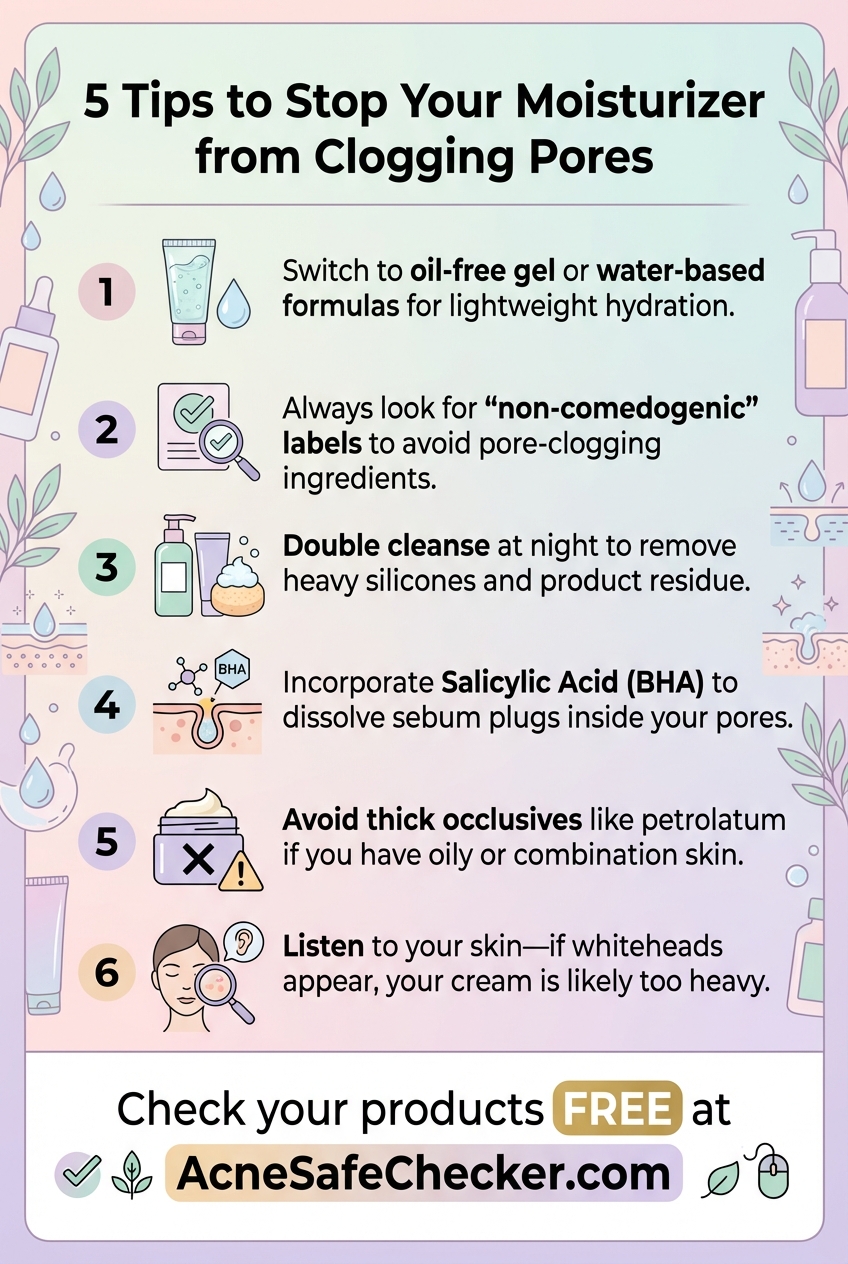
Look for 'Non-Comedogenic' Labels
While not a regulated legal term, the 'non-comedogenic' label generally means the manufacturer has formulated the product specifically to avoid pore-clogging. This is your first line of defense.
Switch to Gel-Based or Water-Based Formulas
If you have oily or combination skin, heavy creams are rarely necessary. Look for 'oil-free' gel-creams. These utilize humectants like Hyaluronic Acid and Glycerin to hydrate without adding the heavy oils that trigger whiteheads.
The Importance of the 'Double Cleanse'
If you use a moisturizer with heavy silicones or sunscreens, a single water-based wash might not be enough to remove it. Incorporating a gentle micellar water or cleansing oil (that emulsifies and rinses clean) before your main cleanser ensures that no product residue is left behind to clog your pores overnight.
Introduce a Chemical Exfoliant
To help clear existing whiteheads caused by your moisturizer, look for products containing Salicylic Acid (BHA). Because BHA is oil-soluble, it can penetrate deep into the pore to dissolve the 'plug' of sebum and product that created the whitehead in the first place.
Final Thoughts
A moisturizer should feel like a relief, not a risk. If you are experiencing a surge in whiteheads, your skin is likely telling you that your current product is too heavy or contains an ingredient that disrupts your natural pore function. By switching to lightweight, non-comedogenic formulas and ensuring a thorough cleansing routine, you can maintain a healthy skin barrier without the frustration of breakouts.
Remember, skincare is not one-size-fits-all. What works for a friend with dry skin might be the very thing causing your whiteheads. Listen to your skin—it's the best guide you have.