
If you have ever purchased a moisturizer labeled "non-comedogenic" only to wake up with a cluster of breakouts forty-eight hours later, you know how frustrating the skincare world can be. For those with acne-prone or sensitive skin, the term "non-comedogenic" often feels like a hollow marketing promise rather than a scientific guarantee.
Is Your Routine Acne-Safe?
Do not guess. Instantly check your products for pore-clogging ingredients with our AI-powered tool.
Check Ingredients NowTo truly protect your pores, you need to look beyond the front of the bottle and dive into the ingredient list. This is where the Comedogenic Rating Scale becomes your most valuable tool. As a dermatologist, I use this scale to help patients decode formulas and identify why certain products may be sabotaging their skin health. This guide will break down the 0-5 scale, the science behind it, and how to use it effectively.
What Exactly is a Comedogenic Rating?
In dermatology, a "comedo" is a clogged pore. An open comedo is a blackhead, while a closed comedo is a whitehead. Therefore, "comedogenicity" refers to the likelihood that a specific ingredient will cause these blockages by mixing with your sebum and dead skin cells.
The Comedogenic Rating Scale is a standardized system that ranks ingredients from 0 to 5 based on their propensity to trigger acne:
- 0: Will not clog pores
- 1: Very low chance of clogging pores
- 2: Low chance of clogging pores
- 3: Moderate chance of clogging pores
- 4: Fairly high chance of clogging pores
- 5: High chance of clogging pores
A Deep Dive into the 0-5 Ratings
Ratings 0-1: The Safe Zone
Ingredients in this range are generally considered "acne-safe." They are unlikely to cause a reaction even in those with highly reactive skin. Examples include Hemp Seed Oil (0), Argan Oil (0), and Squalane (0-1). Squalane is particularly beloved because it mimics the skin’s natural oils without the heaviness that leads to congestion.
Rating 2: The Middle Ground
Many common skincare ingredients fall into the 2 category. For most people, these won't cause issues. However, if you have very oily skin or are currently experiencing a severe flare-up, you might want to exercise caution. Common examples include Grapeseed Oil, Sweet Almond Oil, and Olive Oil.
Rating 3: The Caution Zone
Ingredients with a rating of 3 are moderately comedogenic. These can be problematic if they appear at the very top of an ingredient list (meaning they are present in high concentrations). Sesame Oil and Corn Oil are classic examples. Use these with caution if you are prone to "congestion" or small bumps under the skin.
Ratings 4-5: The Red Flags
These ingredients have a high probability of causing breakouts. While they are often excellent for treating extremely dry, cracked skin (like on the heels or elbows), they are usually disastrous for the face if you are acne-prone. The most notorious offenders are Coconut Oil (4), Cocoa Butter (4), and Wheat Germ Oil (5).
The Science (And Limitations) of the Scale
It is important to understand that the comedogenic scale is not a perfect science. Most of these ratings originated from the "Rabbit Ear Test" developed in the 1970s. Scientists applied ingredients to the sensitive inner skin of a rabbit's ear to see if comedones formed.
While this provided a baseline, human skin is different. Rabbit skin is significantly more reactive than human skin, meaning the scale sometimes overestimates how "clogging" an ingredient actually is. Furthermore, the concentration and formulation matter immensely. A product containing 1% of a level 4 ingredient may be perfectly safe, whereas a product that is 90% of a level 3 ingredient might cause a breakout.
How to Apply This Knowledge to Your Routine
To navigate the scale like a pro, follow these clinical steps:
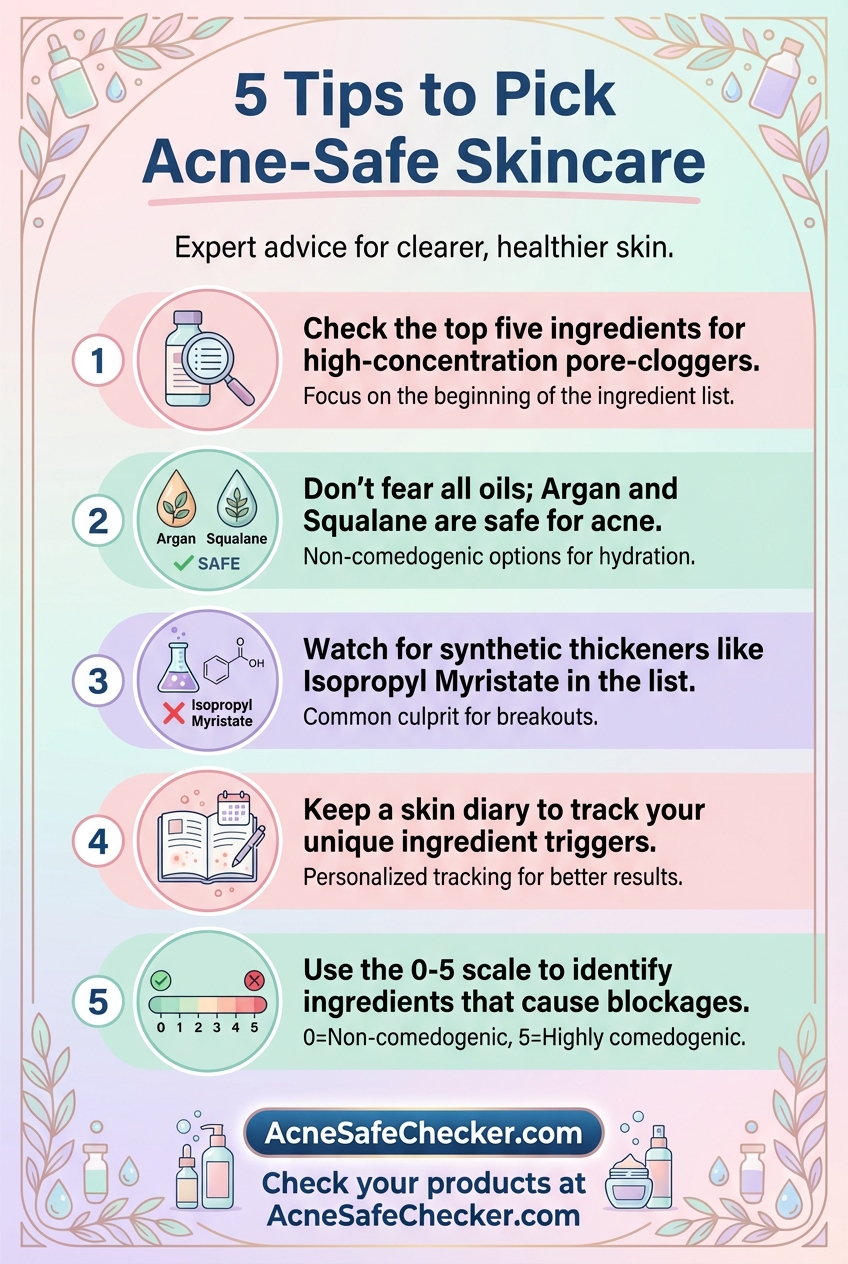
1. Check the Top Five
Ingredients are listed in order of concentration. If a level 4 or 5 ingredient is in the first five slots of the "Ingredients" (INCI) list, it is far more likely to clog your pores than if it is at the very bottom.
2. Identify Your Personal Triggers
Everyone’s sebum composition is unique. Some people can use coconut oil with no issues, while others break out from a level 1 ingredient. Keep a "skin diary" to track which ingredients correlate with your flare-ups.
3. Don’t Fear All Oils
One of the biggest misconceptions is that all oils are bad for acne. As shown by the scale, many oils (like Argan or Safflower) have a rating of 0. These can actually help balance your skin's moisture barrier, preventing the overproduction of oil that leads to acne.
4. Look for Synthetic Comedogens
It isn't just natural oils you need to watch. Many synthetic thickeners and esters are highly comedogenic. Keep an eye out for Isopropyl Myristate, Isopropyl Isostearate, and Myristyl Myristate, which often rank 4 or 5 on the scale.
Conclusion: Balance is Key
The 0-5 comedogenic scale is an essential roadmap for anyone navigating the complex world of acne-prone skincare, but it should be used as a guide, not a set of rigid laws. Your goal is to find a balance between ingredients that nourish your skin barrier and those that keep your pores clear.
If you are struggling with persistent breakouts despite using "clean" or "non-comedogenic" products, consult with a board-certified dermatologist. We can help you identify specific triggers and create a medical-grade regimen tailored to your unique skin chemistry. Remember: clear skin isn't just about what you put on your face—it’s about understanding the science of what’s inside the bottle.