
Finding the perfect skincare routine can feel like a minefield, especially if you have acne-prone or sensitive skin. You’ve likely seen the term "non-comedogenic" printed on dozens of bottles, promising clear skin and unclogged pores. However, as many skincare enthusiasts discover the hard way, a label isn’t always a guarantee of a clear complexion.
Is Your Routine Acne-Safe?
Do not guess. Instantly check your products for pore-clogging ingredients with our AI-powered tool.
Check Ingredients NowIn the world of dermatology, "comedogenicity" refers to the likelihood that a product or ingredient will cause comedones—the medical term for the bumps that form when pores become blocked. Understanding how to verify these claims is essential for anyone looking to manage acne or maintain skin health. This guide will walk you through the science of pore-clogging ingredients and provide a practical framework for checking your products.
What Does "Non-Comedogenic" Really Mean?
At its core, a non-comedogenic product is formulated specifically to avoid blocking pores. When a pore becomes clogged with excess sebum (oil) and dead skin cells, it creates a plug. This plug can manifest as a whitehead (closed comedo) or a blackhead (open comedo). If bacteria get trapped in that environment, it leads to inflammatory acne.
However, there is a catch: the term "non-comedogenic" is not strictly regulated by the FDA or international health bodies. There is no standardized, universal test that a brand must pass to use this claim. While many reputable companies perform internal testing, the definition of what constitutes a "pass" can vary from one brand to another.
The Science: The Comedogenicity Scale
To understand how products are screened, we look to the Comedogenicity Scale. This scale ranks ingredients from 0 to 5:
- 0: Will not clog pores
- 1: Very low probability of clogging pores
- 2: Moderately low probability
- 3: Moderate probability
- 4: Fairly high probability
- 5: High probability of clogging pores
Historically, these ratings were determined through the "Rabbit Ear Assay," where ingredients were applied to the sensitive inner skin of a rabbit's ear. Today, most testing is done via human volunteer trials or in-vitro models. While these scales are helpful, they aren't perfect because they test ingredients in isolation. The way an ingredient behaves in a complex formula can change depending on its concentration and the other ingredients surrounding it.
Common Pore-Clogging Ingredients to Watch For
If you want to check if a product is non-comedogenic, the most reliable method is to scan the ingredient list (INCI list) for known offenders. Here are some of the most common high-ranking comedogens found in makeup and skincare:
1. Certain Natural Oils and Butters
While many natural oils are beneficial, some are notorious for blocking pores.
- Coconut Oil: Highly comedogenic (rated 4). It is excellent for body skin but often problematic for the face.
- Cocoa Butter: Frequently used in rich moisturizers, this is a heavy occlusive that can easily trap sebum.
2. Isopropyl Myristate and its Derivatives
This is a synthetic oil often used to give products a "velvety" feel or to help other ingredients penetrate the skin. Unfortunately, it is highly comedogenic and can be a major trigger for adult acne.
3. Lanolin
Derived from sheep's wool, lanolin is a fantastic emollient for dry skin, but its thick, waxy nature makes it a risk for those with oily or acne-prone skin types.
4. Algae Extract
Often marketed as a "superfood" for the skin, some types of algae extract are surprisingly high on the comedogenicity scale due to their mineral and salt content.
Step-by-Step: How to Analyze Your Product
Follow these steps to determine if your product is safe for your skin type:
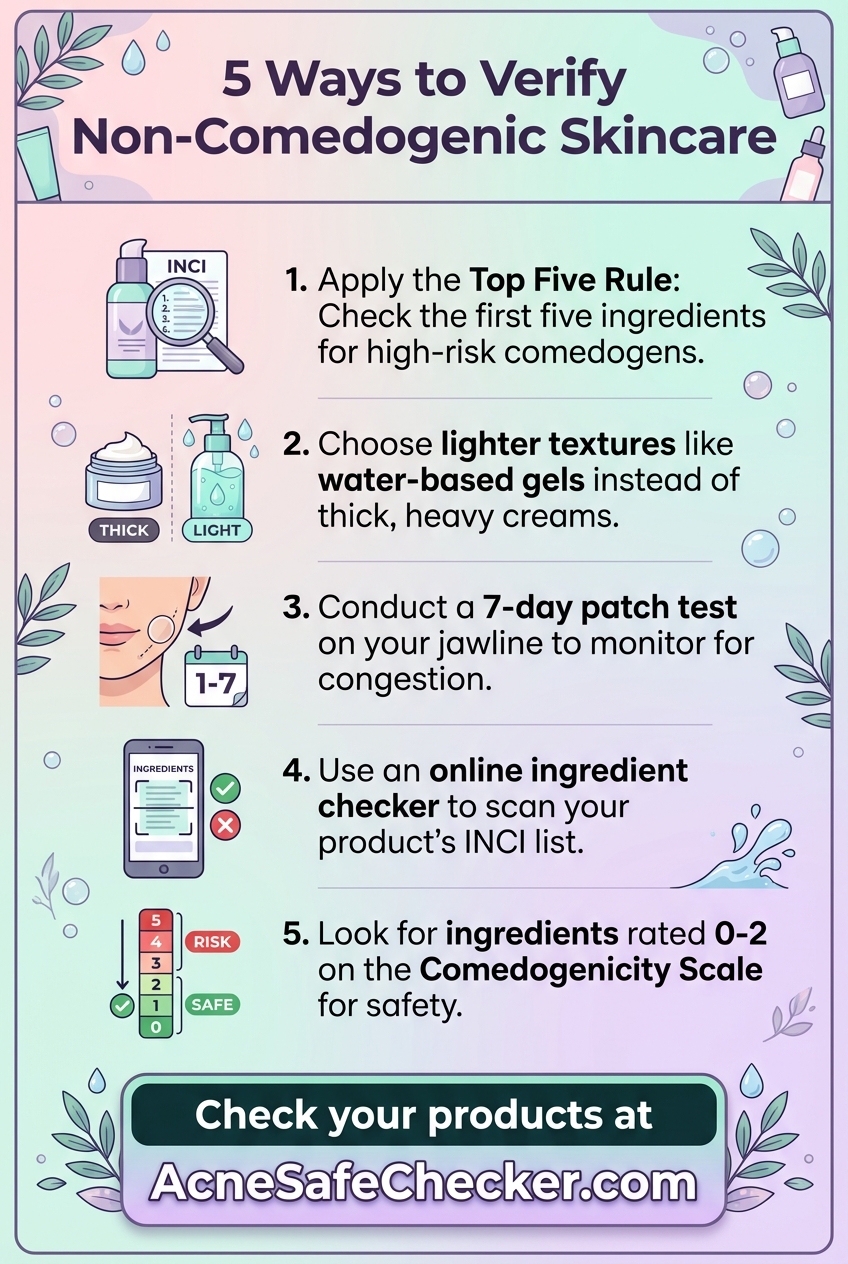
Step 1: The "Top Five" Rule
Ingredients are listed in order of their concentration. Look closely at the first five to seven ingredients. If a highly comedogenic ingredient (like Isopropyl Myristate or Coconut Oil) is in the top five, the product is significantly more likely to cause breakouts. If it is listed at the very bottom of the list, the concentration may be low enough that it won't cause an issue.
Step 2: Use an Ingredient Checker
There are several free online databases where you can copy and paste a product's ingredient list. These tools cross-reference the ingredients against known comedogenicity scales. While they provide a great starting point, remember that they cannot account for the specific formulation or "synergy" of the product.
Step 3: Check the Texture
As a general rule of thumb, thicker and heavier creams are more likely to contain occlusives that can block pores. If you are acne-prone, look for "gel-creams," "lotions," or "water-based" formulas. These are typically designed with smaller molecules that are less likely to sit inside the pore.
Step 4: Perform a Patch Test
Science can only tell you so much; your skin has the final say. Apply a small amount of the product to a specific area of your face (like the jawline) for 5–7 days. If you notice small bumps or increased congestion in that specific area, the product is likely comedogenic for your unique skin chemistry.
Why Individual Results Vary
It is important to remember that skin is a living organ. What clogs one person’s pores might not affect another’s. Factors such as your skin's natural sebum production, the humidity of your environment, and even your hormones play a role in how a product interacts with your pores.
Furthermore, an ingredient that is comedogenic on its own may be "diluted" in a formula to the point of being harmless. This is why some people can use products containing small amounts of "pore-clogging" ingredients without any issues.
Conclusion
Checking if a product is truly non-comedogenic requires looking beyond the marketing on the front of the bottle. By understanding the comedogenicity scale, identifying red-flag ingredients, and paying attention to where ingredients fall on the INCI list, you can make informed decisions that support a clear, healthy complexion.
If you find that you are breaking out despite using seemingly "safe" products, consider consulting a board-certified dermatologist. We can help you identify specific triggers and create a medical-grade routine tailored to your skin's unique needs.