
Navigating the Maze of Skincare Ingredients
Is Your Routine Acne-Safe?
Do not guess. Instantly check your products for pore-clogging ingredients with our AI-powered tool.
Check Ingredients NowIf you have ever spent thirty minutes in a drugstore aisle staring at the back of a moisturizer bottle, you are not alone. For those of us with acne-prone or sensitive skin, a product label can feel like a minefield. One ingredient you will see listed on almost everything—from high-end cleansers to budget foundations—is stearic acid.
But as you scan the ingredients list, the nagging question remains: Is this going to cause a breakout? In the world of skincare, stearic acid is a polarizing figure. It is celebrated for its creamy texture and skin-softening properties, yet it often finds itself on "avoid" lists for pore-clogging potential.
In this guide, we will break down the science of stearic acid, its ranking on the comedogenicity scale, and whether you should keep it in—or kick it out of—your daily routine.
What Exactly is Stearic Acid?
Stearic acid is a long-chain saturated fatty acid. In nature, it is found in both animal fats (like tallow) and vegetable fats (like cocoa butter and shea butter). In skincare formulation, it is a multitasking powerhouse that serves three primary roles:
- Emulsifier: It helps oil and water mix, ensuring your lotion doesn't separate in the bottle.
- Surfactant: It helps lower the surface tension of water, making it easier to wash away dirt and oil (common in cleansers).
- Emollient: It provides that smooth, velvety feel we associate with luxury creams, helping to trap moisture in the skin.
Does Stearic Acid Clog Pores? The Comedogenicity Scale
To answer the question of whether an ingredient clogs pores, dermatologists often look at the comedogenicity scale. This scale ranks ingredients from 0 (won’t clog pores) to 5 (highly likely to clog pores).
Stearic acid typically ranks between a 2 and a 3.
For context, a rating of 2 is considered "lowly comedogenic," while a 3 is "moderately comedogenic." This means that for the average person, stearic acid is unlikely to cause issues. However, for individuals with highly reactive, oily, or grade-three acne-prone skin, it can potentially contribute to the formation of comedones (blackheads and whiteheads).
The Science of Pore Clogging
When we talk about "clogging pores," we are discussing follicular hyperkeratosis—the process where dead skin cells and sebum (oil) get trapped inside the pore. Because stearic acid is a thick, waxy fatty acid, it can, in high concentrations, act as a "glue" that binds these dead cells together.
However, it is important to note that stearic acid is also a natural component of your skin’s lipid barrier. It helps maintain the skin's integrity and prevents transepidermal water loss (TEWL). This creates a delicate balance: your skin needs fatty acids to stay healthy, but too much of a specific type can tip the scales toward a breakout.
Why Formulation Matters More Than the Ingredient
One of the biggest mistakes consumers make is looking at an ingredient list in a vacuum. A "3" on the comedogenicity scale does not mean the entire product is a "3." Here is why the context of the formula matters:
1. Concentration
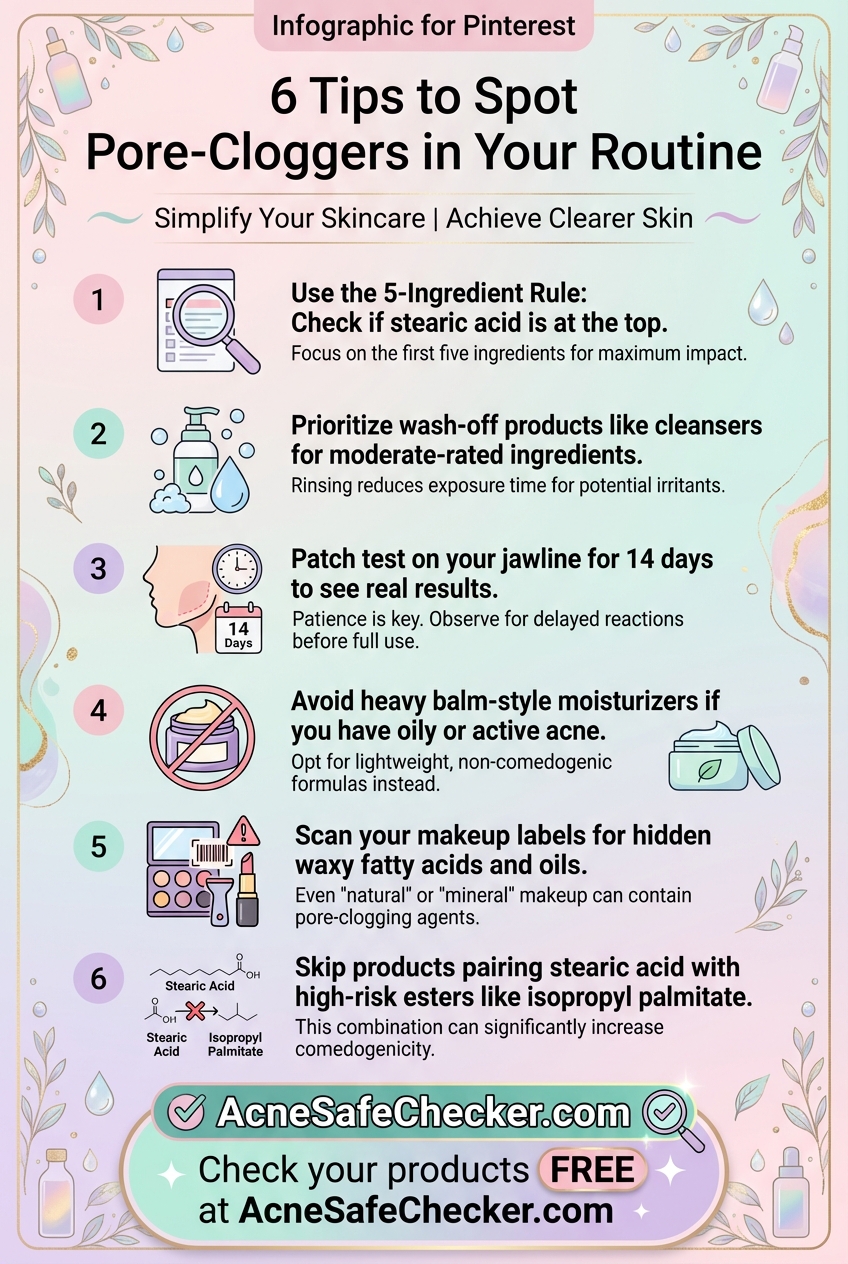
If stearic acid is the second ingredient on the list, there is a higher chance it could be problematic for acne-prone skin. If it is listed near the bottom (after the preservatives or fragrance), the concentration is likely too low to cause a physical blockage in the pore.
2. Product Type
In a wash-off product (like a cleanser), stearic acid is rarely a concern. It is on your skin for thirty seconds before being rinsed away. In a leave-on product (like a thick night cream or a heavy foundation), the ingredient has more time to sit in the follicle and potentially cause issues.
3. Synergistic Ingredients
Stearic acid is often paired with other ingredients that may mitigate its comedogenicity or, conversely, exacerbate it. For example, when combined with high levels of isopropyl palmitate, the "clogging" potential of the product increases significantly.
Is Stearic Acid Right for You?
Deciding whether to use products containing stearic acid depends largely on your specific skin type:
- Dry or Mature Skin: Stearic acid is usually a "hero" ingredient for you. It helps replenish lost lipids and provides a protective seal that prevents dryness and irritation.
- Combination Skin: You can likely tolerate stearic acid in most formulations, though you may want to avoid very thick, "balm-style" moisturizers containing it during humid summer months.
- Oily and Acne-Prone Skin: If you struggle with persistent whiteheads or inflammatory acne, you should proceed with caution. Look for products labeled "non-comedogenic" or "oil-free," which often use synthetic esters instead of heavy fatty acids like stearic acid.
Dermatologist’s Practical Tips
If you are worried that stearic acid is the culprit behind your breakouts, follow these three steps:
- The 5-Ingredient Rule: Check where stearic acid falls on the list. If it is within the first five ingredients, it is a primary component of the formula and more likely to affect your pores.
- Patch Test for Two Weeks: Don’t just test a product once. Apply it to a small, acne-prone area (like the jawline) for 10-14 days. Comedones (clogged pores) take time to form, so a one-day test won't give you the full picture.
- Check Your Makeup: We often blame our skincare, but makeup is a frequent offender. Check your foundations and primers. Many "long-wear" or "creamy" foundations use stearic acid to achieve their texture.
Conclusion
So, does stearic acid clog pores? The answer is: It can, but it usually doesn't.
For most people, it is a safe, effective, and necessary ingredient that keeps skin soft and hydrated. However, if you have a history of stubborn acne, its moderate comedogenicity rating is enough to warrant caution.
Instead of fearing the ingredient entirely, focus on the total formulation. Your skin is unique, and the best way to determine if stearic acid works for you is to monitor your skin’s reaction over time. When in doubt, consulting with a board-certified dermatologist can help you build a routine that supports your skin barrier without compromising your clarity.