
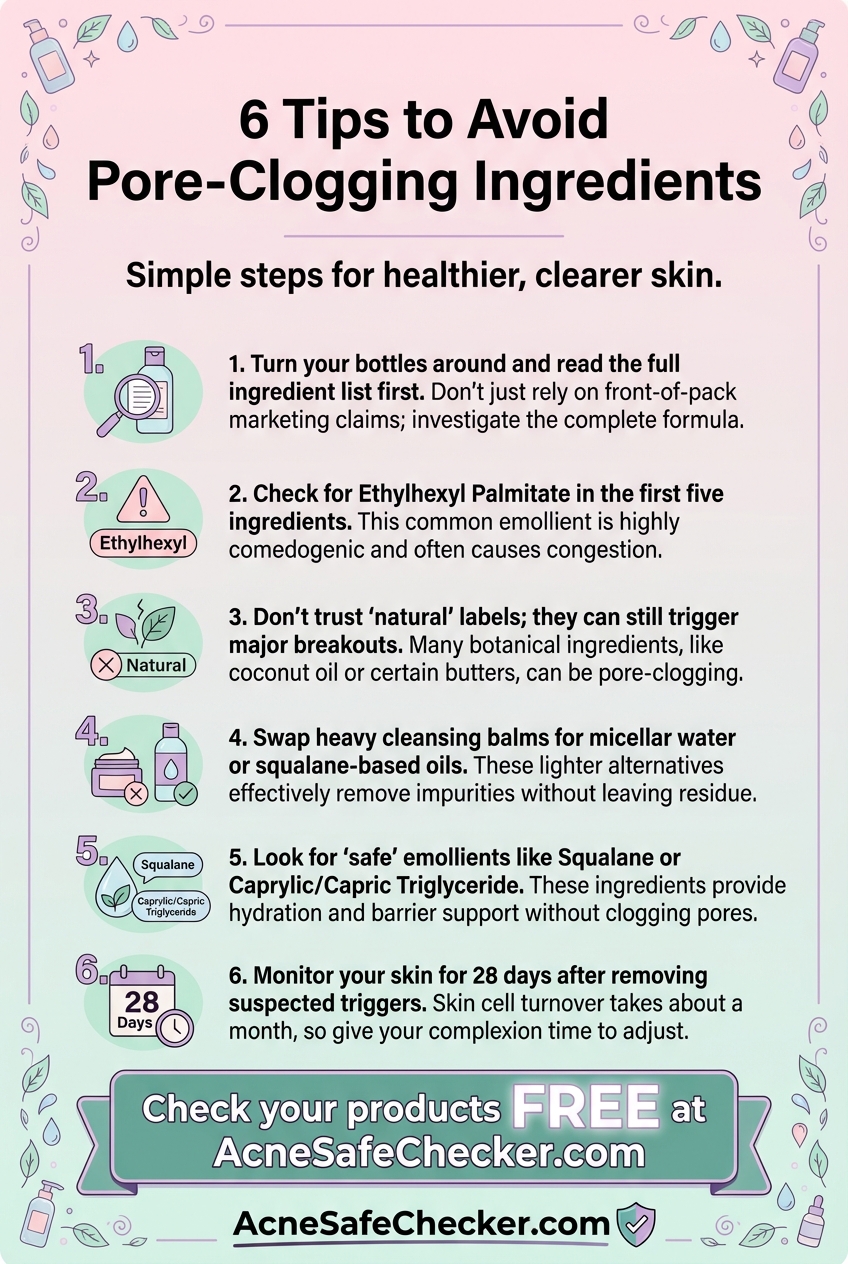
You’ve spent hundreds of dollars on a high-end skincare routine. You’re double cleansing, using your actives, and staying consistent. Yet, you’re still seeing those stubborn whiteheads or persistent congestion along your cheekbones and jawline. As a dermatologist, one of the first things I ask my patients to do is turn their bottles around and look for one specific ingredient: Ethylhexyl Palmitate.
Is Your Routine Acne-Safe?
Do not guess. Instantly check your products for pore-clogging ingredients with our AI-powered tool.
Check Ingredients NowWhile it is widely used in the beauty industry for its silky feel and emollient properties, it is also one of the most notorious triggers for acne-prone individuals. In this guide, we will break down the ethylhexyl palmitate comedogenic rating, the science behind why it clogs pores, and how you can protect your skin barrier without sacrificing your complexion.
What is Ethylhexyl Palmitate?
Ethylhexyl Palmitate (also known as Octyl Palmitate) is an ester of 2-ethylhexyl alcohol and palmitic acid. Palmitic acid is a fatty acid found naturally in animals and plants, most notably in palm oil.
In the formulation world, it is considered a 'texture enhancer' or a 'dry emollient.' It provides that luxurious, slip-and-slide feeling we love in foundations, cream blushes, and rich moisturizers. It is often used as a replacement for silicone because it offers a similar smoothing effect but is often perceived as 'more natural' by consumers. However, for those with a predisposition to acne, 'natural' does not always mean 'safe.'
The Comedogenic Rating of Ethylhexyl Palmitate
In dermatology, we use a scale from 0 to 5 to determine how likely an ingredient is to clog pores (comedogenicity).
- 0: Will not clog pores
- 1: Very low probability of clogging
- 2: Moderately low
- 3: Moderate
- 4: Fairly high
- 5: Very high
Ethylhexyl Palmitate carries a comedogenic rating of 4.
This is a significant red flag for anyone struggling with acne, oily skin, or enlarged pores. An ingredient with a rating of 4 is highly likely to cause the formation of comedones (blackheads and whiteheads) by physically blocking the follicular opening or by mixing with your skin's natural sebum to create a 'plug.'
Why the Number 4 is a Warning Sign
While some ingredients with a rating of 2 can be tolerated by many, a 4 is almost universally problematic for those with an 'acneic' skin type. If you are prone to retention hyperkeratosis—a fancy term for your skin’s inability to properly shed dead skin cells—ethylhexyl palmitate acts like a glue, trapping those cells inside the pore and leading to inflammation and breakouts.
The Science: Why Does it Clog Pores?
To understand why ethylhexyl palmitate is so problematic, we have to look at its molecular structure and how it interacts with human sebum.
- Molecular Size and Shape: The fatty acid chain in palmitates allows the ingredient to penetrate the top layers of the skin effectively. While this is great for delivery of other ingredients, it also means the ingredient settles deeply into the pores.
- Sebum Alteration: When ethylhexyl palmitate mixes with your natural oils, it can change the viscosity of your sebum. It makes your oil 'thicker' and stickier. Instead of flowing out of the pore naturally, the oil becomes trapped.
- The Environment for P. Acnes: Once the pore is blocked, an anaerobic (oxygen-free) environment is created. This is the perfect breeding ground for Propionibacterium acnes, the bacteria responsible for inflammatory acne lesions.
Why Do Brands Continue to Use It?
You might wonder: If this ingredient is so comedogenic, why is it in my $60 moisturizer?
The answer is simple: it’s effective, stable, and cheap.
- Texture: It gives a 'cushiony' feel to skincare and makeup, making products spread easily across the skin.
- Solvent Properties: It is an excellent solvent for organic sunscreens and pigments, which is why you’ll often find it at the top of the ingredient list in sunscreens and high-coverage foundations.
- Shelf Life: It is highly stable and does not go rancid as quickly as some natural oils, extending the product's shelf life.
How to Spot It on Your Ingredient List
Marketing teams are clever. They might hide the presence of comedogenic esters under various names or emphasize other 'hero' ingredients like Hyaluronic Acid or Vitamin C. When scanning your labels, look for:
- Ethylhexyl Palmitate
- Octyl Palmitate
- Palmitic Acid Acid, 2-Ethylhexyl Ester
It is most commonly found in cleansing balms, cream contours, stick foundations, and heavy night creams. If it is within the first five ingredients of a product, the concentration is high enough to cause significant issues for acne-prone skin.
Safer Alternatives for Acne-Prone Skin
If you find that your favorite product contains ethylhexyl palmitate and you’ve been breaking out, it’s time to look for alternatives. As a dermatologist, I recommend looking for emollients that provide moisture without the high risk of clogging:
- Squalane: A bio-identical oil that is highly stable and usually carries a comedogenic rating of 0-1.
- Caprylic/Capric Triglyceride: Derived from coconut oil but processed to remove the heavy fatty acids that clog pores.
- Hemi-Squalane: A thinner version of squalane that is excellent for oily skin types.
- Propanediol: A glycol that provides a smooth feel without the oiliness of an ester.
Practical Steps for Your Skincare Journey
If you suspect ethylhexyl palmitate is the culprit behind your breakouts, follow these steps:
- The Purge: Check all your leave-on products (moisturizers, sunscreens, primers). If any contain this ingredient high on the list, set them aside for two weeks.
- Monitor Your Skin: Observe if the 'texture' of your skin improves. Usually, congestion caused by esters will begin to clear within one skin cycle (28 days).
- The Cleansing Balm Exception: Some people can tolerate ethylhexyl palmitate in a cleansing balm if it is followed by a very thorough second cleanse with a water-based foaming cleanser. However, if you are highly sensitive, I recommend switching to a micellar water or a palmitate-free oil cleanser.
Conclusion
Ethylhexyl palmitate isn't inherently 'bad'—it's a safe and effective ingredient for those with very dry, non-acne-prone skin. However, for the millions of people struggling with clear skin, its comedogenic rating of 4 makes it a primary suspect in the search for acne triggers.
By becoming an educated consumer and learning to read beyond the 'non-comedogenic' label on the front of the bottle, you can make better choices for your skin's unique needs. Remember: clear skin often isn't about what you add to your routine, but what you choose to take away.