
You’ve perfected your double-cleansing routine, you’re using your prescribed retinoids, and you haven’t missed a moisturizer application in months—yet, the stubborn whiteheads and cystic bumps along your jawline and cheeks won’t budge. If this sounds familiar, the culprit might not be your routine, but a specific ingredient hiding inside your products: Isopropyl Myristate.
Is Your Routine Acne-Safe?
Do not guess. Instantly check your products for pore-clogging ingredients with our AI-powered tool.
Check Ingredients NowAs a dermatologist, I often see patients who are doing everything "right" but are unknowingly sabotaging their skin with high-shine foundations or luxurious-feeling creams. Isopropyl Myristate is one of the most notorious triggers in the cosmetic world. In this guide, we will break down the science of why this ingredient is so problematic for acne-prone skin and how to eliminate it from your regimen.
What is Isopropyl Myristate?
Isopropyl Myristate (IPM) is a synthetic oil composed of isopropyl alcohol and myristic acid (a naturally occurring fatty acid). In the cosmetic industry, it is hailed as a "textural enhancer."
Manufacturers love it because it gives products a slick, luxurious glide and a "dry-touch" finish. It helps thick creams feel less greasy and allows ingredients to penetrate the skin more deeply. You’ll commonly find it in:
- Long-wear foundations and primers
- Heavy night creams and moisturizers
- Aftershaves and colognes
- Hair styling products (especially pomades)
- Sunscreen sprays
The Verdict: Is Isopropyl Myristate Comedogenic?
To put it bluntly: Yes. Isopropyl Myristate is highly comedogenic.
On the standard comedogenicity scale—which ranks ingredients from 0 (non-pore-clogging) to 5 (highly pore-clogging)—Isopropyl Myristate consistently scores a 3 to 5. For anyone with a predisposition to acne, this is a massive red flag.
While the comedogenic scale is not an absolute science (as formulation concentration matters), Isopropyl Myristate is unique because of its molecular behavior. It doesn’t just sit on top of the skin; it is specifically designed to penetrate the pore.
The Science of the Clog
Acne begins in the pilosebaceous unit (the pore). For a breakout to form, there usually needs to be a combination of excess sebum and trapped dead skin cells. Isopropyl Myristate exacerbates this process through two primary mechanisms:
- Follicular Irritation: IPM is chemically structured to thin out sebum. While that sounds like a good thing, it actually allows the substance to seep deeper into the follicle than most oils. Once there, it can irritate the lining of the pore, leading to a process called follicular hyperkeratosis—where skin cells stick together and form a plug (a microcomedone).
- Penetration Enhancement: IPM is a "penetration enhancer." It alters the skin barrier to let other ingredients in. If your product contains other mildly irritating or clogging ingredients, IPM acts like a Trojan horse, dragging those triggers deep into the dermis where they can cause inflammatory cystic acne.
Identifying "Pomade Acne" and Cosmetic Breakouts
If you are using a product with Isopropyl Myristate, the breakouts often follow a specific pattern.
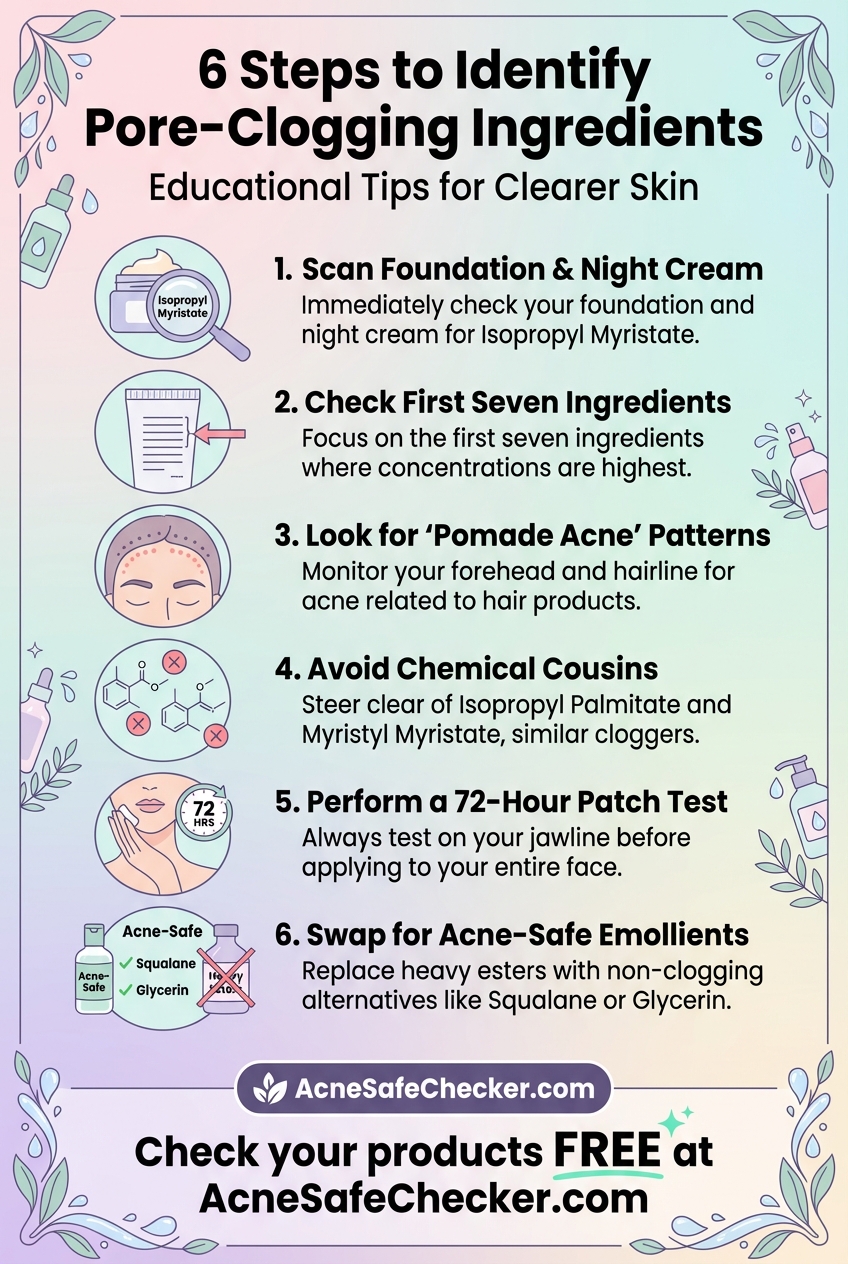
- The Forehead and Hairline: If IPM is in your hair conditioner or styling cream, you may notice small, flesh-colored bumps (closed comedones) along the hairline. This is often referred to as "pomade acne."
- The Cheeks and Jawline: If it is in your foundation or moisturizer, you may experience persistent congestion that feels like a rough texture under the skin, which eventually erupts into painful, red blemishes.
How to Spot It on the Label
Ingredients don't always go by one name. When scanning your bottles, look for Isopropyl Myristate, but also be wary of its chemical "cousins" which often share similar comedogenic profiles:
- Isopropyl Palmitate (highly comedogenic)
- Isostearyl Neopentanoate
- Myristyl Myristate
- Butyl Stearate
Practical Advice: How to Protect Your Skin
If you have oily, combination, or acne-prone skin, I recommend a "zero tolerance" policy for Isopropyl Myristate in leave-on products (moisturizers, primers, and foundations).
1. Audit Your Current Routine
Take every product you apply to your face and check the ingredient list. If Isopropyl Myristate is in the first seven ingredients, the concentration is likely high enough to cause significant clogging. If it’s at the very end of the list, it may be less risky, but for acne-prone individuals, it is still better to avoid it entirely.
2. Choose Non-Comedogenic Alternatives
Look for products that use squalane, glycerin, or dimethicone as emollients. While dimethicone is a silicone, it is generally non-comedogenic for most people and provides that same silky slip without the deep-seated pore irritation associated with IPM.
3. The 72-Hour Patch Test
If you are unsure if a product is triggering you, apply it to a small, acne-prone area (like the side of your chin) for three consecutive nights. If you notice small bumps or increased redness by day four, the product is likely too heavy for your skin type.
Conclusion
In the world of dermatology, we often say that "luxury feel" doesn't always equal "skin health." Isopropyl Myristate is a perfect example of this. It makes a product feel expensive and elegant on the skin, but for the acne-prone individual, it is a recipe for disaster.
By becoming a diligent label-reader and identifying this high-trigger ingredient, you can clear the path for your active treatments to actually work. If you’ve been struggling with mysterious breakouts, cutting out Isopropyl Myristate might be the single most important change you make for your complexion.