
You have a dedicated morning and evening routine, you never sleep in your makeup, and you’ve swapped your pillowcases for silk—yet, the breakouts persist. As a dermatologist, I often see patients who are frustrated because they are doing 'everything right' but are still battling persistent congestion and acne. Frequently, the culprit isn’t a lack of hygiene or the wrong cleanser; it’s the presence of hidden pore cloggers lurking in their existing skincare, makeup, and even haircare products.
Is Your Routine Acne-Safe?
Do not guess. Instantly check your products for pore-clogging ingredients with our AI-powered tool.
Check Ingredients NowIn the industry, we call this Acne Cosmetica. It is a form of acne triggered by the topical application of cosmetic products. While many products claim to be 'non-comedogenic,' this term is not strictly regulated by the FDA, meaning the burden of investigation often falls on the consumer. This guide will help you decode your ingredient labels and identify the silent saboteurs in your routine.
The Science of a Clogged Pore
To understand why certain ingredients are problematic, we must understand the biology of a pore (or more accurately, the pilosebaceous unit). A breakout begins when dead skin cells don't shed properly—a process called retention hyperkeratosis. These cells mix with sebum (your skin's natural oil) to create a plug.
Comedogenic ingredients act as a 'glue' or a 'weight' in this process. Some ingredients are physically heavy and sit on top of the pore, trapping bacteria and sebum underneath. Others actually change the composition of your sebum, making it thicker and more likely to clog. This is why a product might feel 'luxurious' or 'moisturizing' on the surface while simultaneously wreaking havoc underneath the epidermis.
The "Natural" Trap: When Organic Isn't Optimal
One of the biggest misconceptions in modern skincare is that 'natural' or 'clean' ingredients are inherently better for acne-prone skin. In reality, some of the most highly comedogenic substances are found in nature.
Coconut Oil (Cocos Nucifera Oil)
While it’s a miracle worker for dry body skin or hair ends, coconut oil is one of the most notorious pore cloggers. On a comedogenicity scale of 0 to 5, coconut oil typically ranks a 4. It contains high levels of lauric acid, which can be highly occlusive and problematic for the facial pores.
Cocoa Butter and Shea Butter
These are rich, emollient fats that are excellent for the skin barrier but can be far too heavy for those with an active sebum production. If you find breakouts along your jawline or cheeks where you apply your thickest moisturizer, these butters may be the cause.
Algae and Seaweed Extracts
Often found in high-end 'marine-based' skincare, certain algae extracts can be surprisingly comedogenic. They are often rich in iodides, which can irritate the follicle when used in high concentrations, leading to inflammation and breakouts.
The Synthetic Culprits You Might Miss
It isn't just oils you need to watch out for. Several synthetic additives used to improve the texture and 'slip' of a product can be hidden triggers.
Isopropyl Myristate and Its Derivatives
This ingredient is an emollient used to make products feel less greasy and help them penetrate the skin more deeply. Paradoxically, while it makes the product feel light, it is highly comedogenic. If you see 'Isopropyl' on a label followed by 'Palmitate' or 'Isostearate,' proceed with caution if you are acne-prone.
D&C Red Dyes
Frequently found in blushes, bronzers, and lip products, certain red pigments (specifically D&C Red #9, #19, and #30) are known to be comedogenic. If you find you only break out on your cheeks where you apply blush, your 'pop of color' might be the problem.
Sodium Lauryl Sulfate (SLS)
While primarily a surfactant used to create foam in cleansers, SLS can be incredibly irritating. This irritation compromises the skin barrier, leading to 'micro-comedones' that eventually turn into full-blown inflammatory acne.
The Haircare Connection: "Pomade Acne"
Many patients forget that what goes on their hair eventually ends up on their skin. Shampoos, conditioners, and styling creams often contain heavy silicones (like Dimethicone) and oils that run down your face and back in the shower. This can cause breakouts along the hairline, forehead, and shoulders—a phenomenon often referred to as 'Pomade Acne.'
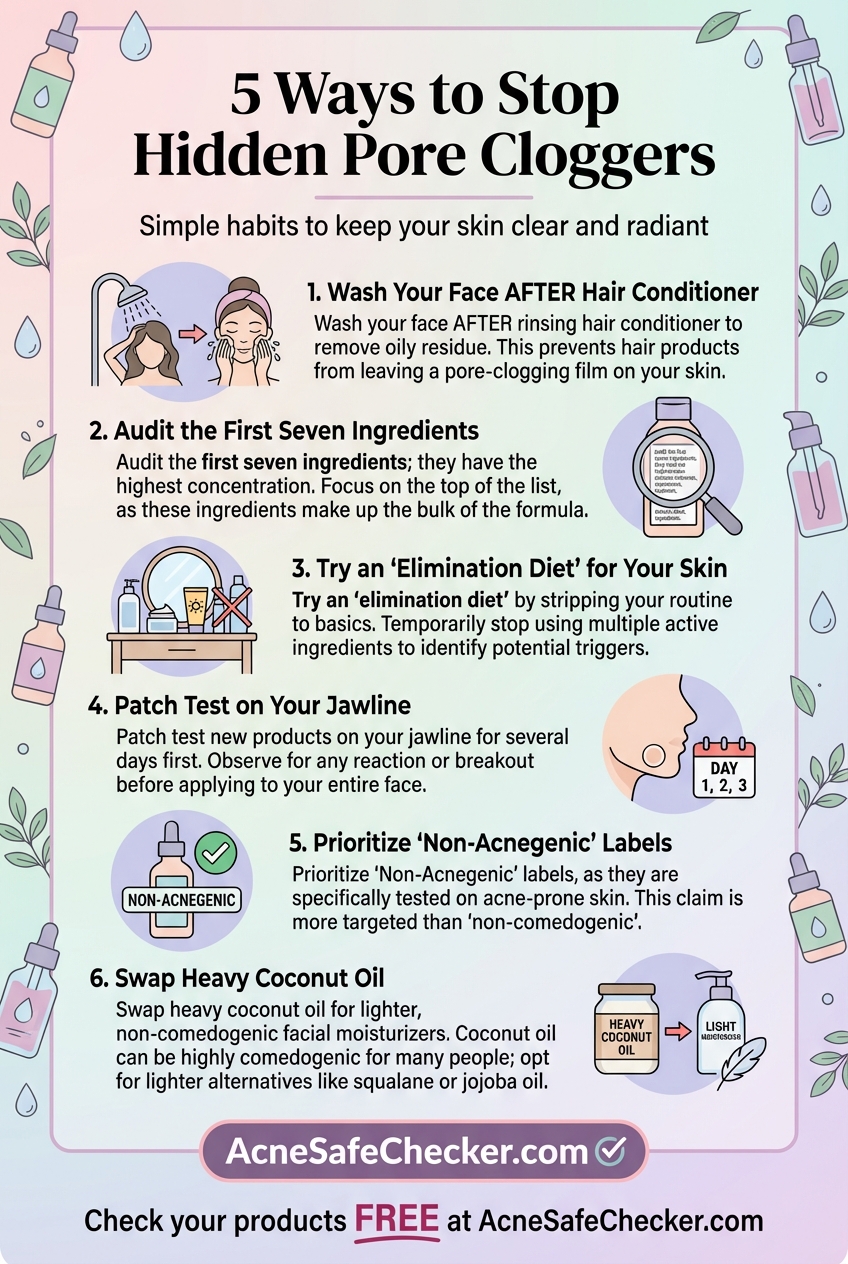
Pro-Tip: Always wash your face after you have completely rinsed the conditioner and styling products out of your hair to ensure no residue is left on your skin.
How to Audit Your Routine
If you suspect your products are working against you, follow these professional steps:
- The Ingredient Audit: Take your most-used products and cross-reference the first seven ingredients with a comedogenic database. Ingredients are listed in order of concentration; if a clogger is in the top three, it is a high-risk product.
- The Elimination Diet: If your skin is flaring, strip your routine back to a basic, dermatologist-approved cleanser and a lightweight, oil-free moisturizer for two weeks. Reintroduce products one at a time.
- Patch Testing: Before applying a new 'miracle' cream to your whole face, apply it to a small area near your jaw for several days to see if any texture or 'under-the-skin' bumps appear.
- Look for "Non-Acnegenic": While not a guarantee, this label usually indicates the product was tested specifically on acne-prone subjects, which is a step above a standard 'non-comedogenic' claim.
Conclusion
Achieving clear skin is often as much about what you don't put on your face as what you do. By becoming a conscious consumer and learning to read beyond the marketing claims on the front of the bottle, you can remove the obstacles standing between you and a clear complexion. Remember, skincare is not one-size-fits-all; what provides a 'glow' for one person may provide a 'clog' for another. Listen to your skin—it's the best diagnostic tool you have.