
If you have ever spent more than five minutes in the skincare aisle, you have likely seen the term "non-comedogenic" plastered across bottles of moisturizer, sunscreen, and foundation. For those of us who struggle with acne, this word is often treated as a holy grail—a promise that a product won't lead to tomorrow's breakout.
Is Your Routine Acne-Safe?
Do not guess. Instantly check your products for pore-clogging ingredients with our AI-powered tool.
Check Ingredients NowBut as a dermatologist, I often see patients who are frustrated because they are using exclusively "non-comedogenic" products yet are still experiencing persistent congestion and whiteheads. This raises an important question: What does this term actually mean, and how much can you trust the label?
The Scientific Definition of Comedogenic
To understand what "non-comedogenic" means, we first have to understand the "comedo." In dermatology, a comedo is the technical term for a clogged pore.
When your skin's natural oil (sebum) combines with dead skin cells and gets trapped inside a hair follicle, it forms a plug. If that plug remains closed to the air, it’s a whitehead (closed comedo). If it reaches the surface and oxidizes, it turns dark, forming a blackhead (open comedo).
Therefore, a comedogenic ingredient is a substance that has a high potential to trigger this clogging process. A non-comedogenic product is formulated specifically to avoid these ingredients, theoretically reducing the likelihood that the product will cause acne.
How is "Non-Comedogenic" Determined?
This is where things get complicated. Unlike the term "SPF," which is strictly regulated by the FDA with standardized testing protocols, the term "non-comedogenic" is not federally regulated. There is no universal standard that a company must meet to use this claim on their packaging.
Historically, testing was done using the "Rabbit Ear Assay." Researchers would apply ingredients to the inner ear of a rabbit, which is highly sensitive, and wait to see if comedones formed. However, this method fell out of favor because rabbit skin is far more reactive than human skin, leading to many "false positives."
Today, most reputable brands use human testing, often referred to as a "Comedogenicity Study." Participants apply the product to their back for several weeks, and dermatologists use a microscopic analysis or "cyanoacrylate biopsies" to see if microcomedones (the invisible precursors to acne) have formed.
The Comedogenic Scale
Many ingredients are rated on a scale of 0 to 5:
- 0: Will not clog pores
- 1-2: Low chance of clogging pores
- 3-5: High chance of clogging pores
While this scale is a helpful guideline, it isn't foolproof. An ingredient that is a "4" on its own might be diluted so significantly in a formula that the final product becomes non-comedogenic.
Why "Oil-Free" is Not the Same Thing
A common misconception is that "oil-free" and "non-comedogenic" are interchangeable. They are not.
Some natural oils, like high-linoleic sunflower oil or mineral oil (which is highly refined), are actually non-comedogenic and can be very beneficial for the skin barrier. Conversely, some "oil-free" synthetic ingredients, like Isopropyl Palmitate or certain myristates, are highly comedogenic.
Never assume a product is safe for acne-prone skin just because it lacks oil. Always look for the specific non-comedogenic label and, more importantly, look at the overall formulation.
Red Flags: Ingredients to Watch Out For
While every individual’s skin reacts differently, there are certain "heavy hitters" that consistently show up as problematic for acne-prone patients. If you are struggling with chronic congestion, check your ingredient lists for these high-risk components:
- Cocoa Butter: Frequently used in heavy creams, this is highly comedogenic.
- Coconut Oil: While great for the body or hair, it is a common culprit for facial breakouts.
- Isopropyl Myristate: Often used to give products a "velvety" feel, but it is notorious for clogging pores.
- Algae Extract: Frequently found in "clean" or marine-based skincare, but some varieties can be highly irritating to the pore lining.
- D&C Red Dyes: Often found in blushes and lip products; specifically, Red #30 and Red #40 can be comedogenic.
Practical Steps for Choosing the Right Skincare
Since the label isn't a 100% guarantee, how should you navigate your skincare routine? Follow these clinical recommendations:
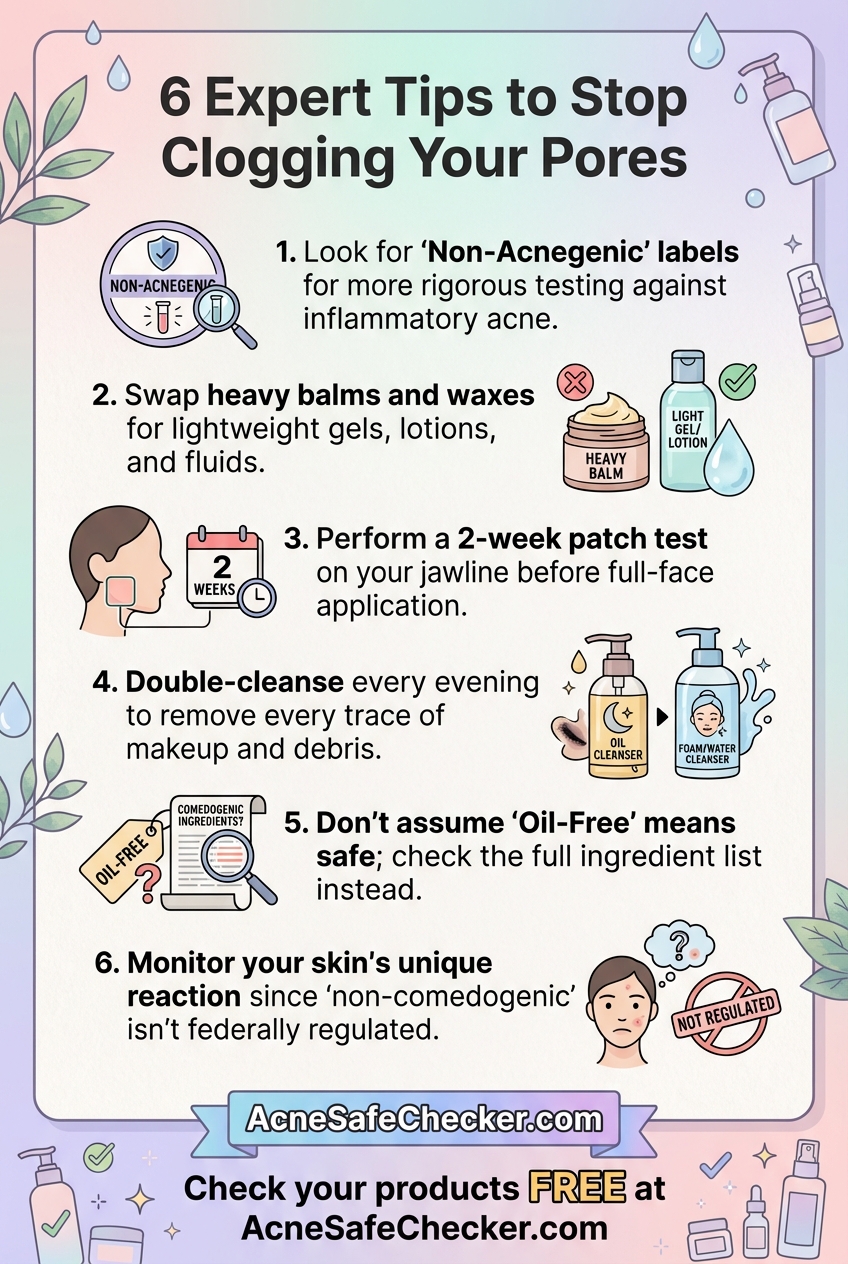
- Look for "Non-Acnegenic": This is a slightly more rigorous claim than non-comedogenic. It implies the product was tested specifically to ensure it doesn't cause inflammatory acne (pustules and papules) in addition to clogged pores.
- Consider the Texture: As a general rule, the thicker the product (balms, heavy waxes, thick creams), the more likely it is to contain occlusive ingredients that might trap sebum. If you are acne-prone, lean toward gels, lotions, and light fluids.
- The 2-Week Patch Test: When starting a new product, apply it only to a small, acne-prone area (like the jawline) for two weeks. If you don't see an increase in "clogginess," the product is likely safe for your specific skin chemistry.
- Wash Thoroughly: Even the best non-comedogenic makeup can cause issues if it sits on the skin for 24 hours. Always practice a double-cleanse in the evening to ensure no residue remains.
Conclusion
The term "non-comedogenic" is a valuable starting point, but it should be viewed as a helpful suggestion rather than an absolute rule. Because there is no standardized testing, the responsibility often falls on the consumer to monitor how their skin responds to specific formulations.
If you find that you are breaking out despite using "pore-safe" products, consult with a board-certified dermatologist. We can help you identify specific triggers in your regimen and prescribe treatments that address the root cause of your acne, ensuring your path to clear skin is backed by science, not just marketing.